

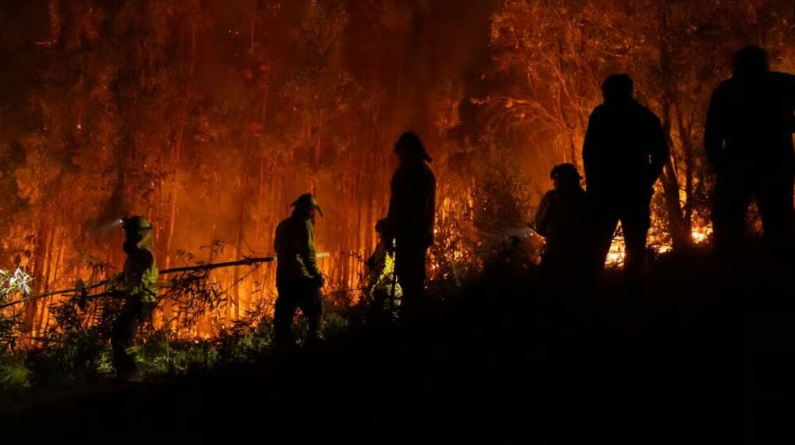
With the aim of addressing the complex meteorological projections for the summer season, regional emergency and forest protection authorities are coordinating joint efforts in the province of Curicó to try to prevent the occurrence of forest fires. Technical projections anticipate that, after a spring with late rainfall, the Maule Region will face a summer characterized by high temperatures, extensive heat waves, and abundant regrowth of dry vegetation, conditions that critically increase the risk of fires, especially between the months of January and February.
Faced with this scenario, local strategies will focus on monitoring areas of high human and territorial vulnerability, such as sectors that have recently been subdivided into parcels and tourist routes like J-55 in the commune of Romeral, where high tourist influx on weekends tends to increase incidents due to improper use of fire. As part of the communal and provincial operational plan, emergency institutions will reinforce patrols alongside Carabineros and Public Security, implementing the "single strike" protocol for the immediate deployment of helicopters during the first minutes after a fire focus is detected. Likewise, the National Forest Corporation (Conaf) and the National Service for Disaster Prevention and Response (Senapred) will strengthen unified incident command and the presence of brigades in hard-to-access pre-Andean areas.
On the other hand, the forestry agency confirmed that from November 1 until March 31, 2027, an absolute ban on the use of fire and agricultural burning will be in effect throughout the Maule Region, a measure aimed at preventing a repeat of the figures from past seasons, when the area recorded nearly 700 fires. Authorities stressed that during this period any smoke column or unauthorized burning will be legally classified as a crime prosecuted criminally together with the Public Prosecutor's Office, with those responsible risking prison sentences. As part of prior mitigation actions, community training sessions will be held focused on the safe management of plant waste and maintaining clean perimeters around homes in rural areas.
Regarding the particular operational challenges in the pre-Andean sector, the Emergency coordinator of the Municipality of Romeral, Carlos Ramos, explained that "In Romeral we have a very complex situation with the tourism issue, since on Route J-55 visitors misuse fire." Along the same lines, the professional warned about the impact of the climate factor by stating that "we will have rain until the last days of November or the first days of December, and that causes vegetation to regrow and grow, so in the months of January and February we will experience a very complex situation for the province of Curicó."
Meanwhile, the Operations chief of Senapred Maule, Cristián Espinoza, praised the anticipated diagnosis carried out in the area, highlighting that "the communal disaster risk management chiefs have already evaluated and identified their critical points, and are working based on the historical analysis of impact." Regarding methodological aspects, Espinoza specified that "we will work strongly on unified incident command."
Finally, regarding the regulatory framework and the criminal nature of infractions, the regional head of Forest Fires at Conaf, Marcelo Rodríguez Crespillo, emphasized that "from November 1, any smoke in the Maule Region is a forest fire, therefore that means the commission of a crime associated with prison sentences." Likewise, the Conaf authority stressed the importance of citizen prevention, concluding that "the only catastrophe of anthropogenic origin is forest fires; all others are of natural origin, therefore what we must work hard on is preventing these fires, reducing their occurrence and reducing their simultaneity; in that way our teams are much more efficient and effective when controlling these incidents."
Source: VLN Radio
With the aim of addressing the complex meteorological projections for the summer season, regional emergency and forest protection authorities are coordinating joint efforts in the province of Curicó to try to prevent the occurrence of forest fires. Technical projections anticipate that, after a spring with late rainfall, the Maule Region will face a summer characterized by high temperatures, extensive heat waves, and abundant regrowth of dry vegetation, conditions that critically increase the risk of fires, especially between the months of January and February.
Source:VLN Radio



Comments (0)
No comments yet. Be the first to comment!
Leave a comment