

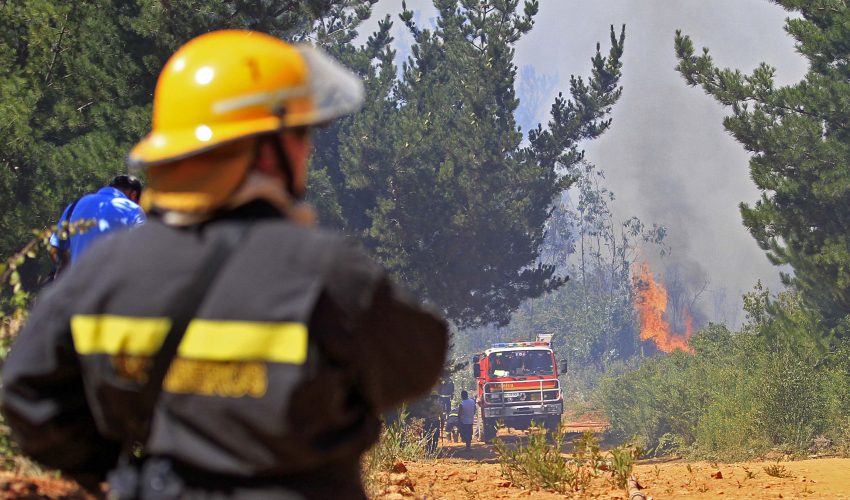
The discussion on the Fire Law faces uncertainty. Although the Mixed Committee maintains as its goal to dispatch the bill before the start of the next fire season, its own members acknowledge that the new regulation would not be operational during this summer.
The reason lies in the stage after legislative dispatch, since the president of the Mixed Committee, Senator Alejandra Sepúlveda, stated that the bill requires a series of regulations for its implementation, which would prevent the new provisions from entering into force during this season.
"I hope that for this fire season we can indeed have the law dispatched, but the complication is that there are several regulations that must be implemented and that means not having it ready for this season," she stated.
And while that calendar runs, the instance still keeps open one of the main points of divergence between both chambers: the incorporation of urban-rural interface zones into territorial planning instruments.
Formally beginning its work in August, the committee has already managed to resolve matters related to claims for non-compliance with the regulations. In September, however, the debate stalled again on urban-rural interface zones.
The bill contemplates mechanisms to incorporate them into communal or intercommunal planning instruments and establish buffer areas, where property owners must carry out vegetation management and build firebreaks to reduce the spread of potential fires.
The problem is that the proposal has not managed to gather the necessary votes. In the last discussion, the article was put to a vote on two occasions and both ended in a 4-4 tie, so the matter remained pending.
But the disagreement is not limited to the incorporation of these zones into regulatory plans. There is also a discussion about the preventive obligations that would fall on property owners and, particularly, about who must assume the costs associated with their compliance.
In this regard, deputy and committee member Sergio Bobadilla (UDI) has stated that before moving forward it is necessary to know a proposal from the Executive on economic compensation for property owners who must carry out preventive work.
On the other hand, the senator for Biobío, Gastón Saavedra (PS), questioned the postponement of the vote and stated that not incorporating the interface zone into planning instruments means not advancing in the protection of families who live precisely in the transition between urban and rural areas.
Evaluation of the government veto
To this knot is added a second front. The Government expressed objections regarding articles of the bill that have already been dispatched and that are not part of the specific divergences that the Mixed Committee must resolve.
As explained by the Minister of Agriculture, Jaime Campos, the Executive's objections point to aspects of financing, substance and form of those provisions. Since they are not matters within the Mixed Committee's mandate, modifying them in that instance would require the unanimity of its members, something that Saavedra has already stated he would not be willing to give.
Given that scenario, the Executive has evaluated resorting to a substitute veto. This tool would allow the President to propose modifications to the text once its current processing concludes, which must subsequently be discussed and voted on by both chambers.
Penco asks that the discussion reach the territory
Amid all this, the Committee had agreed to move one of its sessions to Penco, a commune heavily affected by last summer's fires.
When consulted, the team of deputy Paz Charpentier (Republicanos), a member of the instance, told Diario Concepción that there will be no session this week, because the corresponding report has not yet been submitted. Therefore, they indicated that they could not advance a position regarding the pending matters either.
The mayor of Penco, Rodrigo Vera, stated that "it is fundamental that the discussion goes out to the territory," recalling that from the commune they requested that the committee be able to hold a session there.
Vera also stated that the bill must move forward urgently, indicating that urban territories must be defined, criteria regarding firebreaks must be established, and the impact that fires can have on urban zones must be considered.
In that sense, he alluded to current climatic conditions and stated that what has happened in other places can have repercussions in the area. "We must have a different law for climatic conditions and this fire law is required to safeguard urban sectors and, above all, the population," he affirmed.
The mayor added that Penco's experience must be considered in the national discussion, since in his view, it should not be reduced only to establishing "more or fewer meters of a firebreak," but to determining "how the protection of the population is provided given the climatic conditions."
For his part, Senator Gastón Saavedra explained that any new provision involving public resources "is the Executive that must take the initiative." In that sense, he indicated that they are awaiting eventual indications from the Government.
Source:Diario Concepción






Comments (0)
No comments yet. Be the first to comment!
Leave a comment