

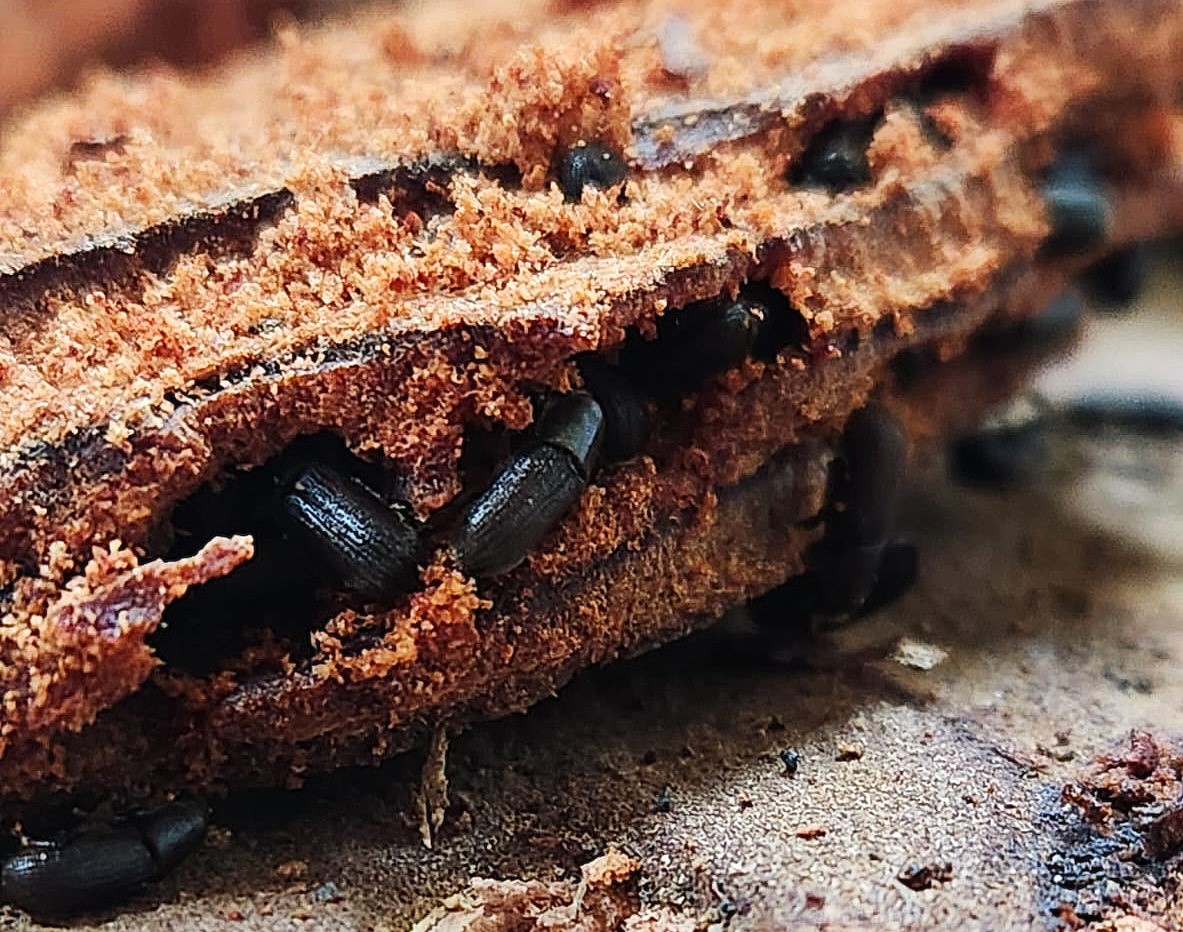
A new technological tool seeks to strengthen the phytosanitary protection of the Chilean forestry industry againstHylurgus ligniperda, known as the pine bark beetle. This is Lignitrap, an attractant developed by researchers at INIA Quilamapu that will now enter a validation and scaling-up stage for use in detection and management systems for this pest.
The initiative obtained funding from the National Agency for Research and Development (ANID) and will be carried out over 24 months. The project is led by INIA Quilamapu, in the Ñuble Region, together with the Forestry Phytosanitary Protection Consortium S.A. (CPF) and the company Biobichos.
The first milestone of this new phase was the formation of the steering committee, a body that will bring together the scientific, technological, and productive capabilities needed to move from experimental development to a solution with potential for field application.
Lignitrap was developed in Chillán by the Chemical Ecology Laboratory of INIA Quilamapu. Its operation is based on specifically attractingHylurgus ligniperdatoward traps, making it possible to have a tool that can be used both to monitor the presence of the insect and to contribute to its management.
A challenge for foreign trade
The importance of the project is directly related to the risks this species represents for the forestry sector, particularly in export operations.
The manager of CPF S.A., Claudio Goycoolea, explained that one of the objectives is to have a trap that incorporates the attractant and allows specific action on the species.
The executive noted that the greatest impact occurs when the insect is detected in cargo destined for international markets. As he explained,Hylurgus ligniperdacan travel as a stowaway in shipments of forestry products, attracted by chemical compounds associated with wood.
Although the insect does not feed on sawn wood, its presence can generate additional requirements for exports and force compliance with control and phytosanitary certification measures established for the entry of forestry products into different markets.
Goycoolea recalled, as background, an episode that occurred in 2006 with Mexico, when the detection of live insects in a shipment led to the loss of an entire vessel.
Science applied to pest behavior
The project incorporates principles of chemical ecology, a research area that studies interactions mediated by chemical signals between organisms.
Ricardo Ceballos, a researcher at INIA Quilamapu and director of the initiative, explained that this knowledge makes it possible to take advantage of the natural responses of insects to design monitoring and control tools.
The strategy seeks to move toward methods that reduce dependence on insecticides, using attraction or repellency signals present in the interactions between insects and plants.
From this perspective, Lignitrap aims to transform scientific knowledge developed in the laboratory into a technological solution applicable to the productive sector, combining protection of exports with a lower environmental impact approach.
The regional director of INIA Quilamapu, Rodrigo Avilés, highlighted that the initiative represents an alliance between research and the private sector to address a challenge that affects both forestry activity and foreign trade.
The steering committee was made up of Claudio Goycoolea, as president; Ricardo Ceballos, as director; Natalí Fernández, as secretary; as well as Rodrigo Avilés and Marcos Gerding, representing INIA Quilamapu and Biobichos, respectively.
Over the next two years, the challenge will be to validate the performance of Lignitrap and move toward its eventual widespread use as a tool for the surveillance and management ofHylurgus ligniperdain the Chilean forestry sector.






Comments (0)
No comments yet. Be the first to comment!
Leave a comment