

Timber production is at the heart of forestry activity and responds to a growing global demand for renewable materials. But the forestry business rests on something broader than wood: the long-term management of a territorial heritage.
On a single property, plantations, areas of high environmental value, watercourses, biodiversity, research, education, sports, recreation, and social and cultural values can coexist. Recognizing these uses and interests, organizing them, and making them compatible is not a task parallel to the business; it is part of its sustainability, because it allows the territory to be safeguarded, the relationship with communities to be strengthened, and the productive activity to be projected over time.
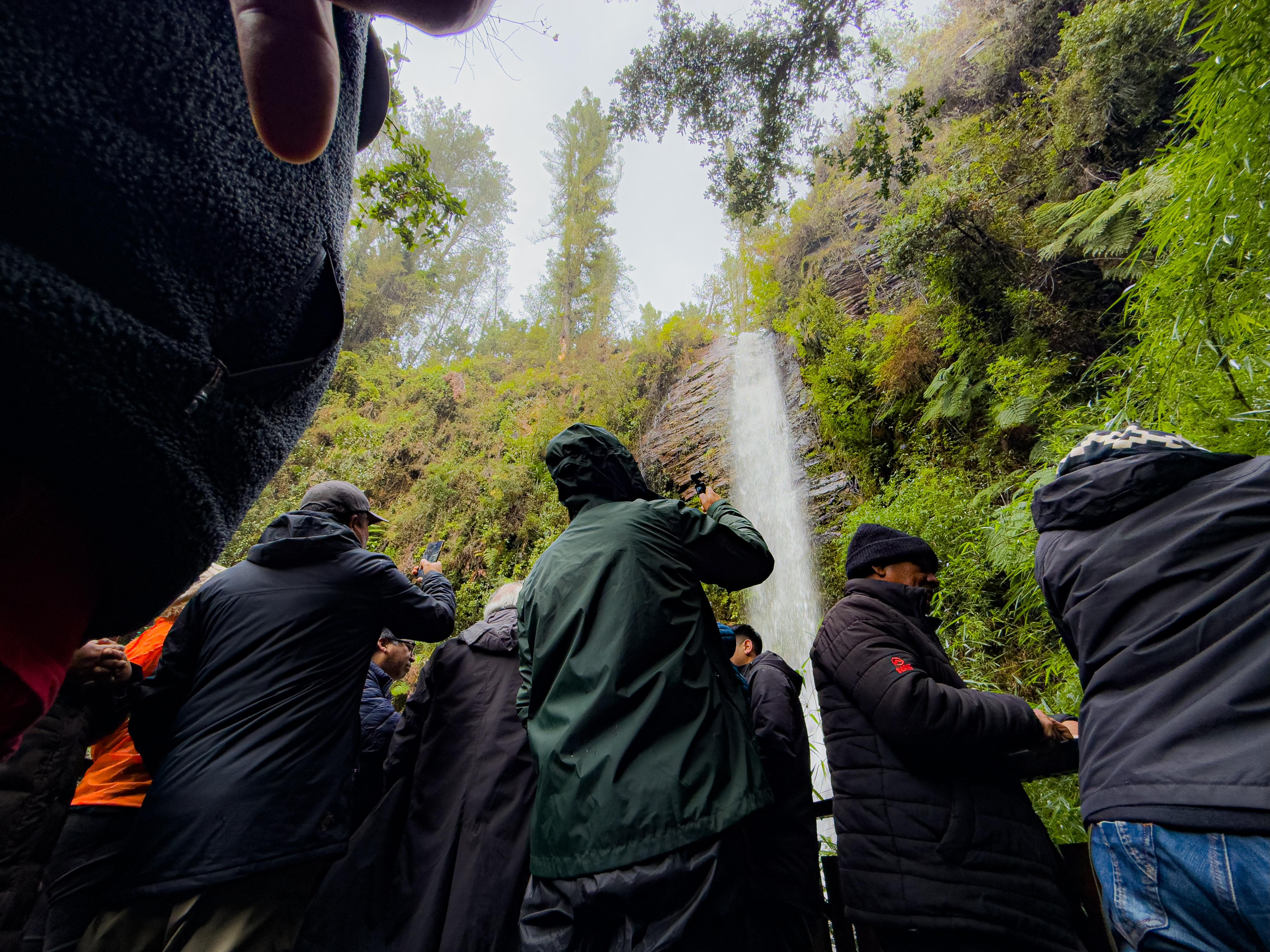
From that logic, Cascada Hueima, located in Lanco, became a new milestone for the Chilean forestry sector. Recently, Forest Stewardship Council FSC® granted the company ARAUCO (Licence Code: FSC-C108276) certification of this space as a cultural ecosystem service.
Recognition of management
It is the first certification of this type granted to a company in Chile and the second worldwide. The recognition highlights a form of management that protects the spiritual significance the waterfall holds for the Hueima Indigenous Community and ensures that its future use respects that value.
Through their ecosystem services verification tools, forest certification systems such as FSC® make it possible to recognize values that could previously remain invisible in traditional forest management.
Cascada Hueima is not only a place with cultural significance; its value also lies in the way that value is identified, safeguarded, and projected over time through concrete commitments, shared governance, and independent verification.
Shared commitment
For the Mapuche community, this waterfall is a space associated with the forest, water, and the transmission of ancestral knowledge. That cultural dimension was the focus of a working group between ARAUCO, the community, and the municipality. "Participating from the beginning meant being able to express the ancestral vision and knowledge about the territory," said José Luis Fernández, president of the community. He added that this made it possible to ensure that the protection of the waterfall also took into account its cultural, historical, and spiritual importance.
The process made it possible to build trust among different stakeholders, a central value when talking about territorial sustainability. "Here a virtuous circle occurred, where the organized community, the State, and the private company develop a project together," said Eladio Méndez, president of the Hueima APR Committee. He added that initial doubts were overcome as the working groups progressed.
Forest certification
Forest Stewardship Council® is an organization that promotes responsible forest management considering environmental, social, and economic criteria. In addition to its base certification, linked to production, FSC® verifies ecosystem services: benefits that ecosystems provide to society and that can be associated with water, biodiversity, soil, carbon, recreation, or cultural values, among others.
"In Chile, FSC®-certified companies such as ARAUCO are implementing verified impacts to maintain and improve ecosystem services in their forest heritage. Today we highlight a new ecosystem service: cultural practices and values," explained Regina Masay, executive director of FSC Chile.
For ARAUCO, Hueima adds a different dimension to its previous experiences in ecosystem services. In this case, the focus is on recognizing and managing the cultural value of a territory.
"In Hueima we are not only talking about environmental conservation, but also about memory, identity, and the transmission of knowledge. It is a recognition of the bond that the Indigenous Community has maintained with this place and of the collaborative work we have developed to protect it and project it over time," stated César Ancalaf, head of Intercultural Relations at ARAUCO.
Knowing in order to conserve
The certified area includes 1.9 hectares associated with the waterfall and its surroundings. As part of the process, trails, viewpoints, information panels, and signage of species in Mapudungun were set up. Sensitive zones, usage rules, and measures to prevent visitation from affecting the spiritual character of the site were also defined. "The logic is to organize access to the waterfall so that it can be known without risking what makes it significant," emphasized Ancalaf.
From the municipality, the mayor of Lanco, Juan Rocha, highlighted that the certification represents an opportunity for the commune and the region. "We are being recognized worldwide in terms of ecosystem services, and that brings with it culture, environment, and tourism," he said.
Forest territories border communities, contain ecosystems, watercourses, areas of cultural value, and spaces that people use or value. Managing that social layer well generates trust, legitimacy, and co-responsibility in the conservation of these values.


Comments (0)
No comments yet. Be the first to comment!
Leave a comment