

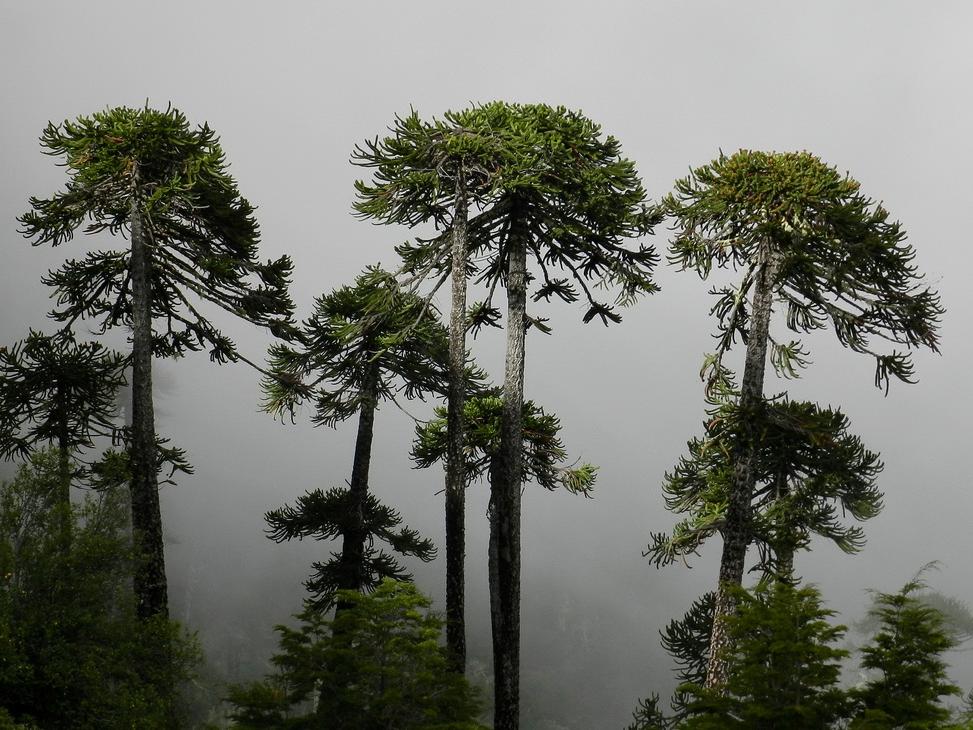
The araucaria, one of the most emblematic trees of the forests of southern Chile, faces a worrying scenario for the coming decades. Research published in the Journal of Environmental Management projects that the four ecosystems where the species currently thrives could reach a Critically Endangered condition by 2060.
The study, titled Climate-driven collapse risk in Chilean Araucaria forests, was led by University of Chile academic Alberto Alaniz and included researchers from the Biodiversity and Environment Laboratory at the University of Santiago.
The research analyzed the four existing araucaria ecosystems in the country: three located in mountain areas between La Araucanía and Los Ríos, and another located in the Nahuelbuta mountain range.
To determine the level of risk, researchers analyzed different dimensions of the transformation of these forests. This included the historical loss of surface area since approximately 1750, changes recorded over recent decades, the projected loss of suitable habitat by 2060, modifications in climatic conditions, and the functioning of the ecosystems.
The results set off an alarm signal. When applying the criteria of the Red List of Ecosystems of the International Union for Conservation of Nature (IUCN), the four evaluated ecosystems would reach the Critically Endangered category.
The main factor behind this scenario would be climate change and, particularly, the reduction of the environmental conditions necessary for these forests to persist.
"Climate change projections indicate that there will be a widespread loss of environmentally viable areas," explained Alberto Alaniz.
The case of Nahuelbuta appears to be one of the most concerning. According to the research, the coastal araucaria forests of this area could completely lose environmentally viable conditions by the year 2060.
The warning does not mean that the species will necessarily disappear that year, but rather that the ecosystem conditions could cease to be adequate to sustain its functioning and long-term permanence.
Given this scenario, researchers suggest the need to act in advance. Among the proposed measures are establishing these ecosystems as a national conservation priority and developing climate change adaptation strategies.
These include seed conservation, plant production in nurseries, seedling selection, and reforestation in the field, as well as incorporating the restoration of these forests as a priority within national ecosystem recovery policies.
The research also suggests that these actions should be coordinated with the National Landscape-Scale Restoration Plan and with the framework established by the legislation that creates the Biodiversity and Protected Areas Service.
The araucaria not only represents one of the most recognizable trees of the southern Chilean landscape. Its forests form ecosystems of high ecological and cultural value. The study warns that protecting them requires starting now to prepare responses to a climatic scenario that could profoundly alter the territories where this ancient species has managed to survive for centuries.






Comments (0)
No comments yet. Be the first to comment!
Leave a comment