

The conservation of the güiña faces a scenario that requires broadening our perspective. Protecting the forests where it lives is no longer enough to ensure the permanence of one of the smallest wild felines in the Americas.
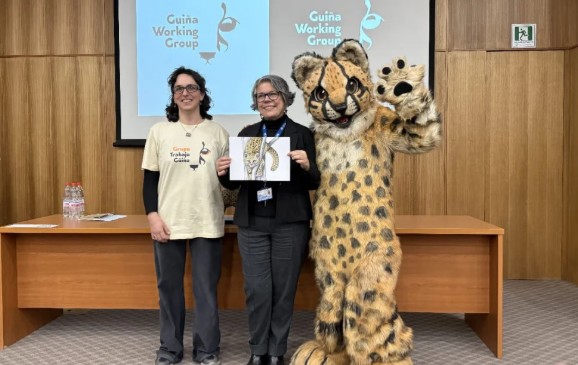
That was one of the main points raised at the Binational Seminar "Advances and challenges for the conservation of the güiña in Chile and Argentina: present and future," held on Friday, August 28, at the San Joaquín Campus of the Pontificia Universidad Católica de Chile.
The meeting was organized by the Güiña Working Group (GWG) and brought together researchers, representatives of public agencies, academics, and organizations linked to biodiversity conservation from both countries.
During the session, the current status of the species and the main challenges its conservation will face in the coming years were addressed. The program included presentations on the work developed by the GWG, the new categorization of the güiña, genetic studies, monitoring, and conservation experiences in Argentina.
Phenomena that are modifying the territories where the species survives were also analyzed, including forest transformation and landscape fragmentation, along with the social factors that are decisive in moving toward coexistence between human communities and wildlife.
A species that survives in transformed landscapes
One of the main challenges raised during the seminar was recognizing that the güiña no longer inhabits exclusively continuous, lightly intervened forest ecosystems.
The species also uses rural and productive landscapes, fragmented areas, and sectors near human settlements. This ability to move and survive in modified environments creates new opportunities for its conservation, but it also exposes the güiña to a set of threats that occur outside the areas traditionally considered priorities for biodiversity protection.
Roads, loss of connectivity between forest fragments, expansion of human settlements, and the presence of dogs and cats are part of a scenario that must be addressed comprehensively.
Conservation, therefore, requires considering the territory as a connected system, where decisions about infrastructure, production, urban development, and landscape management can have direct consequences for the survival of the species.
From a common diagnosis to an action agenda
The seminar was not limited to the presentation of research. During the afternoon, a participatory working session was held aimed at identifying and prioritizing the main threats facing the güiña in different geographic areas.
The session included 32 representatives from public services, municipalities, civil society organizations, and universities, including professionals from the National Forestry Corporation (Conaf) and the Agricultural and Livestock Service (SAG).
The methodology sought to move from identifying problems toward defining possible actions, solutions, and approaches to address them.
The results of this discussion will be incorporated into a policy brief aimed at decision-makers, with the purpose of strengthening the connection between scientific knowledge and public policies related to the conservation of the species.
This step is especially relevant in a scenario where many of the threats facing the güiña cannot be resolved exclusively through protection measures within wilderness areas.
A strategy that crosses borders
The binational dimension was also one of the central elements of the meeting.
The distribution of the güiña extends between Chile and Argentina, so administrative borders do not coincide with the spaces used by the species or with the ecological processes that determine its survival.
Hence the importance of strengthening a collaboration network that allows sharing information, research methodologies, monitoring experiences, and conservation strategies.
Joint work among researchers, universities, conservation organizations, and public agencies seeks precisely to overcome those divisions and build a common vision for the future of the species.
The challenge is outside and inside the forest
The seminar thus left a conclusion that goes beyond the particular situation of the güiña: conserving a species that lives in increasingly intervened landscapes requires incorporating society as part of the solution.
The future of this small feline will not depend solely on maintaining forest areas or expanding protected areas. It will also be conditioned by the ability to maintain corridors and connections between its habitats, reduce the impacts of roads, control threats associated with domestic animals, and generate better conditions for coexistence with rural communities.
The conservation of the güiña, ultimately, must follow the animal wherever it still persists: among forest fragments, productive fields, roads, homes, and other spaces transformed by people.
And to face that challenge, science must meet with public management, communities, and the decisions made daily about the territory.




Comments (0)
No comments yet. Be the first to comment!
Leave a comment