

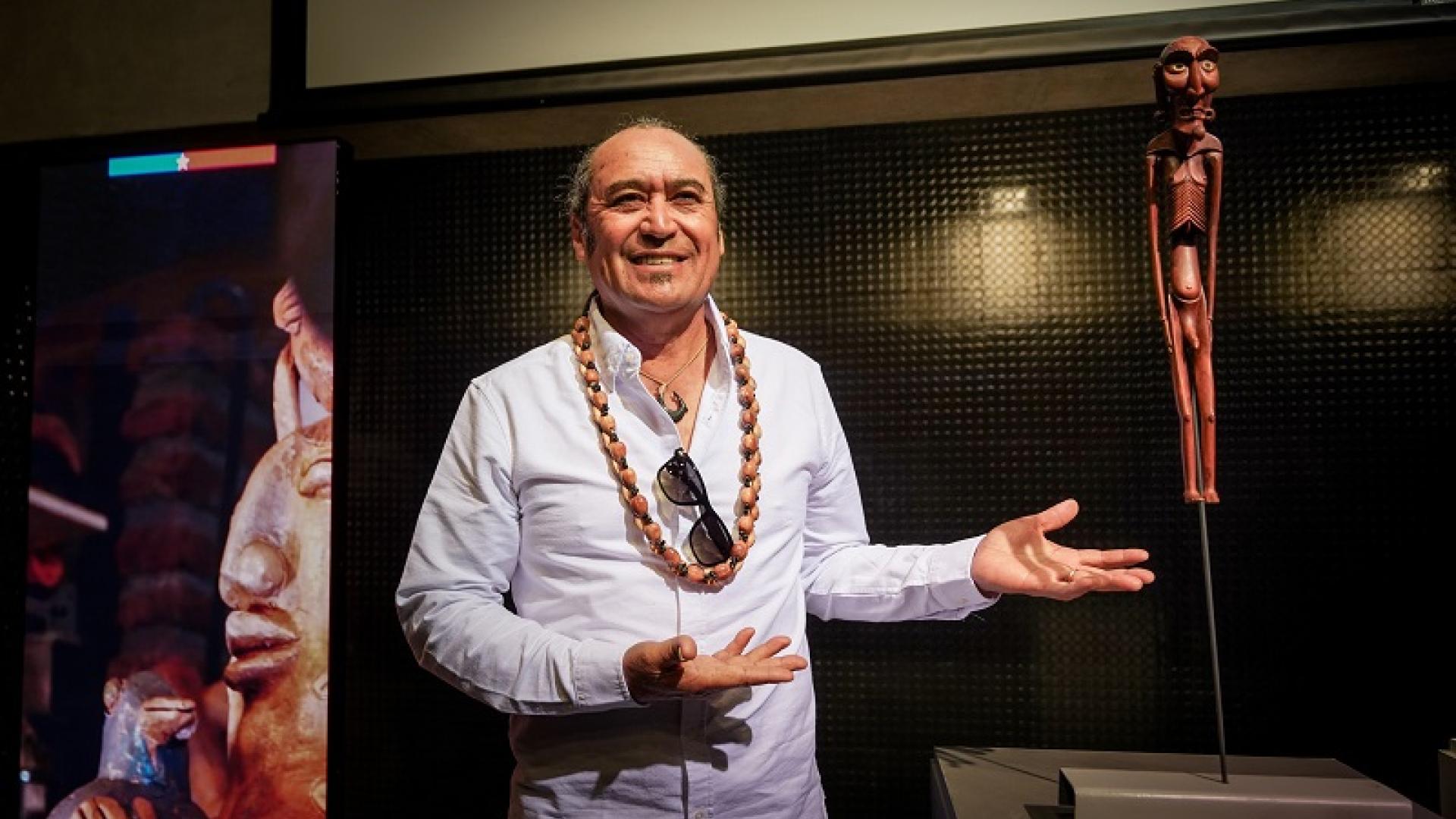
Tomás Tuki Tepano (64) learned to carve wood at age 9 for a very simple reason: everyone in his family did it as part of their way of life on Rapa Nui, along with farming, fishing, and construction. "For us it was never a trade or an art, as it is known today, but a way to survive. In those days a child was not a child, he was another man, labor, and you just had to work. That is what the elders, grandparents, and parents instilled in us."
About that time, he says that what we now know as crafts was nothing more than barter goods or swapping to meet other needs, such as food, which changed over time with the island's development, the arrival of tourism, and the recognition of its culture and artistic expressions. "Now there is greater appreciation for what one does," he states.
Tuki Tepano is today a prominent sculptor in wood and stone, whose work has crossed borders. Winner of two Craft Excellence Seals – in 2011 and 2012, for his works Kava Kava and Moai Mana’u, respectively – his work has been exhibited in Chile and abroad (Australia, Marquesas Islands, Germany), and art collectors from different parts of the world commission pieces that can demand several months of concentration, patience, and time in his workshop.
Mastery of a craft
"Competition made me grow from a young age," says the artisan about his mastery of the craft, who works with unmatched skill and detail on makoi and other woods found on Rapa Nui, which he turns into moais with sunken bellies, protruding ribs, pointed faces, and enormous eyes, among other works that always reflect the island's spirituality and mythology.
A user of the Institute for Agricultural Development (INDAP) as an artisan and farmer – he grows taro, sweet potato, and other vegetables, as well as strawberries – Tuki Tepano has been supported by the Indigenous Territorial Development Program (PDTI) with projects and investments, such as the construction of the First Rapanui Excellence Craft School, a space dedicated to teaching traditional techniques to children and young people on the island. He also served as a leader of the Area Advisory Committee (CADA) of the agricultural service between 2021 and 2024.
His achievements, along with the quality of his art, his contribution to the preservation and transmission of ancestral techniques to revitalize local culture, his creative proposal, and his more than 50 years of work, led the Ministry of Cultures, Arts, and Heritage to award him the Master Artisan Prize in the Traditional 2025 category, in a ceremony held at Palacio Pereira in Santiago.
At the ceremony, attended by the Minister of Cultures, Francisco Undurraga; the Undersecretary of Cultural Heritage, Emilio de la Cerda; and the national head of Crafts at INDAP, Saúl Pérez, awards were also given in the Apprentice category, to goldsmith Dana Canales from Punta Arenas, and the Contemporary category, to ceramist Ernesto Durán from Peñalolén.
Historic recognition
Tuki Tepano said that "this is a historic recognition from Chile that fills me with pride and that I dedicate to all Rapanui people. In my work there is a spiritual component that comes from our ancestors and that I try to maintain."
Another of his recent prides – he said – is the Tapa'o Tupuna Seal of Origin, established in 2024 by the National Institute of Intellectual Property (Inapi), of which he was a driver, to certify works that are made on Rapa Nui and meet the standard that the island communities themselves have determined according to their traditions.





Comments (0)
No comments yet. Be the first to comment!
Leave a comment