

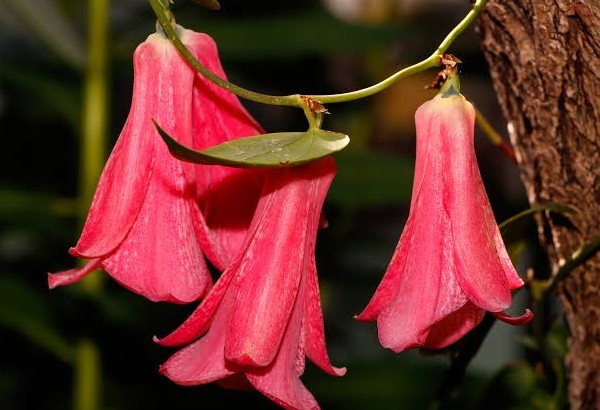
With the aim of verifying compliance with current regulations for nurseries and reinforcing the importance of registering establishments that produce and commercialize plant material such as fruit, forest, and ornamental plants, among others, officials from the Agricultural and Livestock Service (SAG) of Biobío carried out an inspection of the Agua Tendida Copihue Nursery, located in the Rafael sector, Tomé commune.
During the activity, the operating conditions of the establishment, compliance with the requirements associated with its registration, and the sanitary conditions of the production process were verified.
The Head of the SAG Concepción Office, Juan Pablo Becerra, highlighted the importance of this type of inspection. "Today we have verified compliance with current regulations at this nursery of our national flower, the copihue, where we see the owner's effort to preserve this national species," he stated.
This is the Agua Tendida Copihue Nursery, owned by Alejandra Retamal, who explained that "we only focus on reproducing and selling our national flower, which is the copihue. We have been established since 2018, with authorization from SAG, with whom we maintain permanent communication."
In the Biobío region, there are currently 195 registered nurseries, of which 33 are located in the province of Concepción, 38 in the province of Arauco, and 124 in the province of Biobío, where the propagation, multiplication, and cultivation of plants is carried out using different methods, such as seeds, cuttings, or in vitro culture. Their activity covers the different stages of production and development of plants before their sale or transfer.
In the case of plant depots, where produced and finished specimens are stored, displayed, and sold, according to SAG records there are 106 establishments, of which 14 are located in the province of Arauco, 59 in the province of Concepción, and 33 in the province of Biobío.
To register a nursery or plant depot with SAG, among other documents, a photocopy of the following is required: RUT of the natural or legal person, documentation proving that the activity is formalized before the Internal Revenue Service (SII), a sketch or location plan of the property or depot, documentation proving the origin of the plant material used, an official report of nematological soil or substrate analysis, among others.
Registered nurseries and establishments must comply with a series of obligations aimed at safeguarding plant health and preventing the spread of pests, including: producing, transferring, and selling healthy plants free of regulated pests and complying with current regulations; and complying with specific standards related to pests under mandatory control that may affect propagation material, such asFusarium circinatumin pine and Oregon pine nurseries;Plum pox virusin stone fruit species nurseries; andPseudomonas syringae pv. actinidiae(Psa) in kiwi nurseries, among others.




Comments (0)
No comments yet. Be the first to comment!
Leave a comment