

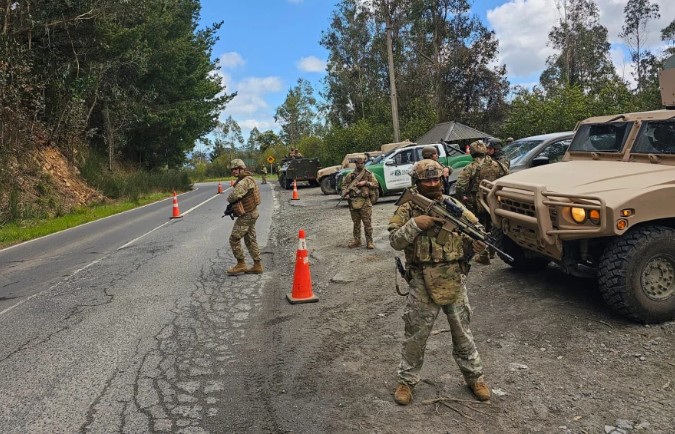
With 104 votes in favor, 19 against, and 14 abstentions, the Chamber's floor session approved the renewal, for 30 days, of the state of exception in the southern macrozone, an extension that will take effect once the previous decree expires, on September 22.
According to the Executive's report, from May 18, 2022, to August 30, 2026, Carabineros reports 722,634 checks: 65% of them vehicular and 35% identity-related. Simultaneously, the arrest of 1,491 people was carried out in the context of services under the state of exception.
The Minister of the Interior, Claudio Alvarado, highlighted that, in terms of order, as of August 30, a 24% decrease in rural violence events is observed in the provinces under the measure, compared to 2025. And, regarding 2021, the reduction reaches 85%.
In any case, he acknowledged that not all indicators are positive. Thus, he revealed that concern persists over arms trafficking, which experienced a slight upward trend. Its circulation implies a focus of insecurity that justifies the extraordinary deployment of police and military forces, made possible by the state of exception.
Regarding development, he said that previous lines of work are being followed, aiming to close infrastructure gaps. Thus, as of the end of July, 23 road connectivity, rural drinking water, and hydraulic infrastructure works were completed, which enabled the activation of 809 drinking water connections and 220 kilometers of roads.
Finally, regarding reparation, he reported that a substitute amendment was presented in the Senate to the victim reparation bill. Among other measures, it will allow access to the Comprehensive Health Reparation and Care Program, for physical and mental care; restoration or replacement of properties and productive assets; preferential access and benefits in seven housing programs; funding for higher education studies of victims; and a 100% exemption from territorial taxes on properties illegally occupied or uninhabitable as a result of an event subject to reparation, among other benefits.
The debate included participation from Cristian Neira, Diego Vergara, Luis Sánchez, Enrique Bassaletti, Andrea Parra, Tomás Kast, Flor Contreras, José Montalva, and Diego Schalper.
Overall, all announced their favorable vote to maintain the state of exception. They said they understand the need to keep the measure given that acts of violence persist in the macrozone.
However, likewise, progress was requested toward a de-escalation process of this system that has been in operation for more than four years. "Will we have to reject to learn about a long-term policy for La Araucanía?" one legislator raised. Likewise, support for the provinces under the state of exception was questioned, since they would experience a reduction in their budgets, according to what some municipalities reportedly communicated.
On the other hand, progress was requested on other alternative tools. In this context, the reform of states of exception and the rule on the use of force were mentioned, to identify, arrest, and remove terrorists and thieves from the exercise of violence.




Comments (0)
No comments yet. Be the first to comment!
Leave a comment