

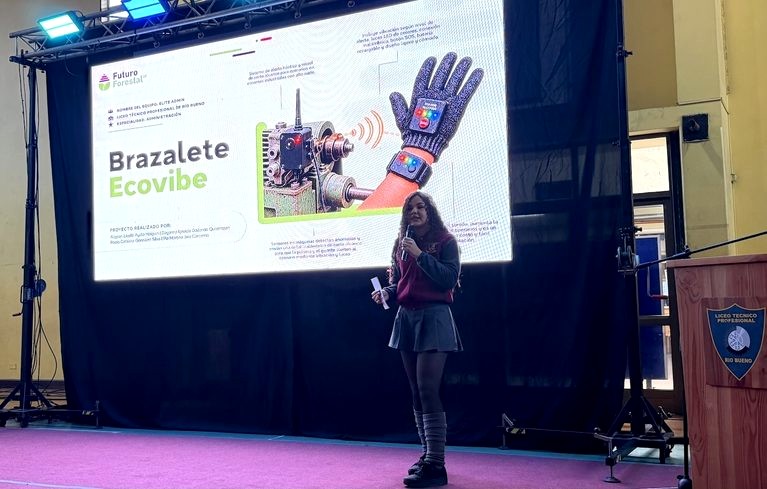
A technological proposal aimed at improving worker safety in noisy industrial environments won first place in the initiative "Futuro Forestal TP: Creatividad, innovación y sostenibilidad," promoted by the Chilean Timber Corporation (Corma) and Disruptiva Lab, with funding from Fomento Los Ríos de Corfo.
It is "Brazalete Ecovibe," a project developed by Allyson Ayala Holguín, Dayanna Gallardo Quilempan, Rocío González Silva, and Pía Jara Cárcamo, students at the Liceo Técnico Profesional de Río Bueno, who designed an alert system that makes it possible to warn of risk situations without relying on sound signals.
The solution responds to a difficulty present in numerous industrial and forestry operations: the noise generated by machinery can prevent workers from hearing an alarm or promptly noticing a dangerous situation.
The device includes sensors installed on the machines, capable of detecting certain anomalies and transmitting a short-range wireless signal to the equipment used by the operator. Once activated, the alert is communicated through vibrations and LED lights of different colors, making it easier to identify the level of risk.
As student Allyson Ayala explained, the prototype incorporates wireless connectivity, an SOS emergency button, and a rechargeable battery. In addition, its design aims to be lightweight and comfortable for use during the workday, with the possibility of integrating the technology into either a bracelet or a glove.
The proposal seeks to offer a complementary tool for accident prevention, especially in places where acoustic conditions make communication and the perception of conventional alarms difficult.
Innovation focused on occupational safety
Worker safety was one of the main focal points of the projects developed under "Futuro Forestal TP." This was highlighted by Antonio Soto, president of Corma for the La Araucanía, Los Ríos, and Los Lagos regions, who valued the relevance of the solutions presented by the students.
"There is a common element in all the finalist groups, which has to do with safety and generating healthier working conditions for those who work in the forest and in the sector's various operations," he said.
The winning project was part of an innovation process that lasted 10 months and brought together nearly 120 students from technical-vocational schools in the Los Ríos Region. During that period, the participants developed 22 prototypes aimed at solving specific problems in forestry and productive activity.
The initiative involved the Liceo Técnico Profesional de Río Bueno, the Instituto de Recursos Renovables y Tecnología Los Ríos, in Valdivia, and the Liceo San Luis de Alba, in Mariquina. The students belonged to specialties such as forestry technician, furniture, industrial mechanics, telecommunications, and administration.
Through innovation laboratories, the participants worked on identifying needs, generating ideas, and developing solutions applicable to their environment. Among the challenges addressed were fire prevention, connectivity in rural areas, work fatigue, travel on roads in poor condition, and the use of waste from the forestry industry.
Twenty-two prototypes to address challenges in the sector
Along with Brazalete Ecovibe, the program gave rise to other initiatives that sought to respond to different needs of forestry operations and the industry.
Among them, Safe Forest App stood out, focused on safety and verification of personal protective equipment; Casco Inteligente, which incorporates communication, geolocation, and emergency tools; and Ecobrick Wood, a proposal to reuse declassified wood in modular construction systems.
Ovnitrix was also developed, aimed at monitoring and geolocation of brigade members; Exoforest, designed to reduce fatigue and physical load during operations; and a deployable emergency beacon intended to make it easier to locate workers in risk situations.
Corma's deputy innovation manager, José Vallejos, highlighted the participants' commitment and the results achieved during the process.
"We are very pleased with the results, both because of the 22 teams that presented their projects and because of the seven finalists, since all of them have done very hard work, demonstrating commitment, creativity, and the ability to identify challenges and develop innovative solutions linked to the forestry sector," he stated.
The initiative's objective was to strengthen the innovation and entrepreneurship capacities of students and teachers, as well as to strengthen the relationship between technical-vocational education, the needs of the territory, and the requirements of the industry.
The Futuro Forestal TP experience highlighted the potential of educational institutions to contribute to the development of new productive solutions. Based on problems identified in their environment, the students managed to transform their ideas into prototypes aimed at improving the safety, efficiency, and sustainability of forestry activities.

Comments (0)
No comments yet. Be the first to comment!
Leave a comment