

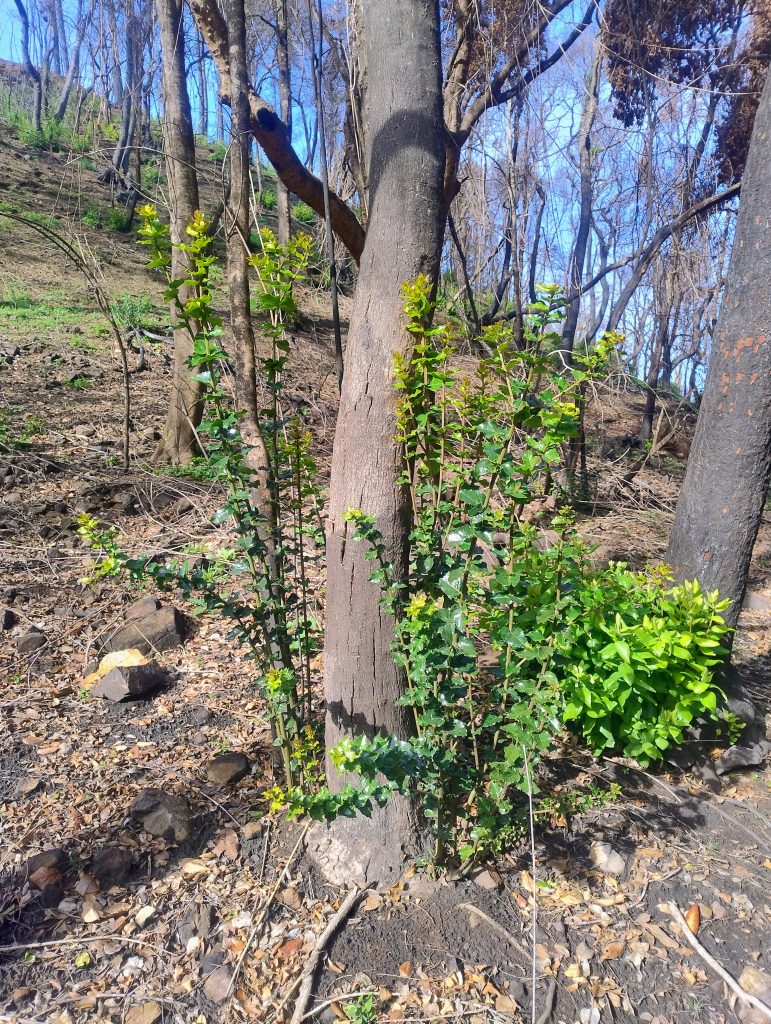
Nine months after the forest fires that affected Penco and the Lirquén sector during January, Fundo Coihueco is beginning to show signs of recovery. In the areas reached by the fire, grasses and shrubs have grown back, while various native trees have begun to resprout from their bases and canopies.
However, the process is still slow. Through monitoring of the sector, Pablo Fuentes, a botany specialist, member of the Wildlife Response System (Sirfas) and of the environmental management commission of Parque para Penco, has been able to observe that annual vegetation is already established at various points and that some species have even begun to bloom.
"Within a few weeks of the fire, different species of grasses began to cover the eroded soil. Later, several tree species began to resprout (from the base and the canopies)," Fuentes explained.
Among the species observed are litre, boldo, hualle, huillipatagua, pitao and queule. The last three species are under threat categories.
Likewise, sprouts of exotic and invasive species were also activated, such as eucalyptus. Also retamilla and blackberry, which leave thousands of seeds in the soil and require open spaces to germinate and establish themselves.
Pablo Fuentes indicated that, at one point, the soil was invaded by small retamilla plants. However, ecological interactions have kept this invasive growth in check.
"In relation to the native forest, although many trees burned, they are still standing, some with abundant resprouts. This is very relevant, since the canopies continue to generate shade and therefore prevent or reduce the probability that exotic species can invade the forest," Fuentes said.
The specialist described this as hopeful, since ecological succession is beginning, a natural process of ecosystem recovery that favors biodiversity in general, including wildlife.
More than 50 species recorded
Recovery has also been observed in wildlife. Joseline Veloso, a veterinarian specializing in wildlife management, commented that, through camera traps and direct observations, more than 50 vertebrate species have been recorded continuing to use the area affected by the fire.
The record includes 32 bird species, 13 mammals, three reptiles and three amphibians. Among the animals identified are the monito del monte de Pancho, olive field mouse, scrub degu, güiña cat, culpeo fox and pudu.
The specialist indicated that species such as the leaf litter frog, mottled frog, slender lizard and Schröeder's lizard have also been observed.
"The records so far account for the presence of native wildlife that continues to occupy the burned area, mainly associated with remnant patches of unburned vegetation, which could be providing refuge and food," Veloso explained.
Both specialists indicated that the early detection of species that move little, such as amphibians, reptiles and small mammals, is relevant. This is because it raises the possibility that some individuals managed to survive within the affected area, rather than having arrived later from other sectors.
"In recent months we have managed to record species with greater mobility in the area, such as the güiña cat and pudu; however, these records still do not allow us to affirm that a recolonization process exists," Veloso and Fuentes said.
Prevention and protection
From Sirfas and Parque para Penco, they highlighted the urgency of strengthening prevention and protection measures in areas such as Fundo Coihueco, especially by avoiding new sources of fire and reducing the accumulation of combustible material in strategic places.
It is also essential to maintain and protect the green remnants of native vegetation, which function as refuges and nuclei from which the recovery of wildlife and the spread of native flora can continue.
"We consider species with conservation problems and habitat specialists to be of special concern, as they need specific environmental conditions to live, such as vegetation cover, humidity or temperature, and can take several years to recover after a fire, as is the case with amphibians," the specialists explained.
One example they mentioned is the monito del monte de Pancho, which needs native vegetation that provides its food during the summer months, a period in which more fires occur and in which it must accumulate energy reserves to hibernate.
Likewise, the red-tailed hawk, a forest raptor listed as Endangered according to the International Union for Conservation of Nature (IUCN), which needs mature forests to nest and reproduce, and which has been recorded in Parque para Penco, which sparks the interest of experts considering the few breeding pairs reported worldwide.
Source:Diario Concepción







Comments (0)
No comments yet. Be the first to comment!
Leave a comment