

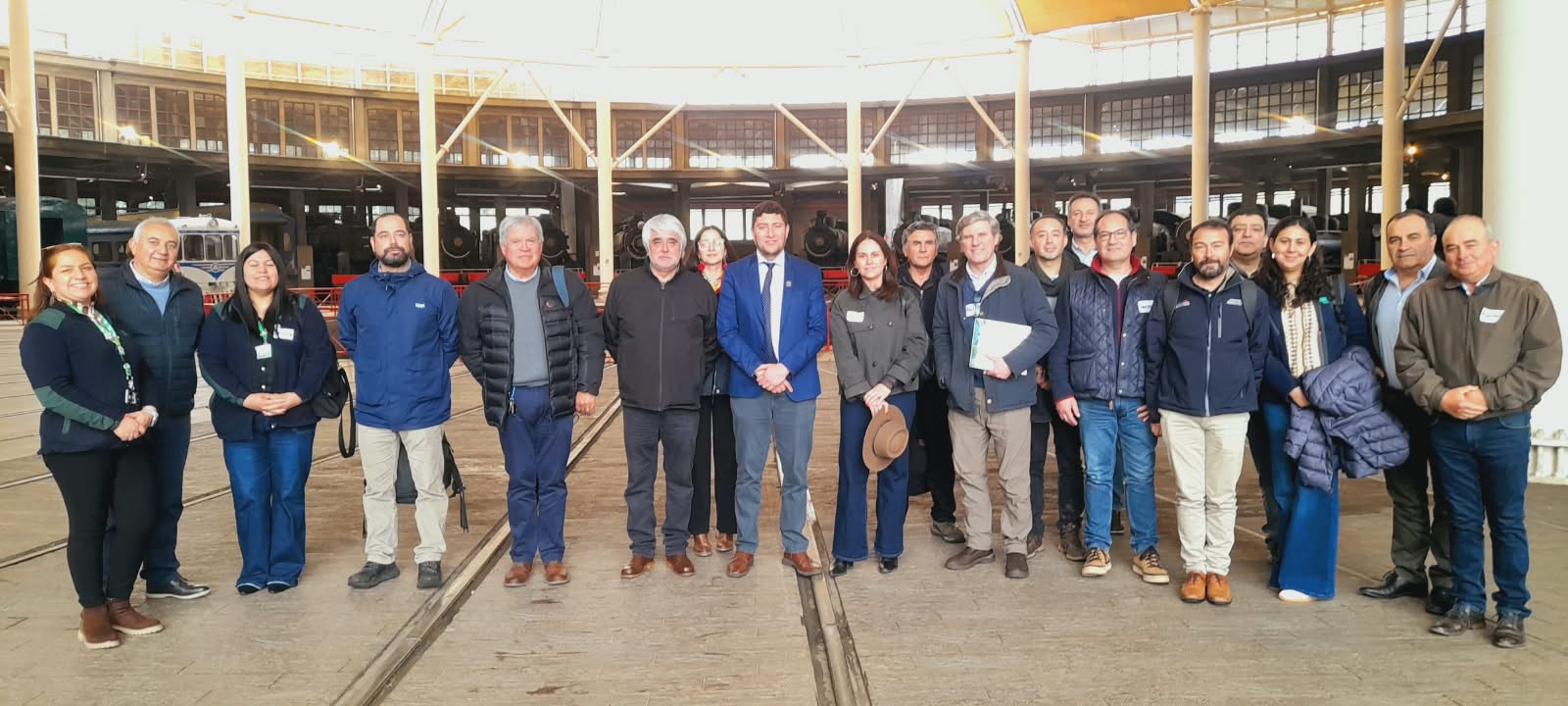
The La Araucanía Regional Forestry Roundtable took a new step in its consolidation with the formation of its board and the definition of four strategic pillars that will guide its work over the coming months. The body seeks to strengthen public-private coordination and generate proposals that respond to the region's productive and territorial needs.
During its second session, Mauricio Reyes, a forestry engineer from the University of La Frontera, was appointed president, while Antonio Soto, president of the Chilean Timber Corporation (CORMA) for La Araucanía, Los Ríos and Los Lagos, took on the vice presidency. The National Forestry Corporation (CONAF), meanwhile, will serve as Technical Secretariat.
The roadmap was structured around four priority areas: productive linkages, competitiveness, market and commercialization, and associativity and governance. These pillars will make it possible to organize initiatives, set priorities and facilitate collaboration among the various actors linked to the forestry and timber sector.
Driving concrete actions for regional development
One of the roundtable's main challenges will be turning agreements into concrete initiatives during the remainder of 2026 and early 2027. Among the priorities are promoting the use of wood, increasing planted area and promoting sustainable management of native forest for timber production, biomass generation and the use of non-timber forest products.
The body's vice president, Antonio Soto, highlighted the technical capabilities and institutional coordination that the roundtable brings together to advance these objectives.
"We have capabilities, experience and significant public-private coordination. The challenge is that during the remainder of 2026 and early 2027 we move concretely into action, promoting the use of wood, increasing planted area and promoting sustainable management of native forest," he said.
Soto added that the joint work represents an opportunity to project a more solid and sustainable forestry activity, capable of generating new productive opportunities and contributing to the economic development of La Araucanía.
Forestation, innovation and territorial participation
For his part, the roundtable's president, Mauricio Reyes, highlighted the region's forestry potential and the need to integrate the capabilities of public institutions, universities, trade associations, producers and small and medium-sized enterprises to identify gaps and build shared solutions.
Among the areas requiring attention, he mentioned forestation, genetic improvement and soil conservation, considering the particularities of the different territories and the needs of those participating in the activity.
"This forestry roundtable is important for the region because it articulates different bodies. We must be able to bring together all the actors and learn, from their own experiences, what the urgent needs are to boost the forestry sector," Reyes said.
He also raised the importance of incorporating the Regional Government into the coordination work, with the aim of broadening institutional participation and facilitating the development of initiatives aligned with the territory's priorities.
CONAF highlights public-private coordination
CONAF's regional director, Héctor Tillería, valued the formation of the board and the definition of the areas of work, highlighting the contribution this body can make to strengthen regional forestry activity.
"As CONAF, we greatly value this body, since it will make it possible to carry out the necessary efforts to strengthen the forestry sector in the region and, of course, to focus on the lines of commercialization, productive linkages and forestry policy to determine the long-term lines of work in the forestry sector of our region," he said.
With a board in place and a roadmap defined, the La Araucanía Regional Forestry Roundtable seeks to consolidate itself as a space for collaboration among the public sector, the private sphere and territorial actors. The challenge will be to translate its four strategic pillars into measures that boost competitiveness, promote sustainable management of forestry resources and strengthen the activity's contribution to regional development.




Comments (0)
No comments yet. Be the first to comment!
Leave a comment