
A scientific project from Universidad Técnica Federico Santa María (USM) seeks to deepen understanding of how thermal radiation generated by the flames of a wildfire can damage homes and other structures, even when the fire does not come into direct contact with them.
The research is led by Gonzalo Severino, an academic in the Department of Mechanical Engineering at USM, Viña del Mar campus, and is funded by the Fondecyt de Iniciación program of the National Agency for Research and Development (ANID).
The study, titled "Towards a better understanding of the radiative characteristics of flames produced with forest fuels," focuses on analyzing the thermal energy emitted by flames generated from different materials present in the wildland-urban interface, such as leaves, pine needles, wood, and construction materials.
Thermal radiation is one of the pathways through which a fire can affect its surroundings without direct contact with the flames. For this reason, understanding its characteristics is relevant for refining the models used to estimate the impact of heat on buildings located near vegetated areas.
Experiments to understand flame behavior
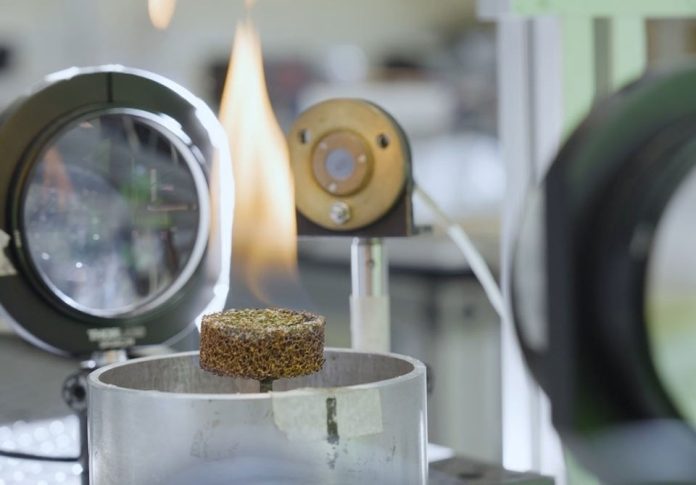
To study this phenomenon, the team develops experiments with small-scale, laminar-flow flames, whose properties are examined using cameras, heat flux sensors, and non-intrusive optical techniques.
These tools make it possible to analyze parameters such as temperature and soot concentration, elements that influence the amount of thermal radiation emitted during combustion.
According to Severino, one of the central purposes is to build an experimental database with information on different forest fuels present in Chile's wildland-urban interface. These data will serve to improve and validate models capable of predicting the thermal radiation produced by fires, both at full scale and in scenarios of greater territorial extent.
The results could contribute to a more precise assessment of the risks faced by homes and other constructions near forested areas, providing scientific evidence to understand how heat is transmitted during these events.
A platform to expand the research
The project also contemplates developing an equipped experimental platform to provide continuity to this line of work and extend the analyses to a greater variety of materials.
The infrastructure will make it possible to study other plant species, structural fuels, and solid materials that may be involved in wildfires or urban fires, expanding knowledge about heat transfer mechanisms.
In this way, the research seeks to generate scientific tools that contribute to a better understanding of fire behavior in the wildland-urban interface, where the proximity between vegetation, homes, and infrastructure poses significant challenges for fire prevention and risk management.


Comments (0)
No comments yet. Be the first to comment!
Leave a comment