

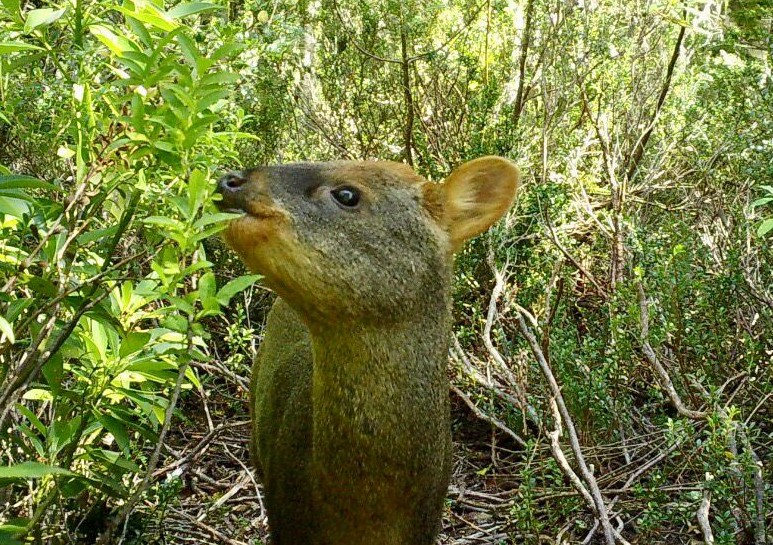
Knowing the forest to know the pudú. That is one of the central ideas of the environmental education program "Following the pudú's tracks, dweller of the Chiloé forest," developed by the Center for the Study and Conservation of Natural Heritage (CECPAN).
The initiative, funded by the Environmental Protection Fund (FPA) of the Ministry of the Environment for the 2025-2026 period, is carried out at El Palomar Rural School, Puente Puntra Rural School, and Chepu Alla Mapu Rural School, with third and fourth grade students.
From the forest to the pudú
The program includes four educational units that combine games, photographs, drawings, role-playing, sensory activities, audiovisual resources, and outdoor experiences.
The first, "The Chiloé forest, a shared home," provides insight into the biodiversity and the different layers that make up this ecosystem.
"May there be an appreciation and knowledge of the Chiloé forest," explains Carolina Rodríguez, geographer and CECPAN member and project leader.
Then, "Pudú for a day" introduces students to the characteristics, diet, and reproduction of this small deer.
The third unit, "The pudú and its neighbors of the Chiloé forest," addresses the relationships between species and the importance of food webs.
Finally, "AlertaPudú" focuses on threats such as road collisions, dog attacks, irresponsible pet ownership, and habitat loss due to deforestation, land subdivision, and road construction.
The proposal also provides tools to prevent these risks and promote a more responsible relationship with the forest.
May the tracks reach further
Each unit lasts a minimum of 90 minutes and includes the participation of teachers. The program also incorporates diagnostics before and after its implementation to evaluate learning.
The challenge now is to expand its reach. CECPAN is working on the production and free distribution of the educational materials to other schools in the archipelago, so that they can use and adapt the program autonomously.
"We would like this environmental education program to have a greater reach," says Rodríguez.
The initiative also includes a workshop with traditional educators from the archipelago to share the contents and materials.
A small deer, a great ecosystem
The pudú (Pudu puda) is one of the smallest deer in the world. In Chile it is classified as vulnerable (VU) and internationally as near threatened (NT).
It measures between 40 and 55 centimeters, weighs approximately between 7 and 10 kilos, and inhabits humid, temperate, or cold forests with abundant vegetation. Its diet includes mainly ferns, shrubs, vines, and fruits.
In Chile it is distributed from Maule to Aysén, with a greater presence between Biobío and Los Lagos.
In Chiloé, following the pudú's tracks is also learning to know and value the forest that sustains it. Because protecting this species means, at the same time, caring for the entire ecosystem of which it is a part.

Comments (0)
No comments yet. Be the first to comment!
Leave a comment