

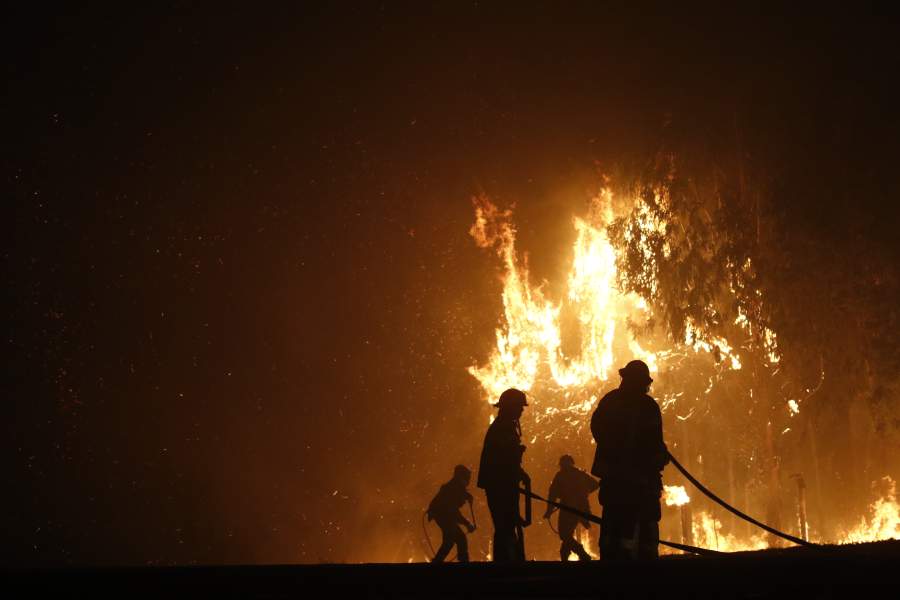
The intense rains that occurred in winter and that continue to spread into spring, but with less damage, have been viewed with concern among those who work in fighting forest fires.
This climatic condition, marked by the influence of El Niño, affects the high growth of vegetation which, when the high summer temperatures arrive, dries quickly and acts as a vector for the spread of fire.
Experts have warned that the spring rainfall associated with this phenomenon could reach intensities typical of winter, that is, on the order of 5, 6 or 7 millimeters per hour.
El Niño corresponds to an anomalous increase in sea surface temperature in zone 3-4 of the Pacific, located off the coast of Ecuador.
This was explained by the researcher and agroclimatology expert at INIA Quilamapu, Raúl Orrego, who detailed that between 0.5 and 1 °C above normal corresponds to a weak El Niño; between 1 and 1.5 °C, moderate; between 1.5 and 2 °C, strong; and above 2 °C, extremely strong.
"The latest projections indicate that for the October-November-December quarter, the phenomenon could exceed 2.7 °C above normal (which were those reached in 2015), which would leave it as the most intense event recorded with direct measurements," he indicated.
The specialist maintained that under current conditions there is the possibility of storm events, with wind and even hail, due to greater atmospheric instability, which contrasts with a normal spring where rains tend to be sporadic and brief.
One of the mechanisms that explains this scenario is the weakening of the Pacific anticyclone, a system that normally stops the entry of rain fronts toward the continent. Being weakened, frontal systems can enter more frequently. In the same way, El Niño favors the occurrence of the so-called atmospheric rivers—large concentrations of water vapor that transport moisture toward the continent—which can contribute greater volumes of precipitation.
The combination of high temperatures and a greater accumulation of biomass as a result of the rains can increase the risk of forest fires, although the present humidity could partially moderate that effect.
In an interview with La Discusión, the regional director of Conaf, Domingo González, anticipated a complex period given the current climatic conditions.
"With this El Niño Godzilla phenomenon, spring is going to be rainy. We have had a very rainy winter with natural disasters due to flooding and this generates exuberant vegetation growth. When summer arrives, at the end of December and January, these grasses are exuberantly developed, they dry out and become a fuel that is very prone to burning. In addition, it is a light fuel and has a very high spread speed; therefore, detection of the fire focus and arrival time are crucial to be able to quickly control that incipient fire," he explained.
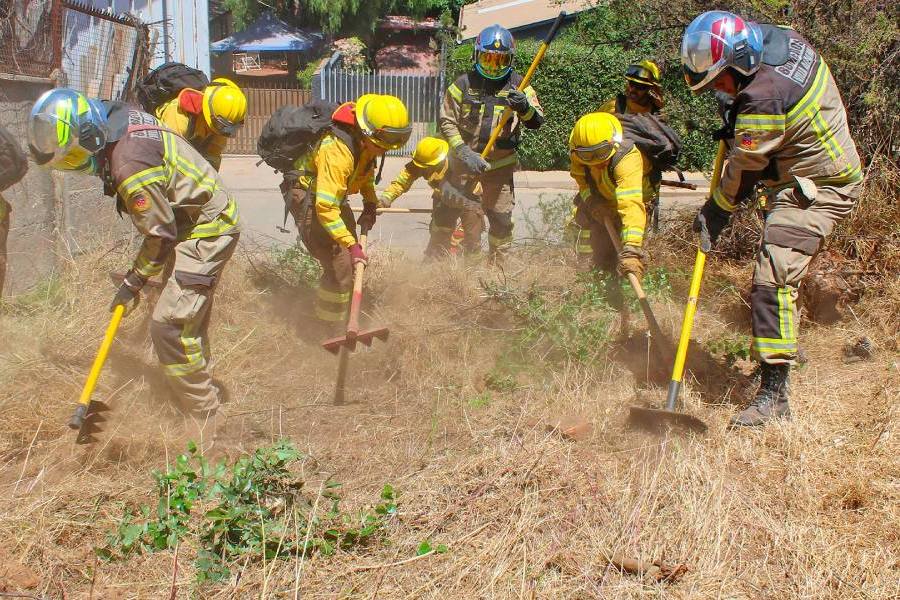
For this reason, the National Forest Corporation (Conaf) has held coordination meetings with those in charge of emergency and security in the communes so that, among other measures, by November of this year the municipalities have carried out firebreaks and vegetation clearing work in critical areas, that is, where there is key infrastructure and population to protect in the event of a fire.
Likewise, last week the first two brigades, with 28 personnel, have already been deployed to begin the new season of high risk of forest fire occurrence 2026-2027.
They are expected to increase in a staggered manner by November with a projection of 20 brigades in total in the Ñuble region.
The season has already begun after responding to the uncontrolled spread of two unauthorized burns in San Carlos.
"In a normal year we begin a ramp-up starting from this date in the number of resources we have until ending in December, whether it be the personnel brigade or those made up of machinery, whether Skidder or another resource. This year, considering that we had already been warned about this El Niño Godzilla issue and that firefighting conditions are going to be more complex, we have prepared to bring this ramp-up forward," said the executive.
There is no cut
Although the institution did not specify the regional budget allocated for the period, due, they explained, to the fact that they have not yet carried out the "national allocation" of this item, they assured that it will not experience a cut and operational resources will be similar compared to last year.
"The resources, both aerial and brigade, have not been reduced this year. They are the same as we had the previous year. There is no cut. They are not only made up of the work forces of brigade members, who total 197, but also brigades that are water trucks and also skidder. We are still seeing whether there are more or fewer skidders, but in the end, in terms of resources, it is more or less the same as has been used in previous years," he commented.
However, Conaf Ñuble confirmed that it has experienced an increase in its resources over time, going from five brigades in the former province to 20 in the current region.
"Before we depended on a helicopter that was in Concepción, when we were a province. Today we already have aircraft present here and, in addition, there are some medium-to-large aircraft that have an interregional service. That is, they support Biobío, La Araucanía, the Maule Region and also us. But the advantage as a region is that we have our airfield," added Domingo González.
Increasing damage
According to statistics provided by Conaf, Ñuble recorded a moderate increase in the number of forest fires during the 2025-2026 period, but the increase was much more significant when considering the affected area.
The region went from 445 fires in 2024-2025 to 454 in 2025-2026, that is, 9 additional fires, equivalent to an increase of 2%. This figure is also below the five-year average of 492.2 fires.
However, the damaged area showed a significant rise. It went from 5,809.58 hectares in 2024-2025 to 9,789.47 hectares in 2025-2026. This represents an increase of 3,979.89 hectares, equivalent to 68.5%.
"Two percent of the fires, in total, cause about 80% of the damage. That is, the rest, 98%, are small fires that we can control. Two percent of those fires become megafires that cause tremendous damage," he detailed.
In territorial terms, the fires of the 2025-2026 season had a considerably greater impact.
"We maintain an average fire occurrence on the order of 400 or 410 fires every year. That number fluctuates and the number of fires that occur in the seasons remains very steady, year after year, for several five-year periods now. However, the damage caused by these fires has been much greater as we advance through the seasons," emphasized the director.
The climatic factor and the amount of biomass present in the territory influence these figures.
"The impact of Climate Change is no longer unknown. We have temperature increases, sometimes unexpected rain or floods. Also wind speeds or temperatures that are complex in summer. For 15 years we had prolonged droughts and that has meant that the fuel material is extremely dry and available to ignite. Added to that, in recent years there has been a retreat from the practice of reducing biomass through the use of tactical fire, because there has been environmental resistance. We have an accumulation of biomass on forest floors that is extremely high and if that is combined with a day of high temperature, high wind speed and low relative humidity and a fire occurs, then it quickly becomes a megafire," he clarified.
To reduce agricultural waste, Conaf has promoted alternative practices to burning, such as, for example, the use of crop residues for mushroom production, energy generation and animal feed.
"We did a study with INIA, in which Carlos Ruiz, who was a researcher, participated, where we developed different techniques for incorporation or alternative use of fire for agricultural waste. Today we are putting it into operation. We are starting with that and each year we are staggering to do more and more incorporation and we also do it in coordination with some companies that require, for example, agricultural waste such as straw or others for mushroom production, or some others that also require those bales for animal feed or also for energy generation. We carry out the treatments south of the cities, because normally the winds in summer run from the southwest," he highlighted.
Electrical disconnection on emergency days
Forestry companies are aware that "dangerous" weather conditions are approaching. Under that scenario, the Chilean Timber Corporation (Corma) considered public-private coordination essential ahead of the most critical months.
In that sense, the entity pointed out that on preventive alert days or before a fire begins, there must be availability to make preventive decisions such as temporarily stopping risky activities, increasing surveillance, controlling access and, when appropriate, carrying out preventive electrical disconnections focused on certain sectors and times of maximum risk.
"Preventive electrical disconnection is a tool used in extreme scenarios and Corma is proposing to advance in the way of applying it in a focused, anticipated and safe manner during the days of greatest emergency. Authorities and all actors must reach those days coordinated, with measures defined, teams prepared and communities informed. These are exceptional and limited measures that seek to reduce to the maximum the possibilities of a fire starting," stated the manager of Corma Biobío and Ñuble, Margarita Celis.
According to the guild, at the macrozone level, 31,000 kilometers of maintenance work have been carried out on prevention structures, such as firebreak strips, vegetation-free strips and fuel-break strips. More than 6,500 kilometers of new prevention structures have also been built (21% in the Ñuble region).
Objections to machinery restrictions
In firefighting tasks, it indicated that heavy machinery (bulldozers and skidder) is essential to support firefighting and contain the advance of fire, but the executive warned that today there would be restrictions that can hinder their movement.
"In previous seasons, temporary solutions have been achieved. Corma's proposal is to move toward a definitive solution that allows the free transit of emergency machinery throughout the season, with the corresponding protocols and safeguards. We cannot have a machine available to fight a fire and have a restriction prevent it from arriving on time," she emphasized.
Considerable resources and work beyond property
Corma's available resources are 56 aircraft and 5,000 brigade members. Of this total, 50% are allocated to the Biobío and Ñuble regions. For the Ñuble region, 12 aircraft and 1,000 brigade members are considered.
From Corma they indicated that there has been coordination with Conaf and Firefighters in emergencies.
"It has been defined, for several years now, that we must arrive as soon as possible, when the focus is small, since in this way it is more likely to control it and prevent it from becoming a larger fire. It does not matter where the fire is, nor whose affected place it is; what matters is that whoever detects it first or is closest to the focus can arrive with resources," assured Celis.
The implementation of nighttime brigades by the companies has also been fundamental, together with the use of heavy machinery, which helps do more efficient work in building firebreaks.
Drones are gaining relevance for surveillance and monitoring the advance of fires, when visibility conditions allow it. Likewise, satellites are maintained for monitoring.
In addition, they detailed that the training program for Firefighters has continued, reaching to date more than 2,700 volunteers in the macrozone trained in fire behavior and firefighting.
"Chile can strengthen brigades, aircraft, technology and resources, but in extreme weather conditions a megafire can exceed traditional response capacities," detailed Margarita Celis.
Regarding the balance of the 2025–2026 season, the Corporation indicated that it once again demonstrated Ñuble's high exposure to forest fires. "Although the affected area remained below the average of the last five years, it increased significantly compared to the previous season and was strongly concentrated in large-scale episodes during January," it closed.
Source:La Discusión




Comments (0)
No comments yet. Be the first to comment!
Leave a comment