

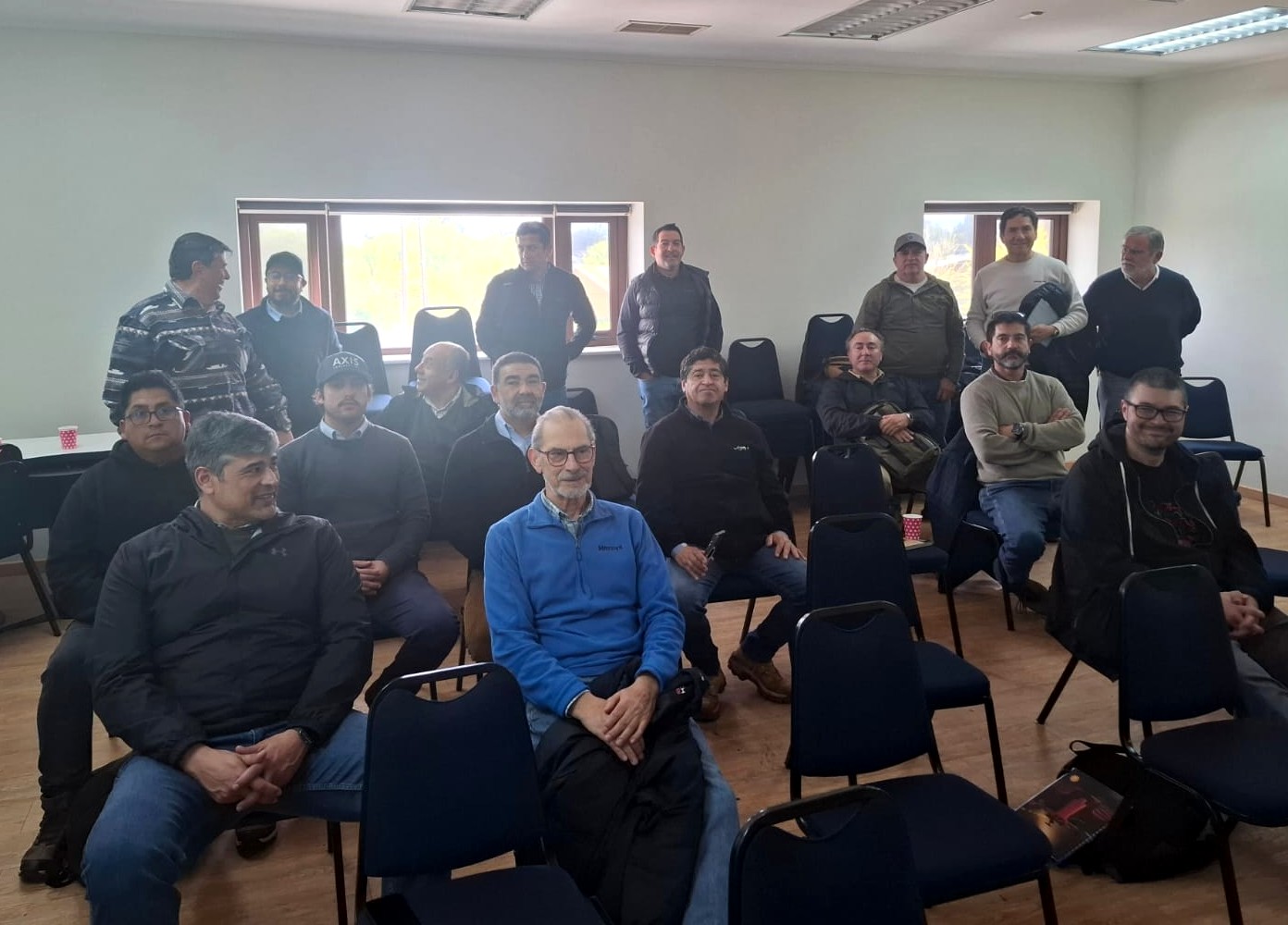
In a scenario marked by rising costs, pressure on rates and difficulties in maintaining operational continuity, ObservAcción and the Association of Forestry Contractors (Acoforag) held the workshop "Recovering margin from operations," an instance focused on identifying opportunities to improve productivity and strengthen the economic sustainability of companies in the sector.
The meeting, held in Los Ángeles, Biobío province, brought together Acoforag members and guests, who participated in a session aimed at analyzing how waits, variability in operations, equipment availability and late decisions affected performance and reduced the margins of forestry service companies.
The speakers Mario Sauer and Juan Carlos Carrillo, from ObservAcción, shared their knowledge in productivity, operational analysis and forestry operations, with emphasis on identifying losses and implementing concrete improvements in the field.
Sauer is an industrial civil engineer and holds a master's degree in Engineering Sciences, with more than 25 years of experience leading productivity projects. His work has specialized in the analysis, measurement and design of operational improvements. Carrillo, meanwhile, is a business engineer and agro-industrial management engineer, has more than 25 years of experience in consulting and forestry operations, and has developed roles related to supply, contracts, roads and sustainability at CMPC.
Identifying losses to improve productivity
During the session, one of the main challenges of forestry contractors was addressed: understanding where time, capacity and resources are lost, differentiating the factors that depend directly on each company from those that require coordination with the client companies or respond to external conditions.
The activity emphasized that the sector's economic difficulties cannot always be resolved through rate negotiations or by increasing working hours. It is also necessary to analyze how much of the available capacity is effectively transformed into production and what losses can be recovered through better planning, supervision and operational coordination.
Among the topics discussed were the relationship between productivity and cost per cubic meter, variability in operations, operational demands, costs associated with losses and the conditions necessary to achieve sustainable profitability.
The methodology presented by ObservAcción was structured in four stages: observing what happens in the field, analyzing utilization and efficiency losses, designing practical solutions and implementing actions whose results can be measured and adjusted.
"We must be efficient and achieve better economies"
Acoforag's manager, René Muñoz, highlighted the importance of productivity as a tool to face new market conditions, especially amid rate reductions and external pressures affecting operating costs.
"Today, with the new rate requirements, we are forced to place productivity as the concept we should address. Efficiency, quality of work and equipment utilization are factors that allow us to move forward and adapt to new market conditions," he said.
Muñoz explained that external conditions, including the influence of fuels, have generated pressure on rates and have forced companies to seek alternatives to maintain their competitiveness.
"We must be efficient and, with that, achieve better economies that allow us to keep our companies working with reasonable margins," he added.
His statements reinforced one of the main points of the meeting: improving productivity does not only mean producing more, but also using equipment better, reducing unproductive times, strengthening supervision and ensuring the quality of operations.
A collaborative approach for the forestry sector
The session also highlighted the importance of promoting shared learning among Acoforag's member companies and identifying common operational gaps, safeguarding the confidentiality of each company's individual information.
The proposal presented contemplated a pilot experience with the participation of between six and ten member companies, with the purpose of identifying concrete improvement opportunities and evaluating the results before moving toward a larger-scale initiative.
The process considered that each company could identify priority opportunities, establish a baseline to evaluate its performance and define actions aimed at improving its operational and economic results.
With the participation of Mario Sauer and Juan Carlos Carrillo as speakers from ObservAcción, the meeting organized together with Acoforag focused on the need to transform the analysis of operations into concrete actions, strengthening the productivity, management and sustainability of the companies that are part of the forestry services chain.



Comments (0)
No comments yet. Be the first to comment!
Leave a comment