

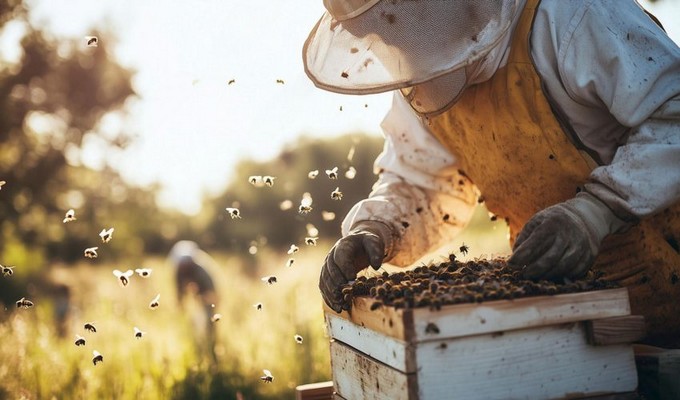
Amid a scenario where agricultural sustainability and ecosystem protection have gained prominence, the implementation of Beekeeping Law No. 21,489 is beginning to set the standard for the sector in Chile.
In the Biobío Region, particularly in rural areas near Concepción and the Biobío province, producers and beekeeping leaders are closely monitoring the changes that have already taken effect and those that will come into force starting in April, generating expectations but also concerns regarding their practical application.
What does the regulation state?
The regulation, whose general rules were published on June 11, 2024, in the Official Gazette, establishes for the first time a comprehensive framework for the protection, promotion, and development of beekeeping in the country, recognizing it as a strategic agricultural and forestry activity.
It is not just about honey production but the fundamental role bees play in pollination, biodiversity, and, consequently, in food security. Under this logic, the law aims to promote the sustainable development of the sector, safeguard bee health, and regulate both the production and marketing of beekeeping products, also incorporating the strengthening of pollination services.
One of the most relevant changes already began to be applied on January 26, 2026, when the obligation to notify at least 48 hours in advance the application of agrochemicals classified as "highly toxic" to bees came into effect.
What until recently was considered a technical recommendation is now a legal requirement that falls directly on the farmers who carry out these applications. This notice must be made through verifiable channels, such as emails, text messages, or written notifications, and aims to give beekeepers time to protect their hives, either by sealing them or relocating them.
Looking ahead to April
However, the next regulatory milestone is already on the horizon. Starting April 26, 2026, this obligation will also be extended to products classified as "moderately toxic," which will significantly increase the scope of the measure.
The so-called "48-Hour Rule" thus becomes the central axis of the law, establishing a minimum margin for coordination between farmers and beekeepers, while also setting time restrictions for pesticide application, allowing it only during periods of lower bee activity, such as the early morning or evening.
To facilitate this process, the Agricultural and Livestock Service (SAG) has made available the Consultation for Notification (CPA) platform, a tool that cross-references the geolocation of agricultural properties with the apiaries registered in the system, identifying potentially affected parties.
However, the regulation is clear on one point: the responsibility for notification lies entirely with the person applying the pesticide. In turn, for beekeepers, keeping their apiaries properly registered and georeferenced in the SIPEC Beekeeping registry is an indispensable condition for receiving the notices, thus establishing a logic of shared responsibility in the implementation of the law.
Perspectives from Beekeepers in Biobío
In Biobío, where beekeeping coexists with intensive agricultural sectors and growing pressure on ecosystems, these changes have been met with a mix of appreciation and concern.
From the Los Junquillos Beekeeping Committee, its president Orlando Ira Ira acknowledges that the regulation introduces concrete challenges in the daily operation of the sector, particularly regarding transhumance and the distance requirements between apiaries.
"If I am going to locate myself in a specific place, I have to take into account, for example, where I am going to arrive, because I cannot locate myself too close to another beekeeper. We already have some distancing requirements that we must respect, that is a complex focus," he stated.
The leader, a native of Santa Bárbara, also warns of uncertainty regarding the entry of new actors into the sector. In his analysis, the regulation could generate conflicts in territories where apiaries are already established.
"If there is someone who wants to enter the sector in the field of beekeeping, I don't know what will happen there. For example, if they are near me, near my apiary, if that person owns their land and says I want to have bees on my land because I see it as work that can be sustainable for me, what will happen there?" he questioned, highlighting a concern that is repeated among small producers in the area.
From a broader perspective, the national beekeeping union and cooperative leader, Daniel Iraira, highlights the historic nature of the law, although he warns that its impact will depend directly on its implementation.
In his view, the recognition of the strategic value of beekeeping is a relevant step forward, but insufficient if it does not translate into concrete policies.
"The Beekeeping Law marks an important advance because it recognizes the strategic value of beekeeping, but that recognition must now become reality. The bee does not only produce honey, pollen, or royal jelly; it also fulfills an essential function for food production through pollination," he stated.
In that vein, he suggested that the country has an unprecedented opportunity to project itself internationally. According to him, Chile could stop being seen solely as a honey producer and move towards comprehensive beekeeping.
"Our vision as union and cooperative leaders in the beekeeping world is that Chile must take a leap and present itself to the world as a beekeeping power in three dimensions: production of hive foods, pollination services, and development of high-quality standardized biological material," he affirmed, also highlighting the country's sanitary advantages and its potential as a global provider of pollinators.
However, the leader insists that the challenge will not be resolved solely with regulation. In his opinion, strengthening the sector requires public policies that accompany the process.
In that sense, he emphasized the need for access to financing and productive development tools. He explained that, like other agricultural sectors, beekeeping needs credit with appropriate conditions, investment in technology, traceability, and innovation, especially in a context where specialized labor is increasingly scarce.
Iraira warns that the success of the law will depend on its correct execution. "Today we are in a very good position because we have the law, however, if it is poorly implemented, we run the risk of having an important law on paper, but insufficient in its concrete effects on the future of the sector," he stated.
Along the same lines, he underlined that the real challenge lies in its application in areas such as health, certification, and the incorporation of technology. "But what really matters is its implementation. That is the real challenge," he stressed.
Source:Diario Concepción







Comments (0)
No comments yet. Be the first to comment!
Leave a comment