

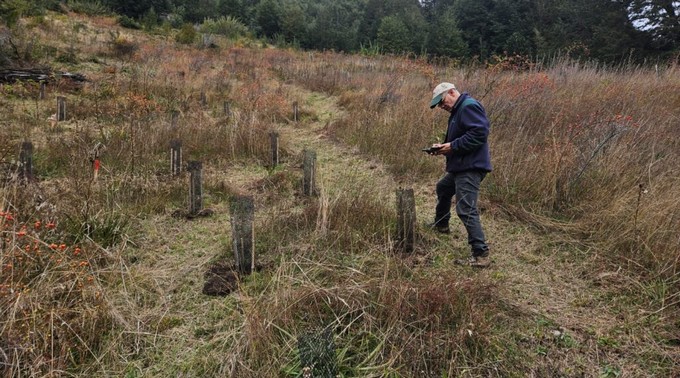
An inspection carried out by the National Forestry Corporation (CONAF) in the La Araucanía Region showed highly positive results in native forest restoration processes, within the framework of fulfilling commitments associated with the Convention on International Trade in Endangered Species (CITES).
The inspection took place at the Llancalil property, in the commune of Pucón, where measures implemented by the company Servicio de Compensación de Emisiones S.A. were evaluated, related to the export of Araucaria araucana specimens produced in nurseries in the Metropolitan Region, an emblematic and protected species of southern Chile.
Among the main results, the verification of a plantation of 1,200 araucarias stands out, with a survival rate of 99.7%, well above the required minimum standard of 70%. This indicator positions the experience as a relevant case at the national level in terms of ecological restoration with native species.
The technical report indicates that the plants show adequate health status, good vegetative development, and absence of significant damage, which is attributed to the correct application of planting, protection, and site selection techniques.
The intervention was carried out over an area close to 8,700 square meters, using a nucleus planting system, a methodology that has proven effective for improving the establishment of native species in complex terrain conditions.
Along with this, the progress of a parent stock intended for future seed production was evaluated, where 670 live plants were counted, in good general condition, although with challenges associated with managing competing vegetation.
It should be noted that the Procedures Manual for the application of CITES establishes the standards that regulate the international trade of protected species, safeguarding their traceability and legality. In this context, the National Forestry Corporation acts as the administrative authority in Chile for terrestrial flora, supervising exports, verifying the legal origin of specimens, and overseeing compliance with regulations in coordination with other State agencies.
The regional director of CONAF in La Araucanía, Héctor Tillería Flores, highlighted the scope of these results. "This type of experience demonstrates that it is possible to reconcile the development of productive activities with high conservation standards. The survival observed in this plantation is a concrete sign that good practices can generate positive and measurable impacts on the restoration of our ecosystems," he stated.
Likewise, he added that "CONAF's role is key to ensuring that these processes comply with national and international regulations, ensuring that the conservation of species like the araucaria translates into effective actions on the ground."
The report also provides recommendations aimed at strengthening the development of plantations, including weeding and silvicultural management practices for the parent stock.
The experience is taking place in the Liucura River basin, in an environment dominated by native forests of high ecological value, reinforcing the relevance of this type of initiative for biodiversity conservation at the national level and compliance with international environmental commitments.




Comments (0)
No comments yet. Be the first to comment!
Leave a comment