

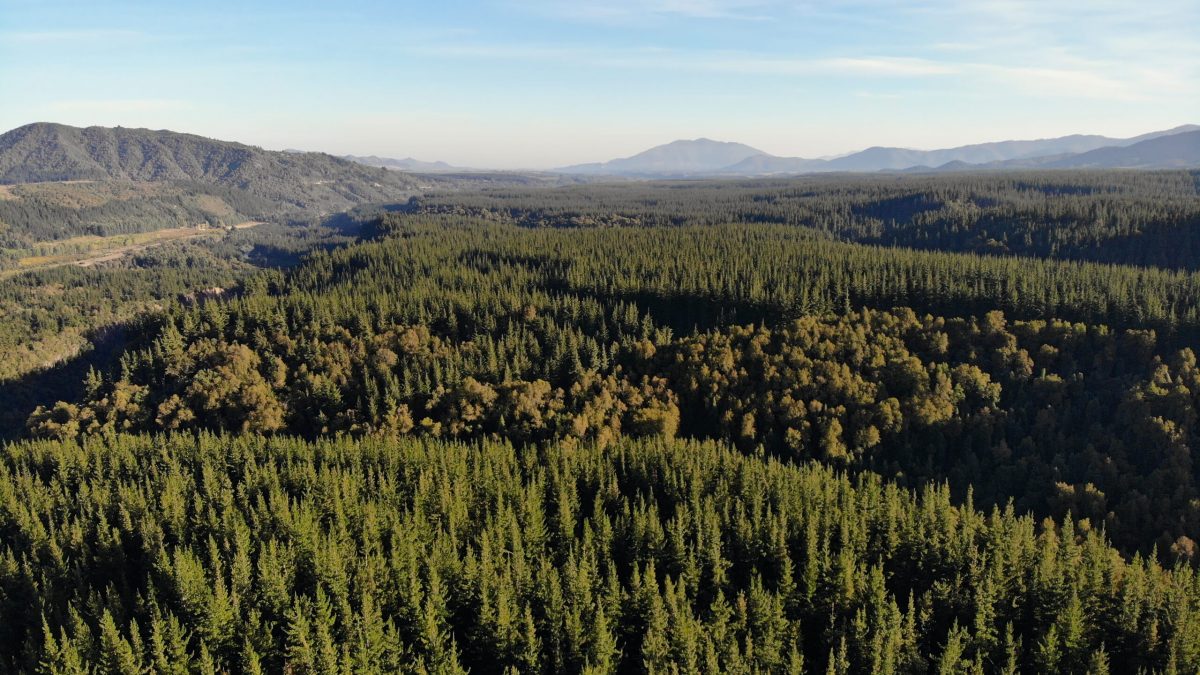
The Chilean forestry sector is going through a complicated period due to both local and global factors. On one hand, forestry exports continue to fall this year, following a negative 2025, due to lower pulp prices, increased global supply of raw materials, and weak demand for wood products amid international uncertainty.
On the other hand, fires, insecurity, and low afforestation are reducing the availability of wood for the coming years. Although the sector acknowledges there is potential to generate new plantations, they state that there is a lack of state incentives to develop them, a situation they have raised with the current government.
Declining Shipments and Concerns
According to Central Bank data, in the first quarter of 2026, pulp and paper exports fell 15% year-on-year to US$896 million, while shipments of forestry products and wood furniture fell almost 18% in the same period, totaling US$450 million as of March.
In 2025, forestry shipments reached US$5.923 billion, a decrease of 7% compared to the previous year and far from the record of US$6.838 billion in 2018 (see infographic), according to data from the Forestry Institute (Infor), an agency under the Ministry of Agriculture.
Rodrigo O'Ryan, president of the Chilean Wood Corporation (Corma), explained that the weakening in international pulp prices "is largely due to the entry of new volumes into the global market, especially from Asia and South America, which has generated higher supply levels and sustained pressure on prices."
Regarding the decline in shipments of boards and remanufactured products, he indicated that the drop is associated with a contraction in dispatched volumes, amid greater international uncertainty; inventory adjustments by customers and "more restrained demand, particularly in markets linked to the construction sector."
Hernán Muñoz, president of PymeMad —a guild that groups together forestry sector SMEs— stated that the decline in forestry manufacturing "is not news to us." He maintained that "woodworking SMEs have been in a downward trend since forest promotion ended in 2012, and the decline accelerated sharply from 2017 with the first mega-fires in Maule." He added that "weakened international prices, cooled Chinese demand, and a domestic construction sector that is not recovering worsen a problem that is already structural."
The sector is concerned about the effects of global trade tensions and geopolitical conflicts. O'Ryan explained that China has reduced its import dependence and increased "its bargaining power, which directly impacts exporting countries like Chile."
"The United States, due to tariffs, redirects products to countries where it competes with us, putting downward pressure on prices." He added that "woodworking SMEs are suffocated by falling demand, narrow margins, and difficulty accessing credit."
Afforestation and Security
The decrease in forest cover in Chile is another issue of concern for the sector due to its impact on the sector's expansion. The country's largest companies in the area, Arauco and CMPC, have gone to Brazil, among other reasons, due to greater forest availability.
According to the latest available data from Infor, as of 2023, forest plantations covered 2,224,163 hectares nationwide, an annual decrease of 2.3% and a drop of almost 8% compared to 2016, before the mega-fires in the south-central region.
"This decline is due both to the impact of the mega-fires and the lack of effective instruments that incentivize afforestation and the recovery of affected areas, especially in the case of small and medium-sized owners. Therefore, the need to advance a public policy that promotes reforestation has been raised, along with the development of complementary tools, such as carbon markets, to make these processes viable," stated O'Ryan.
The head of Corma estimated that in Chile "there are about one million hectares with forest suitability available for planting, to which are added significant burned areas that have not yet been recovered."
Hernán Muñoz stated that "fewer plantations mean less raw material in 20 years and an industry with nothing to work with." He indicated there are two million hectares of forest suitability available between O'Higgins and Los Lagos. To increase plantations, he stated the country "needs a new promotion instrument. DL 701 expired and was not replaced. Meanwhile, Uruguay, Brazil, and Paraguay are surpassing us with incentives they copied from our own model."
The representative of forestry SMEs acknowledged they have raised their concerns with the Government, through the Ministry of Agriculture, both regarding promotion of afforestation, and access to financing and incentives for wood construction.
Corma also presented a work agenda to the new authorities, focused on forest recovery through promotion instruments, security "with a robust fire law" and development of the bioeconomy. O'Ryan stated that "without adequate security conditions, it is not possible to attract investment." On this point, Muñoz added that "wood theft remains a scourge that is not addressed with the seriousness it deserves."
It was not possible to obtain the opinion of Infor, which was consulted for this article.
Brazil, the Growth Destination for the Matte and Angelini Groups
Last year, both Arauco —linked to the Angelini group— and CMPC —related to the Matte family— saw their profits affected by lower pulp prices. Despite this and the complex scenario in Chile for forestry activity, these groups are betting heavily on growing pulp production in Brazil, expecting a market recovery. In that country, in addition to accessing abundant forest cover, they have found support from local authorities to accelerate their mega-projects.
Arauco's financial efforts are focused on its Sucuriú project in Brazil. This US$4.6 billion pulp plant in Mato Grosso do Sul is 50% complete.
"This is not simply another pulp plant. The largest and most ambitious project in the entire history of our forestry subsidiary is being executed, the largest scale in the world's pulp industry, with a production capacity of 3.5 million tons per year," said Roberto Angelini, in the letter to shareholders contained in the 2025 Annual Report released on Friday.
CMPC, meanwhile, plans to continue expanding in Brazil with the Natureza pulp project, worth about US$4.6 billion, located in Rio Grande do Sul.
"The investment in pulp growth that began with the acquisition in 2009 of the Guaiba industrial complex, in the State of Rio Grande do Sul, Brazil, has not only been profitable but also lays the groundwork for a new growth cycle through the Natureza project. Part of the fruits of that investment," stated Bernardo Larraín Matte, president of Empresas CMPC, in his latest letter to shareholders.
The Matte's paper company is already preparing bank financing to begin that initiative.
Source:El Mercurio




Comments (0)
No comments yet. Be the first to comment!
Leave a comment