

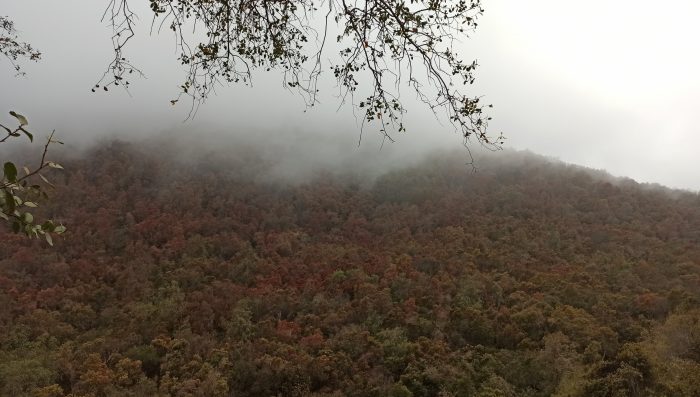
In the midst of the megadrought that has affected central Chile for over a decade, the sclerophyllous forest has experienced progressive deterioration, with visible signs such as leaf loss in perennial (non-deciduous) plants, foliage browning, and tree mortality.
However, some emblematic species of this ecosystem, such as the litre and the peumo, have shown greater resistance.
This was revealed by a study conducted in La Campana National Park, Valparaíso Region. The research, published in the scientific journal Annals of Botany, analyzed 11 native tree and shrub species to understand why some plants have better withstood prolonged water stress.
The work was led by Frida Piper from the University of Talca and Susana Paula from the Austral University of Chile-UACh, both researchers at the Institute of Ecology and Biodiversity (IEB). It also involved the participation of Rocío Urrutia-Jalabert (Lili, University of La Frontera, UACh, and the Center for Climate and Resilience Research, CR2).
The study involved examining healthy and damaged trees under natural conditions, and then complementing the analysis of samples in the laboratory. One focus of the study was to explore sugar and starch reserves to determine if a lack of energy reserves was one of the causes of decline.
They also analyzed the isotopic signal of twigs to understand how different species conserve water and perform photosynthesis, the process by which plants produce sugars from atmospheric carbon dioxide. Finally, tree growth rings were analyzed to obtain information from both the period before and during the megadrought.
In this context, the results showed that tree survival does not depend solely on resisting water scarcity, but on maintaining a balance between water regulation and carbon production through photosynthesis.
“What we found was quite clear. The species least affected by the megadrought were those capable of continuing photosynthesis even under water stress. In particular, we saw that the more resistant species could close their stomata efficiently and in a timely manner. These structures are small pores present in plant leaves.
Through them, the carbon dioxide needed for photosynthesis and energy production enters. The problem is that water is also lost through these same pores. So, plants constantly face a dilemma: how to capture carbon without dehydrating,” explains the lead author of the study.
Starving to death
In this regard, Frida Piper points out that the most affected species, such as the lingue, kept their stomata open for longer, which led them to lose more water and dehydrate.
“This would have also affected their photosynthetic capacity, probably because water stress damaged the metabolic and enzymatic functioning of their cells,” she highlights.
Regarding this, researcher Susana Paula adds a relevant point: “What we saw is that trees do not necessarily die of thirst, but of hunger. When they cannot maintain photosynthesis for years, they deplete their carbon reserves and enter a process of physiological collapse. This aligns with the hypothesis that plants, in the face of extreme droughts, die not only from lack of water, but also from lack of carbon. That is, they starve to death.”
This phenomenon, known in English as carbon starvation, occurs when trees consume more energy than they manage to produce through photosynthesis during prolonged periods of stress.
11 emblematic forest species
The study showed that the most resistant species, which exhibited the least leaf loss and browning, were the peumo and the litre. Both managed to maintain their physiological functioning better, with more efficient water regulation and a greater capacity to sustain photosynthesis under stress.
In an intermediate range of tolerance were the boldo, quillay, belloto del norte, molle, arrayán, and lilén. Finally, the most sensitive species were the lingue and the tevo. The latter showed that, although they closed their stomata to save water, they could not continue producing enough carbon.
Understanding these differences was also possible thanks to a tool developed by the research team: a field decline index that allowed collecting a large amount of data in a short time. To do this, two indicators of tree condition were combined: defoliation (leaf loss) and browning (dry or brown leaves remaining on the tree).
Science for the present and the future
The researchers highlight that the results of this work are valuable both for understanding the present and for projecting future scenarios, considering the advance of climate change, emergencies such as forest fires, and possible reforestation strategies.
For her part, Frida Piper mentions that, although there may be rainier years in the central zone, the megadrought does not automatically disappear.
“Today we know that drought depends not only on the amount of rainfall, but also on the increase in temperature. At higher temperatures, the atmosphere demands more water vapor and increases water loss from plants. Therefore, even in years with more precipitation, conditions remain different from those historically experienced by these Mediterranean forests.”
Resilience
Susana Paula explains that Mediterranean ecosystems are often considered resilient to drought, as they are capable of withstanding these disturbances and returning to their original state.
“However, what we are seeing in central Chile is the most extensive and rapid decline event of all those observed in other Mediterranean ecosystems worldwide. And while biodiversity always changes, and that is part of ecological dynamics, the problem here is the speed and intensity of those changes. What happens in the future will largely depend on how the climate evolves. If extreme events recur more frequently, forest recovery will become increasingly difficult.”
In light of this, the UACh researcher points out that to study these phenomena adequately, permanent research teams dedicated to ecological contingency are needed.
“This implies having a system where, in the face of a drought or a fire, there are groups prepared to measure, monitor, and respond quickly. That requires stable funding and flexibility, because current systems are often very rigid and require justifying every expense based on very specific objectives, which makes it difficult to respond in real time.”
Source:El Mostrador






Comments (0)
No comments yet. Be the first to comment!
Leave a comment