

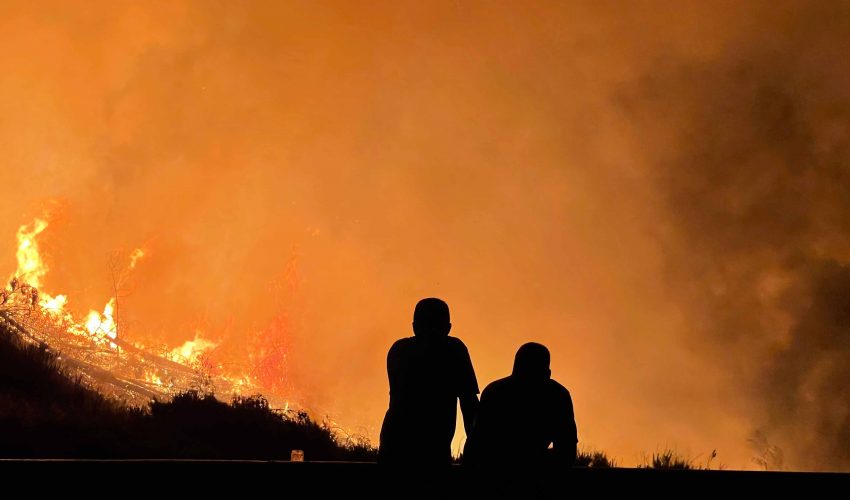
The upcoming summer season, according to the climatological analyses available so far, presents conditions that would facilitate the spread of forest fires in the Biobío Region, due to a climate scenario pointing to higher temperatures and a greater probability of extreme heat events.
In this context, it should be remembered that, in the area, during recent years, specifically in the 2022-2023 and 2025-2026 seasons, catastrophes associated with forest fires were experienced due to complex meteorological conditions, linked to increased heat and strong winds.
In that regard, Francisco Lang, an academic from the Department of Geophysics at the Faculty of Physical and Mathematical Sciences of the University of Concepción, pointed out that current projections point to the persistence of an El Niño phenomenon with strong characteristics over the coming months.
"Currently, it is likely that for the rest of the year and part of the summer we will be under the influence of El Niño. And, as the forecasts show, it is a phenomenon classified as very strong," he explained. In that context, he stated that it is still too early to have a definitive forecast.
The academic indicated that this phenomenon has already had effects on the meteorological conditions of the area, including a rainier winter, a scenario that could continue during spring. "As has already been seen, it has produced a much rainier winter, probably a rainier spring, but it also implies an increase in temperatures," he noted.
Looking ahead to summer, that combination generates additional concern due to the temperatures that could be recorded and the possibility of prolonged periods of heat. "What we can perhaps project is a warmer summer, with a greater probability of extreme temperatures and, obviously, associated with that, more hours of heat," Lang stated.
The projections do not correspond to a single meteorological model. According to the academic, it is information obtained from different models developed by international organizations, which have shown a similar trend regarding the conditions expected for the coming months.
"These projections consider numerous global models from different organizations, all with different conditions, and they converge toward a certain temperature range," he explained.
"Globally, there are organizations that carry out more precise monitoring, such as the National Oceanic and Atmospheric Administration of the United States (NOAA) or the Bureau of Meteorology (BOM) of Australia, which also has its own models. All of them show these projections," he indicated.
In general terms, he stated that there are more than 20 models being considered and that they show a similar trend toward a very strong El Niño during the summer.
Sea temperature
Lang noted that the estimates consider the anomaly in sea surface temperature and point to elevated values. "We are talking about sea surface temperature anomalies of more than 3 degrees, even between 3 and 3.5 degrees in general," he detailed.
One of the main variables that could work against the fire season will be the increase in temperatures. "The most important one is that the atmosphere is going to be warmer, so we will have higher temperature values," Lang explained.
Added to this is the behavior that summers have shown in recent years, in a context of climate change. "And we have already seen that, as a result of climate change, summers have been becoming increasingly warmer, with more extreme values, not only in Chile but also globally," he added.
Asked whether the next season could be more complex than the previous one, the academic was cautious and stated that it is still too early to make a definitive projection. "It could be. It is still very early, but that is what is expected. In fact, more heat waves are expected," he initially indicated.
"In fact, one could speak of a greater probability of heat waves occurring," he clarified. A scenario that would not only have consequences for the spread of forest fires, but also for other areas.
Preparing before the season
Faced with these projections, Lang highlighted the importance of climate information being shared with the institutions responsible for emergency prevention and response. "There are certain institutions, such as the Center for Climate Science and Resilience (CR2) in Chile, whose researchers maintain permanent contact with institutions such as Senapred and the Meteorological Directorate of Chile," he explained.
The objective, he added, is for the projections to be known in advance and used for planning. "And, obviously, the respective institutions then take charge of generating measures and being, in some way, prepared for this type of situation," he affirmed.
A "Godzilla Niño"?
Amid the projections of a strong El Niño, a more media-driven concept has also reappeared, such as the so-called "Godzilla Niño." Lang explained that it is a colloquial designation and not a scientific category. "It is more of a colloquial name. In reality, we talk about very strong or strong Niños, which are the categories," he clarified.
The term began to be used more strongly during the 2015 El Niño phenomenon, when there were also projections of a particularly intense event. Therefore, he stated that it is mainly a way of drawing attention to the intensity of the phenomenon, rather than a classification used by science.
In another aspect, the academic detailed that rain will not disappear immediately.
"Toward summer it is more difficult, because fronts and storms do not pass, or do not do so frequently. However, during spring we are still exposed to greater precipitation," Lang explained.
The scenario projected for the coming months combines a spring that could still be rainy with a summer marked by higher temperatures and a greater probability of heat waves.
Seasonal forecast
The Meteorological Directorate of Chile (DMC) released on its official website the forecast for the July-August-September 2026 quarter, which projects above-normal precipitation for a large sector of the country, extending from the Coquimbo Region to the Magallanes Region.
In the same document, the DMC detailed that the National Oceanic and Atmospheric Administration of the United States (NOAA) confirmed that El Niño conditions are present and are partially manifested in the seasonal forecast for this quarter. Furthermore, these conditions are expected to intensify toward the 2026-2027 summer season.
Source:Diario Concepción




Comments (0)
No comments yet. Be the first to comment!
Leave a comment