

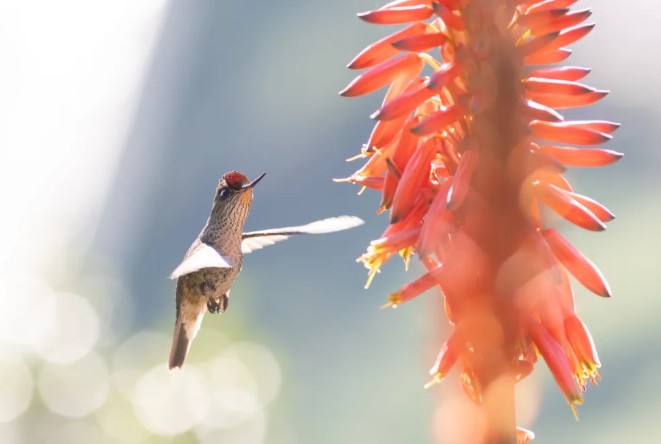
The sharp trills that have been heard more frequently over the past few weeks at Campus Concepción announce the return of one of its most characteristic winter visitors. The arrival of migratory populations of the green-backed firecrown (Sephanoides sephaniodes) once again turns the university gardens into a refuge for this emblematic native species.
It is common to see them on those days hovering over the blooming strips of Aloe arborescens -a succulent known as the candelabra/octopus plant- in apparent choreographies of play accompanied by vocalizations, which are nothing more than disputes over resources.
"They are very territorial, very good at fighting. If there is a place with many good-quality flowers, it is very likely that there is a hummingbird trying to dominate the area," commented José Valdebenito Chávez, academic from the Department of Zoology at the Faculty of Natural and Oceanographic Sciences.
Winter is the peak blooming season for the candelabra plant, a relative of Aloe vera that is present in several points of the Campus and abounds in areas adjacent to the booths.
The stalks of tubular flowers with an intense orange color are a feast for the hummingbird, whose accelerated metabolism -trochilids have the fastest among warm-blooded animals- requires it to consume up to half its body weight in food each day.
The tiny bird meets that need by eating small insects, but above all lots of nectar, which it obtains by visiting thousands of flowers every day.
"That's why in Chile we call it 'picaflor.' In other countries they are known as hummingbirds," notes Professor Valdebenito, who holds a PhD in Biology and is a specialist in ornithology.
The syrup of the flowers is essential in supplying energy for its constant movements, where its hovering flight stands out. "It is a specialized way of flying that is related to its feeding method. To perch on flowers, they developed static flight," detailed the ornithologist.
Evolution with flowers
The very specific fluttering and feeding habits of these birds are traits of an evolution closely linked to flowers, which began about 22 million years ago with the arrival of their ancestors in the Americas, where they had a successful adaptation.
In fact, they are exclusive inhabitants of our continent and, as the ornithologist points out, they are highly valued by bird enthusiasts worldwide for their characteristic coloration and demanding flight.

Photo byEsteban Paredes Drake/DirCom UdeC.
That flight is sustained by a fantastic machine: the heart of trochilids, in general, beats between 1,200 and 1,260 times per minute, while their wings move between 80 and 90 times per second.
Hummingbirds belong to the family Trochilidae, which encompasses more than 300 species, nine of which live only in our country. One of them is Sephanoides sephaniodes.
The words of its name come from the Greek roots sephan, meaning crown or diadem, and oides, meaning "similar to," and together they translate as "resembling a diadem/crown." The naming is due to a specific characteristic of the male, which is distinguished from the female by its reddish and iridescent coloration of the head.
It can measure up to 11 centimeters (including its tail) and weigh between 5 and 6 grams, making it the second smallest bird in the country, after the Arica hummingbird.
The southernmost in the world
This bird native to Chile -and also to Argentina- inhabits temperate forests, valleys, and scrublands, as well as urban gardens.
It has a wide distribution: it lives between the regions of Atacama, with Caldera at the northern limit, and Magallanes, where Cape Horn marks the farthest point where it can be found during the summer season.
This makes it the southernmost trochilid in the world.
"The distribution changes throughout the year due to migratory movements, because the green-backed firecrown is considered a partial migrant. This means there are resident populations and others that are migratory," said José Valdebenito.
Thus, there are populations that move south between spring and summer, during the breeding period. That is the time when they can be found at their southernmost point.
"That's why in summer you no longer see many hummingbirds on Campus. The density drops quite a bit, because they disperse," commented the specialist.
Starting in winter, hummingbirds begin to move toward lower latitudes fleeing the southern cold in search of refuges in more temperate zones, on a journey in which UdeC constitutes a point of arrival on the migratory route for some individuals.
In this way, the Campus acts as a kind of urban oasis, where resident and migrant hummingbirds find shelter and food in the wide variety of trees and flowering plants that populate the university parks and gardens.
Comparison of the distributions of the green-backed firecrown. On the left, the summer period (January to December) is observed, and on the right, the winter period (June to July). Although many are residents, some migratory populations that breed in the far south move toward the central zone of the country/Data from the open platform of bird observations eBird.







Comments (0)
No comments yet. Be the first to comment!
Leave a comment