

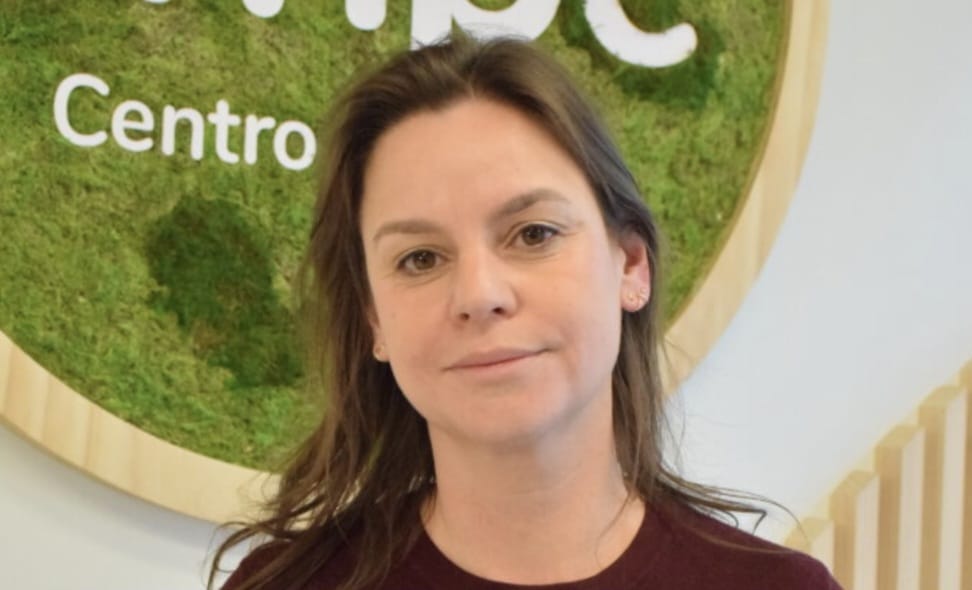
Preparing forests to face the effects of climate change is today one of the main challenges of forestry research in the province of Biobío. That is the work led by Bibiana Rubini, manager of Research, Development, and Bioeconomy at CMPC, who since 2023 has led teams dedicated to generating new processes, products, and solutions for the operations the company maintains in Chile and Brazil.
Among the areas under her responsibility is CMPC's Industrial Research and Development Center, located at the Santa Fe Plant in Nacimiento, whose facilities were reopened on July 6 to strengthen applied research in wood, pulp, and new materials, with infrastructure designed to meet the innovation needs of the next decade.
In a conversation with Diario La Tribuna, the Brazilian chemical engineer reviewed her professional career, from her early years as a researcher in her home country to her arrival at CMPC, as well as explaining how science and innovation seek to anticipate the changes that forests are already experiencing.
FROM BRAZIL TO CMPC
Born in Niterói, in the state of Rio de Janeiro, Bibiana Rubini spent much of her childhood traveling through different cities in Brazil with her family. Those experiences marked her early years and sparked her interest in the exact sciences.
"Something important about me and my family is that we are quite nomadic. My parents changed cities a lot during my childhood for work reasons. My father was a nuclear engineer, and that's where my taste for engineering and the exact sciences comes from. Since we moved so much, I don't have a place that I feel is my lifelong home," she recounted.
That curiosity led her to study Chemical Engineering, a degree she complemented with a master's in the same discipline and various postgraduate programs and MBAs focused on innovation, management, and leadership. With that preparation, she began a career in applied research that led her to work for more than two decades in the pulp industry before taking on a new challenge in Chile.
"I started as a researcher at Aracruz. Then I moved to Fibria, where I held various positions until reaching research management. Later, I was executive manager at Suzano and, in 2022, I received the invitation to take on this position at CMPC. It seemed like a very good opportunity, and I moved to Chile with my husband and my two children," she recalled.
Since February 2023, she has lived in Chile with her husband and two children. Although her base is in Santiago, her duties frequently take her to the province of Biobío, where a significant part of the research led by CMPC is concentrated.
INNOVATION FROM THE PROVINCE OF BIOBÍO
From her position, Bibiana Rubini leads a team focused on incorporating new technologies and developing initiatives that contribute to the company's growth, from applied research to the creation of new products.
"I am responsible for research, development, innovation, and bioeconomy at CMPC. Our work consists of generating knowledge, developing technological solutions, and seeking tools that allow us to make processes more efficient, develop new products, reduce our environmental footprint, and better serve the market," she explained.
The years dedicated to research also allowed her to participate in projects that gave rise to patented innovations. However, one of the aspects she values most since her arrival at CMPC is the quality of the production obtained at the Santa Fe Plant.
"I have three or four patents in my name, the result of developments I carried out during my time as a researcher. At that time, my dream was to develop a pulp that had the performance of Santa Fe pulp. Look where I am now, I have it for myself," she commented.
Among the milestones she most remembers in her career is the development of a nanocellulose plant, a project that coincided with a very special stage in her personal and professional life.
"It was one of the first nanocellulose plants in the world and the first in Latin America. I returned from my maternity leave and they gave me that project. It was a huge challenge, because we knew nothing about the subject, but it was a very nice experience," she recalled.
PREPARING FORESTS FOR THE FUTURE
The experience accumulated over more than two decades in research allows her to see firsthand how the conditions in which forest plantations develop have changed. That scenario, she stated, requires a perspective that covers the entire forest cycle to anticipate what is coming.
"As a manager, my work covers the entire process: from the seed and the DNA we are going to plant to the product we are delivering. Today our main challenge is the forest. Climate change brings us much more severe droughts, higher temperatures, and rainfall with different patterns. How do we keep the forest productive? How do we keep the forest healthy? That is our most important challenge," she stated.
In Rubini's view, the speed with which those conditions evolve has also made it necessary to strengthen the research capabilities that CMPC develops in the province of Biobío, where a significant part of the scientific work led by her team is promoted.
"What previously happened slowly is now accelerating. Our great challenge is to prepare for the future of forests. At the Industrial Research and Development Center in Nacimiento, we carry out experimentation to transform biomass into pulp and other products, such as nanocellulose. We complement that work with the specific laboratory for forest technology located in Los Ángeles," she concluded.
Source:La Tribuna




Comments (0)
No comments yet. Be the first to comment!
Leave a comment