

[translation]
[translation]
Psychologist and academic at Universidad Mayor, Alicia Cruzat, explained to The Clinic that "we will see that if we leave a child in the middle of the forest, it will activate their desire to run, explore, and climb trees without having given them instructions to do so. This will activate hundreds of learnings about themselves. They will be learning about their body and their motor adjustment skills with their environment. They will exercise their gross and fine motor skills, and their brain will fill with new connections in service of their cognitive and emotional growth. It will also activate their contemplation, observation, and exploration skills, so diminished in new generations, and key to acquiring any type of learning."
"Going for a walk in the hills or the countryside activates circuits associated with pleasure and calm. The natural world activates a less anxious and more contemplative body. We have a bodily and brain design that enjoys contact with nature," she adds.
In that sense, the also family therapist states that "there is substantial evidence showing how a few minutes in a forest activates states of greater calm and less anxiety in our biology. There are even experiences where exposing hospitalized patients to gardens and green areas accelerates their recovery and health experience."
Leaving the classroom
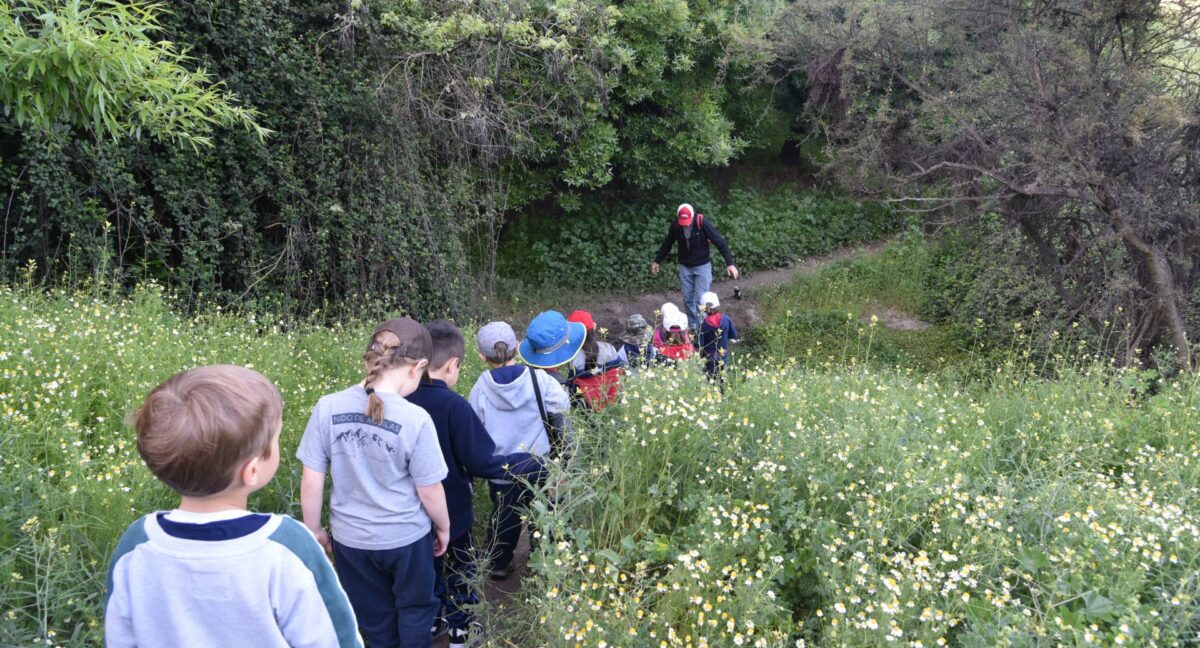
Colegio Nido de Águilas implemented a learning model, in the preschool stage, that consists of integrating nature as a central axis in the education of boys and girls. From the institution, they assure that since the launch of the initiative, "notable benefits have been observed, including the development of conflict resolution skills, greater teamwork, decreased levels of absenteeism due to illness, and increased enthusiasm."
In practice, this approach transforms the natural environment into an extension of the classroom. All through systematic outdoor learning experiences and the incorporation of natural elements where students observe, explore, ask questions, and face real challenges, guided by educators trained in outdoor learning. Being integrated into the curriculum, it not only promotes experiential learning but also strengthens key skills such as autonomy, critical thinking, self-regulation, and collaborative work, in a context where the connection with nature becomes an essential part of their formative process.
Carolina Correa, director of the preschool cycle and educator in Outdoor Learning, stated that "it is not about expanding extracurricular activities or taking children to the hills once a week. We see nature as an essential part of learning and we expand what we understand by classroom to form critical, creative people aware of their environment."
"The change has been impressive. We have seen children afraid of running or jumping transform into little adventurers. What they tell us most after field activities is that they feel 'calm,' something that is projected afterward in the classroom and at home, since their parents also notice it. This is extremely valuable in a world of technology and constant stimuli," Correa emphasizes.
The Valdivian rainforest
Colegio Claude Gay in Osorno also added nature to its learning approach to such an extent that last month they created their first Miyawaki pocket forest. On their website, the institution explained that it is an initiative that "seeks to promote biodiversity, strengthen environmental education, and generate new outdoor learning spaces through the planting of native species of the Valdivian Rainforest."
These are small areas of urban vegetation created through a reforestation method developed by Japanese botanist Akira Miyawaki. The technique consists of planting native species of high diversity and at high density to accelerate the development of a forest similar to natural ecosystems. These spaces, which can be installed on small plots, aim to increase biodiversity, capture carbon, mitigate heat islands, and improve the environmental quality of cities.
This initiative is joined by the recent installations of pocket forests. An example of this is the one launched by the Pontificia Universidad Católica at its San Joaquín Campus. All with the goal that both students and visitors lower their stress levels by connecting with nature and taking a calm breather amid all the stress of living in the Metropolitan Region.
Of native forests and sprouts
Brotario is a non-profit organization that works with rural schools to bring children closer to native flora and fauna. Its founder, Sofía Schmidt, explained to The Clinic that they first started with a program called Jardín Nativo and, as life would have it, she came to live in Puerto Varas and thus began working with rural schools in the area.
"We thought there was a great opportunity to work pedagogically around landscapes and native flora, in the long term, to create that awareness and that culture of wanting to care for what surrounds us," Schmidt comments.
Regarding why to create Brotario, she emphasizes that "we thought that the right to access nature constantly from formal education was very positive and very beneficial. So, our purpose is that hopefully all public schools in the country can have the opportunity to have a significant experience in nature and with native flora, which is part of our nature."
"We have not yet worked with large schools, only with rural ones. We have rural schools that have added it to their educational project. Contact with nature and the Jardín Nativo project is part of the school's identity. So, it is a very significant space during the year, as they have this project that has determined, for example, that they have an environmental certificate," she highlights.
They also provided consultancy to Fundación Cosmos, which manages the Maipo River wetland. "They have been caring for that space for several years and recently they were developing a survey of the native flora around the wetland." In essence, they wanted to be more than a field trip and become an educational experience for students.
"They asked us to design an activity that could link the school curriculum so that visits would be intentional. So we designed an activity that had classroom preparation, then the visit itself, and then a classroom closure as well. Being able to understand that the plant, for example, has a certain fruit that the bird can eat, or observing the bird's beak that is a certain way that allows it to eat such fruit," she indicated.
"It is our long-term purpose to be able to generate influence on education policies where nature plays such an important, beneficial, and decisive role for people's lives, that we think it should be included. Just as we have civic education or sex education, in certain periods of education there should be an incentive to go out into nature. To be able to connect with your territory. Clearly, the memory of having gone to the hills is surely much more significant, or memorable, or lasting, but perhaps that doesn't happen so much. We want our purpose, perhaps in the medium term, to influence that public policy," she reflects.
Source: The Clinic



Comments (0)
No comments yet. Be the first to comment!
Leave a comment