
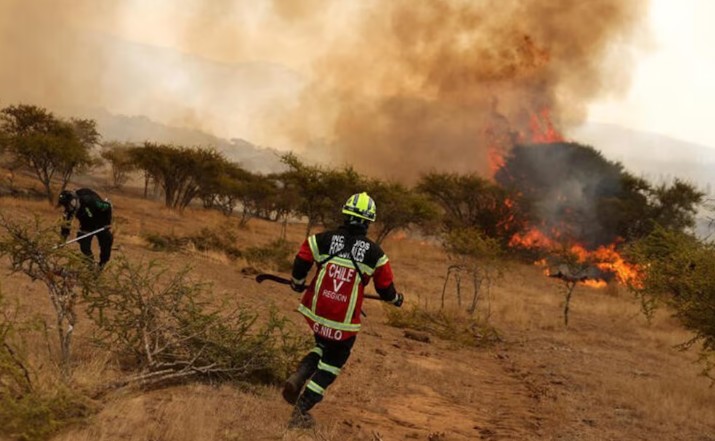
Colombia's request for international support from Chile and the United States to address the forest fires in Tolima has put the spotlight on the strategies these two countries have developed to prevent, detect, and respond to large-scale emergencies.
According to El Tiempo, the Colombian government turned to both countries because they have specialized experience and capabilities for managing forest fires. Their models combine investment, technology, response capacity, and community participation, although each has developed particular mechanisms to address this type of emergency.
Chile: prevention, early response, and community participation
According to the aforementioned media outlet, one of the main components of the Chilean model is the investment allocated to the prevention and response to forest fires.
In October of last year, the Government of Chile announced a budget of 160,803 million Chilean pesos to face the fire season. According to the information published by the newspaper, the resources allowed for a 27% increase in combat and prevention brigades, the incorporation of 15 additional aircraft, a 48% increase in firefighting personnel nationwide, and a 40% increase in resources allocated to prevention.
The Chilean strategy also incorporates technological tools to identify conditions that may favor the onset and spread of fire.
The country has an "Integrated Technological System for the Prevention and Combat of Forest Fires," which allows for identifying territories with the highest probability of spread and responding early.
How does the 'Red Button' work?
The "Red Button" analyzes variables such as temperature, wind speed, humidity, and dead fine fuel present in forest areas.
Based on this data, it establishes the probability of ignition. When this exceeds 70% and wind speed is greater than 20 kilometers per hour, patrols are carried out in the area and the use of agricultural machinery may be suspended.
The tool thus allows for identifying risk conditions before a fire occurs or when there is still the possibility of acting on factors that may favor its onset.
The second mechanism is the "Single Strike," created in 2017 after the forest fires that affected the central and southern zones of Chile.
This protocol establishes the deployment of the greatest possible number of resources from the moment a hotspot is detected, even when the affected area is less than one hectare.
The mechanism starts with an immediate response to the first signs of a fire, without waiting for it to reach a larger surface area.
A community network to report fires
The Chilean model also directly incorporates communities through the Community Prevention Network (RPC).
In 2025, the initiative brought together more than 3,520 trained residents across eight regions and had 494 committees. Its activities include space recovery, drills, courses, and training sessions.
One of the resources used by residents is Rawli, a bot that works through WhatsApp and allows reporting potential fires.
To make a report, residents must write #IF and attach photographs, videos, location, and texts about the emergency. The information is subsequently sent to 12 network centers, where it is verified and the necessary resources are coordinated.
According to the figures from the Community Prevention Network cited by El Tiempo, 53% of fire prevention measures are implemented by residents, while 2,696 people participate through Rawli.
Cristián Contreras, head of Management of the Community Prevention Network, explained to Curanilahue Televisión that the use of the system increased over time because communities identified its speed and ease for reporting emergencies.
These tools are joined by Waze Forestal, which allows establishing routes to respond to fires and uses information from thermal cameras, and Tero, an application developed to issue alarms.
The scheme also includes actions such as maintaining firebreak zones and eliminating combustible material in forests.
In the United States, the strategy to control forest fires includes technological tools such as cameras with artificial intelligence, community programs, and measures to protect homes in high-risk areas. - credit REUTERS/Daniel Cole
United States: technology, aerial capacity, and community protection
The American model is characterized by a combination of permanent investment, technology, aerial capacity, and measures to reduce community vulnerability.
The United States Forest Service and the Department of the Interior allocate resources to the prevention, research, and reduction of risks related to forest fires.
One of the main examples is found in California, where forest fires have caused some of the largest emergencies of this type in the United States.
According to the information provided, California allocates approximately 3.8 billion dollars per year to combat and prevent fires. The Department of Forestry and Fire Protection (CAL FIRE) works year-round on emergency response.
'Zone Zero': protection around homes
Among the measures applied in California are regulations aimed at homes located in high-risk areas.
The so-called "Zone Zero" establishes that vegetation must be kept clear within the first 1.5 meters around homes.
The measure is part of the provisions aimed at reducing conditions that may favor the impact on structures when a forest fire occurs.
The American model also includes Firewise USA, a program that brings together more than 3,000 recognized communities in the country.
The initiative promotes the participation of residents in risk reduction and preparation for forest fires.
ALERTCalifornia uses cameras and artificial intelligence
Technology constitutes another component of the American system.
The ALERTCalifornia project integrates more than 1,200 high-definition cameras and uses artificial intelligence algorithms capable of identifying smoke within minutes.
When signs of a potential fire are detected, the system can send alerts to the agencies responsible for responding to emergencies.
The United States Forest Service also uses artificial intelligence models fed with decades of meteorological information. These models are used to predict risk zones, optimize resource deployment, and support decision-making before, during, and after emergencies.
A specialized aerial fleet
Aerial capacity is another element that differentiates the American model.
Among the aircraft used to combat large fires are the DC-10 Very Large Air Tankers (VLAT), capable of dropping up to 9,400 gallons of retardant in a single operation.
This fleet is joined by C-130 Hercules equipped with the MAFFS system, medium-sized air tankers such as the BAe-146, MD-87, and RJ85, and the CL-415 Super Scoopers, amphibious aircraft designed to load water directly from lakes and reservoirs.
Source:Infobae


Comments (0)
No comments yet. Be the first to comment!
Leave a comment