

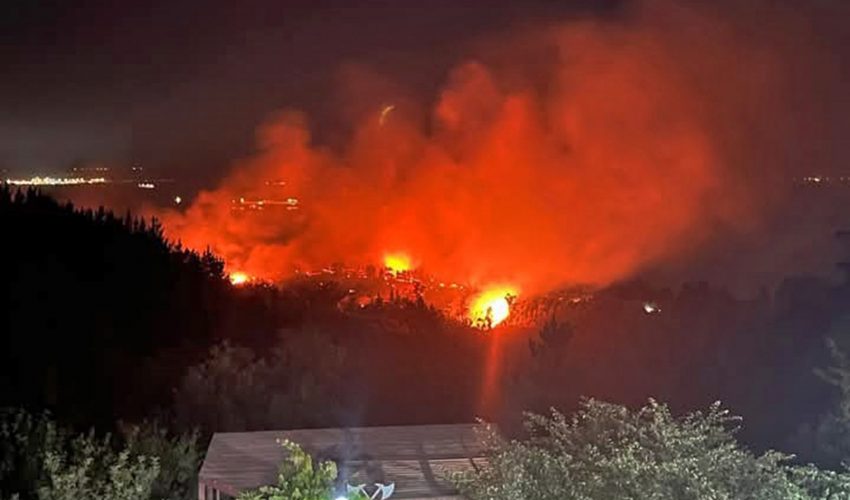
The Biobío Region is preparing for a new forest fire season under a scenario that authorities describe as complex. The National Forestry Corporation (Conaf) defined 90 priority communes nationwide to reinforce prevention.
The full list has not yet been released. However, Conaf's national director, Aída Baldini, advanced that among the prioritized communes in Biobío are Tomé, Hualqui, and Santa Bárbara. She also mentioned sectors of special concern, such as Trinitarias, in Concepción, affected by the fires earlier this year.
Among the main measures announced is the hiring of approximately 10,000 people through Conaf, mainly for weed clearing and creating firebreaks in urban-rural interface areas.
According to the dual minister of the Interior and Segegob, Claudio Alvarado, this deployment will focus on communes that "according to historical records are the most critical (…), and in these, support will be provided with this network of people who will help improve prevention."
Along the same lines, Baldini also confirmed that the municipalities have already received their respective prevention plans. "We are deploying preventive measures that had never been done in the country," she stated.
Prioritized sectors
Asked by Diario Concepción, the mayor of Hualqui, Ricardo Fuentes, noted that "the places where we frequently have fires are the Pichaco Sur sector, Rangel, and on some occasions Gomero. They are the most recurrent sectors," he explained.
Regarding prevention in the commune, the communal leader assured that the municipality has developed "plans to be able to face this upcoming period with high temperatures, which in one way or another put citizens at risk."
Added to this is the link with private forestry companies, which are also relied upon to support firefighting.
However, the mayor raised one of the main difficulties that municipalities face in this type of emergency, which is the availability of resources. "They will always be insufficient and will also depend on the magnitude of the forest fires we may have," he stated.
"We will always also be waiting for support from Conaf, on the one hand, and even private companies such as the forestry ones," he said.
The authority also recalled that the previous season was not especially challenging for the commune, although he stated that the scenario requires maintaining preparedness.
"We hope it won't be like that, we hope the risk decreases. Last year we were relatively calm and, therefore, now all that remains is to prepare," he concluded.
Conditions that could favor propagation
And the meteorological scenario is perhaps the element given greatest consideration in planning. The national director of the National Disaster Prevention and Response Service (Senapred), Alicia Cebrián, explained that technical agencies are observing the conditions that could occur during the coming months, in a context marked by the El Niño phenomenon.
According to projections provided by the Chilean Meteorological Directorate (DMC), during the September-November quarter, rainfall above normal could be recorded between Coquimbo and La Araucanía. For the authorities, this could generate an increase in available vegetation, and with it a greater amount of combustible material.
"If temperatures rise quickly, all that vegetation could eventually dry out and generate fuel or have present fuel that could favor the faster spread of fires," Cebrián explained.
The authority, however, was emphatic that these conditions do not necessarily mean there will be a greater occurrence of fires. In Chile, she maintained, 96.5% of these events originate from human action.
"We can prevent fires from occurring if we all commit to not engaging in negligent behaviors that cause them," she said.
In particular, authorities point to urban-rural interface areas, where the presence of vegetation, waste, and other combustible elements can make it easier for flames to quickly reach homes and inhabited areas.
Along these lines, Baldini called on property owners to keep their land clear, remove weeds, and avoid the accumulation of garbage and leaves. She also warned about the risk posed by embers (incandescent fragments transported by the wind during a fire), which can reach homes and find combustible material there.
Anticipated prevention toward 2027
Likewise, according to Cebrián, since August more than 30 institutions and organizations have been working on preparation for the summer season.
For the authority, one of the main focuses will be the temperatures that may be recorded between December and March, since in previous years the country has already experienced episodes with temperatures above 40 °C and prolonged heat waves, a situation that also generates direct impacts on the population.
In the case of Biobío, moreover, Senapred keeps under monitoring another potential threat associated with climatic conditions such as harmful algal blooms. Cebrián explained that, in years when the El Niño phenomenon has presented a particular intensity.
The head of the service, however, stressed that these are scenarios being monitored and not emergencies that will necessarily occur. "We are not saying this is going to happen," she clarified, but rather that technical agencies have identified conditions that could be present during the summer period.
On the other hand, in line with what Cebrián stated, in mid-August, Conaf opened 536 positions to reinforce its brigades in Biobío, including 314 brigade members, 85 chainsaw operators, 72 squad leaders, and 65 brigade leaders.
Additionally, the organization was moving forward in defining its Action Plan, which will determine the distribution of capabilities and resources according to the needs of each territory.
The private sector also anticipated a reinforcement of its resources. Forestal Arauco committed nearly US$60 million for prevention and firefighting, with more than 130 brigades, about one third of them with nighttime operations, in addition to four Black Hawk helicopters and multispectral cameras.
CMPC, meanwhile, announced an "active and proactive staffing" scheme to reduce response times, along with reinforcing surveillance through cameras, AI, and drones with day and night operation capability.
Finally, with the aim of finding out whether Penco — one of the communes most affected by the January fires — was also included among the priority ones, Diario Concepción consulted the municipality. However, by the close of this edition it was not possible to obtain a response.
Source:Diario Concepción





Comments (0)
No comments yet. Be the first to comment!
Leave a comment