

A circular economy project led by Codelco División Ventanas allowed 700 kilos of wood that were no longer in use at the operation's Temporary Non-Hazardous Waste Storage Center to be given a new purpose.
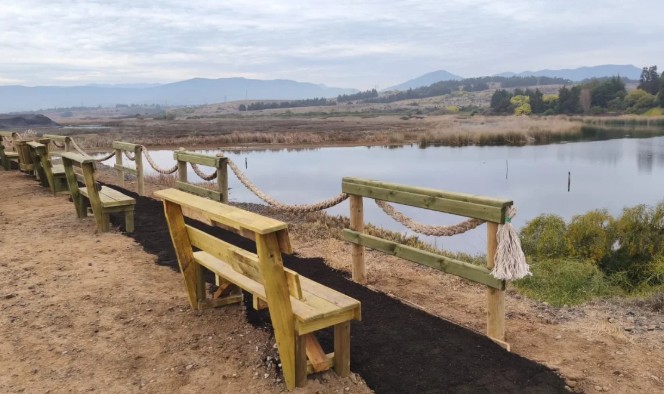
The materials were recovered and transformed into infrastructure for the Los Maitenes Campiche wetland, in the commune of Puchuncaví, with the purpose of improving access and stay conditions for students, community organizations, and visitors who come to the site to carry out environmental education and wildlife observation activities.
The intervention included the installation of six benches, six protective railings, and two waste containers, distributed at strategic points throughout the wetland.
The project also incorporated a local development component, since the manufacturing and assembly of the structures was carried out by SEPEVEN, a company made up of members of the Ventanas Fishermen's Union.
In this way, the initiative made it possible to link the recovery of industrial waste with local suppliers, turning wood that had lost its original use into infrastructure destined for a space of environmental value for the community.
Ecosystem protection
In addition to providing greater safety and comfort to those who visit the wetland, the new structures fulfill an environmental protection function. The railings make it possible to delimit circulation areas and help prevent people from entering sensitive areas, particularly those used by resident and migratory birds for feeding, resting, and nesting.
Codelco highlighted that the initiative is part of División Ventanas' sustainability commitments for 2026, particularly in matters of circular economy, waste valorization, and territorial integration.
The director of Environment and Territory of Codelco División Ventanas, María Teresa Cortés, valued the work carried out together with local organizations.
"We are very happy to have developed this initiative together with the Ventanas Fishermen's Union, because it reflects our commitment to sustainability and the development of the territory."
The executive added that the reuse of wood and the participation of local suppliers made it possible to improve the wetland's infrastructure and make it easier for more people to learn about and value its biodiversity and environmental heritage.
The project thus reflects a model in which waste from an industrial operation can be reincorporated into a new cycle of use, simultaneously generating environmental, social, and economic benefits for the territory.


Comments (0)
No comments yet. Be the first to comment!
Leave a comment