

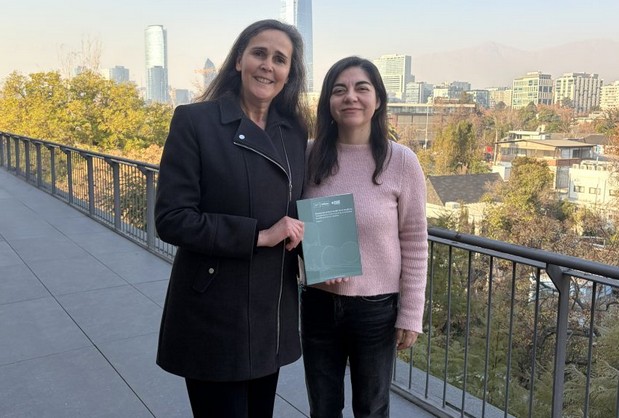
Wood is once again positioning itself as one of the materials with the greatest potential for more sustainable construction. However, fully harnessing its advantages requires understanding how it behaves over time, under environmental conditions, and against organisms that can deteriorate it. With this goal in mind, the Collection on Durability and Preservation of Wood in Construction was created, an interdisciplinary initiative of UC (led by CENAMAD, together with CIM UC) that brings together and updates the available scientific knowledge on this material.
The first volume of the collection included the participation of professors from the Faculty of Agronomy and Natural Systems UC, Paulina Fernández and Priscila Moraga. Titled Natural durability of wood: Properties, classification, and risk assessment, the volume provides the scientific foundations for understanding how the biological and structural characteristics of wood determine its performance against different deterioration agents.
The publication is part of a three-volume work that addresses wood durability from its molecular structure to its application in construction, integrating knowledge from engineering, architecture, forest sciences, and biology.
In this first volume, Professor Paulina Fernández developed the content related to the anatomy, formation, and physical-mechanical properties of wood, as well as explaining how factors such as forestry practices and climatic conditions influence its development.
"Our participation was to provide the foundations on anatomy, structure, and physical-mechanical properties of wood that serve as the basis for the following volumes, where preservation and design topics are directly addressed," explains the academic.
Meanwhile, Professor Priscila Moraga was in charge of the chapters dedicated to wood biodeterioration, describing the main microorganisms and xylophagous organisms that affect this material, as well as the different levels of risk they represent for structures.
"I mainly participated by identifying the agents that generate different levels of risk for wood, from fungi that produce superficial stains to decay fungi and xylophagous organisms such as termites. Understanding these processes allows for better decision-making in the field of construction and material preservation," she notes.
One of the main contributions of the collection is concentrating in a single work knowledge that until now was scattered across technical and scientific publications, also incorporating the most recent advances on wood durability and its behavior in different usage scenarios.
For the co-authors, the challenge was not only to systematize decades of research, but also to bring this knowledge closer to professionals, researchers, and students linked to wood design and construction.
"We concentrated a large amount of information about wood in three volumes in an accessible format, which allows understanding this material from its cellular origin to its use in construction. We hope it contributes to disseminating this knowledge and encourages greater use of wood as a construction material," concludes Paulina Fernández.





Comments (0)
No comments yet. Be the first to comment!
Leave a comment