

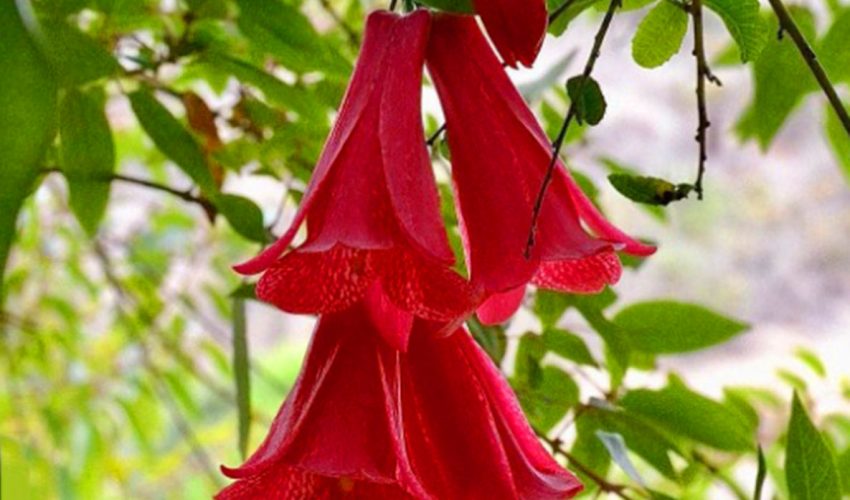
During September, the copihue is one of the species that takes on special prominence as a national symbol. This vine, recognized for its generally red flowers, is distributed in the Biobío Region mainly in coastal areas.
This was stated by the Agricultural and Livestock Service (SAG) of Biobío. "It is a species native to Chile that grows abundantly naturally between the Biobío and Los Lagos regions. It is also found naturally in the Valparaíso Region and in the relict forest of Fray Jorge, in the Coquimbo Region," they said.
Likewise, forestry engineer Dámaso Saavedra explained that the coastal area of the region is where there are the most copihues. "It is a plant that grew naturally beneath the native forest, but now we also find it among forestry plantations," he said.
The specialist detailed that the transformation of the territory, as a result of the replacement of native forest areas by plantations, allowed the copihue to adapt to these new environments. "It can grow there in plantations and native forest, but ideally in the small ravines that people have near their fields," Saavedra commented.
Among the communes where it can be found, he mentioned Santa Juana, Tomé, Penco, Talcahuano and Concepción, as well as other coastal and mountain areas of the region.
Natural conditions
Humidity is one of the fundamental factors for the development of this species. According to Saavedra, the intervention of forests can directly affect the conditions the copihue needs to grow. "The copihue grows very well in humid areas and is being affected by the felling of native forests or also of plantations," he explained.
To this is added climate change and rising temperatures. According to the forestry engineer, its effects on the species are not yet fully known, although he warned that specimens could begin to decline and become increasingly restricted to sectors where there is greater water availability.
"Most likely, the populations that are abundant in some communes will begin to decline. Then we will find it only in the ravines where there are watercourses," he stated.
Protection and conservation
The extraction of the national flower is regulated by Decree 129 of the Ministry of Agriculture, which prohibits the uprooting, cutting, transport and commercialization of copihue plants and flowers.
On the other hand, the regulations allow the transport, possession and commercialization of specimens from nurseries or plant breeding sites registered with the SAG. In the case of natural copihue groves, the commercialization of their flowers is permitted upon prior registration with the Agricultural and Livestock Service.
This was confirmed by Alejandra Retamal, owner of the Agua Tendida Copihue Nursery, in Rafael (Tomé). There they dedicate themselves exclusively to the reproduction and commercialization of the copihue.
"We concern ourselves only with reproducing and selling our national flower, which is the copihue. We have been established since 2018, with authorization from the SAG, with whom we have permanent communication," Retamal expressed.
For Dámaso Saavedra, the protection of the specimens that remain in the forests is especially relevant, also considering their status as natural heritage and national flower.
Saavedra explained that one of the difficulties for its conservation is that people may come across flowering specimens during their walks through natural areas and decide to cut them without knowing the time the plant requires to reproduce. "A copihue, in order to bloom, bear fruit and be able to reproduce, takes around seven years and people don't know that," he said.
For this reason, the specialists mentioned that during these National Holidays the call is to observe the national flower in its habitat and avoid its extraction, especially of those specimens that grow naturally in forests and ravines of the region.
Source:Diario Concepción





Comments (0)
No comments yet. Be the first to comment!
Leave a comment