

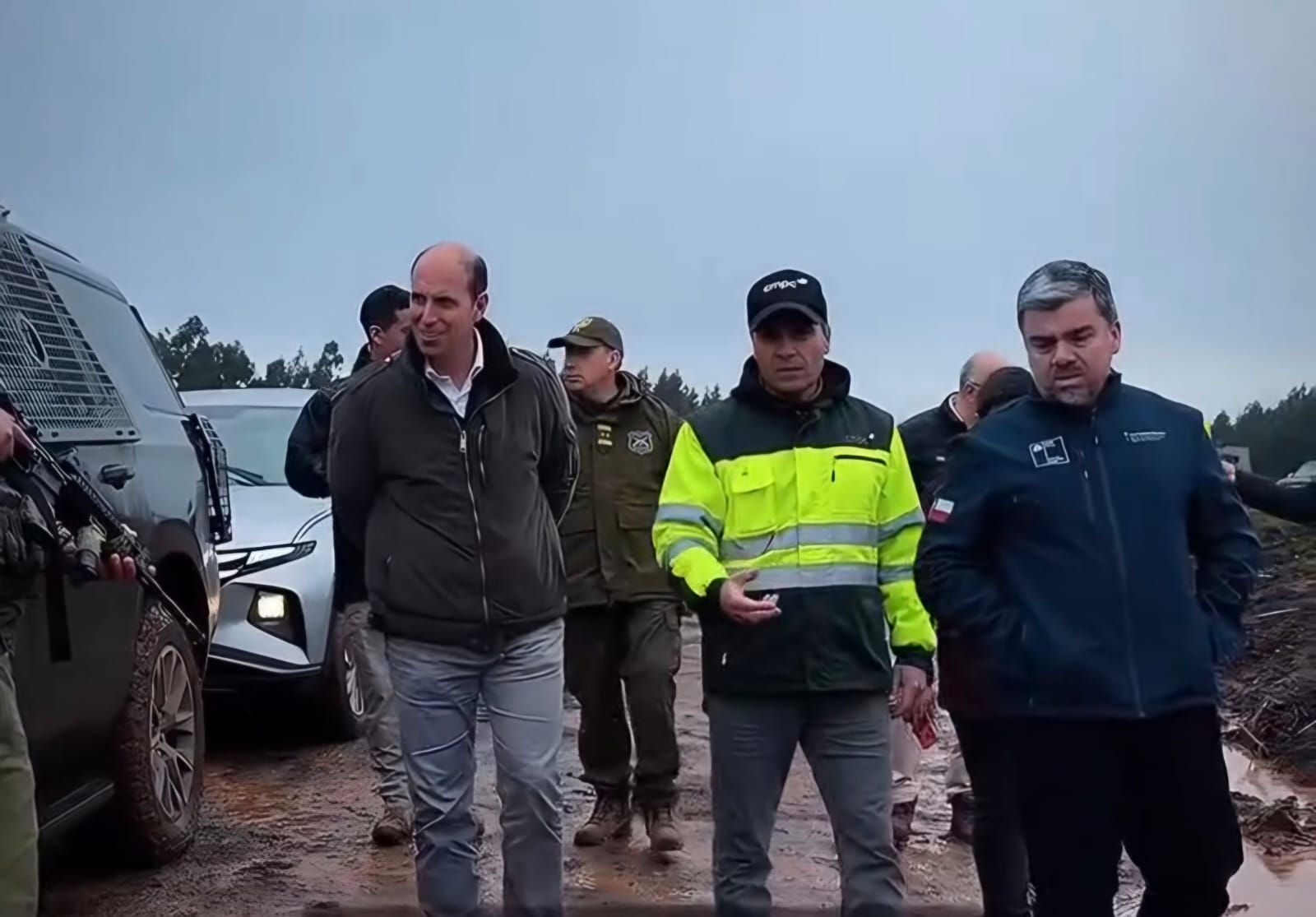
The visit of the Minister of Security, Martín Arrau, to a forestry operation in the commune of Angol, in the La Araucanía Region, was valued by Acoforag as a positive sign, although the organization called on the authority to also learn about the reality faced by forestry contractors in the areas where the activity has not yet managed to return to normal.
During his visit, Arrau highlighted the recovery of forestry activity in sectors where, according to him, it had not been possible to operate for nearly seven years.
What you saw there is an exception"
From Acoforag, its manager, René Muñoz, valued that the Secretary of State traveled to an operation and was able to directly learn about the work carried out by contractor companies, but he stated that the situation observed in Angol does not represent the reality of the entire sector.
"We have seen on social media the visit of the Minister of Security to a forestry operation in the commune of Angol. We value that the authority is present on the ground and directly learns about the reality of a forestry operation, but we want to point out that what he was able to observe there does not represent the reality that forestry contractors in the Macrozona Sur are experiencing today," he stated.
Muñoz maintained that forestry contractors have faced situations of violence and insecurity for decades that have affected both the continuity of operations and their workers.
"We forestry contractors have suffered for 30 years from the abandonment of the State, violence, insecurity and mistreatment of our workers. That is why we make a public call to the minister to receive us so that we can tell him directly what is happening to us," he said.
The manager of Acoforag also raised the need to address the situation of sectors where forestry activity continues to be restricted.
"There are still around 100,000 hectares seized by terrorist groups in the Macrozona Sur, particularly in the provinces of Arauco and Malleco, where we cannot carry out our activity," he stated.
Muñoz emphasized that the recovery observed in Angol constitutes a positive example, but that there remain territories where companies cannot work normally.
"What you saw today at that operation is a reality, but it is an exception. In the coastal area of these provinces, it is not possible to work normally. There is no formal work at the levels there should be and economic activity has decreased. Our workers face a situation of permanent insecurity," he maintained.
Call for a meeting
Acoforag reiterated its willingness to participate in a dialogue instance with the Ministry of Security to address the necessary conditions to recover forestry activity in the affected territories.
"That is what we want to address. If this situation continues, our activity will continue to reduce its participation in the economy and, especially, in the regional economies of the Macrozona Sur," Muñoz stated.
Finally, the leader made a direct call to the minister to meet with the representatives of the forestry contractors.
"Minister, receive us. Let's talk, let's learn what the State's plans are and let's also see how we can contribute to advancing the recovery and normalization of forestry activity in the Macrozona Sur," he concluded.
During the tour, Arrau stated that "we are in the commune of Angol, in Malleco, and we are very happy to be at a forestry operation. You may wonder what this has to do with security. In this area it was not possible to operate or work for nearly seven years. Today, on the other hand, there are local contractor companies and workers from other areas carrying out this activity as noble as the forestry sector," he stated.
The authority linked this recovery to the evolution of security indicators and the work carried out by Carabineros, the Investigative Police, the Army and the Public Prosecutor's Office.
"This is very important. Not only because of security, which shows good figures this year thanks to the work of Carabineros, the Investigative Police, the Chilean Army and the Public Prosecutor's Office, but also because the private sector is beginning to resume its activity in places where that seemed very distant," he maintained.
The minister added that the recovery of private activity, employment and investment must continue to be encouraged in the Macrozona Sur, along with generating security conditions that allow confidence to be restored.
"That activity, that employment, that work and that investment are what we must continue to encourage in the Macrozona Sur. This requires protection and security, but also that the private sector restores its confidence," he stated.



Comments (0)
No comments yet. Be the first to comment!
Leave a comment