

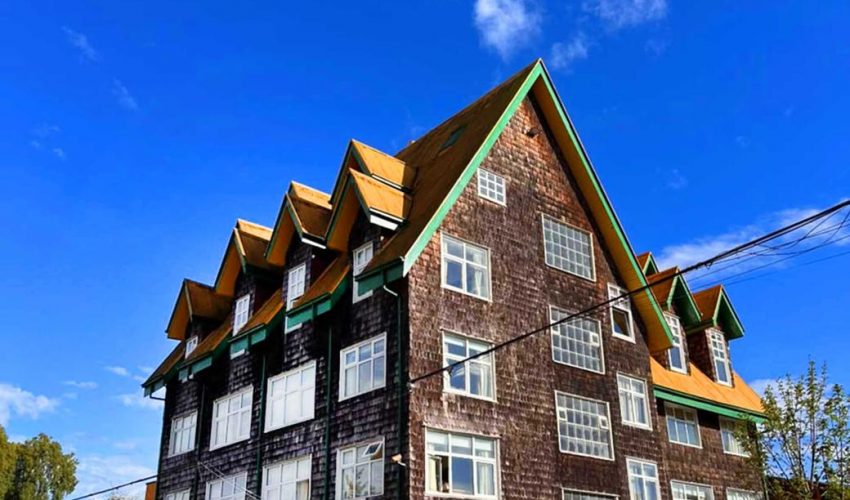
In the heart of Puerto Varas stands an architectural and historical work without precedent: the tallest wooden building in southern Chile. Standing seven stories tall, clad in recycled larch shingles and raised using traditional techniques of Chiloé's boat carpentry, the El Greco Museum Hotel stands out not only for its tourism and cultural proposal, but also for establishing itself as a pioneering example of circular economy and structural sustainability in the country.
The history of this building began 16 years ago, at a time when the concepts of large-scale recycling and material circularity were not yet part of public debate. Its founder, Alfredo Soto Vidal —who studied Business Administration at the Universidad de Concepción in the 1970s and today, at nearly eight decades of life, leads this initiative employing more than 50 people— decided to rescue the demolition wood from the old German School of Puerto Varas. Instead of discarding beams, planks and shingles more than 140 years old, he meticulously recovered them to give them a new life cycle in a large-scale structure.
"This is the tallest building constructed in wood in southern Chile." Recycled larch shingles and Chiloé technique were used. It has seven floors, assures Alfredo Soto, who built the hotel with recycled wood when, 16 years ago, no one talked about circular economy or recycling, using shingles from the waste of the German School of Puerto Varas. The building included a construction formula based on the assembly widely used in Chiloé, which uses no nails, screws or bolts; this technique is called "cajón y espiga" (mortise and tenon).
In this regard, Alfredo Soto states that: "wooden dowels were used, as they build in Chiloé, typical of the Island's traditional carpentry. The fishermen of the area build their boats with the same technique. Therefore, this formula that is born in the boat's frame was used, then it passes to the construction of houses and we also used it to raise the El Greco museum hotel."
The El Greco hotel is an establishment with a marked cultural accent. Every month local and national artists come to present their works with extraordinary public success; in parallel, painting exhibitions of the most varied techniques and styles are presented, which are available to guests and the Puerto Varas community.
The establishment is called a hotel-museum due to the great variety of artistic and heritage elements that adorn its spaces. It has 5 pianos, collections of more than 200 paintings, sculptures, 20 record players, accordions, countless clocks, old agricultural tools, production elements, measuring instruments, typewriters, the library inherited from the school, glassware and antique furniture.
About the process, Alfredo recalls that: "it took us about three years to build the building. One, as an art teacher, tries to think that all those things that at a given moment do not have much importance, but they do have it because along with the memories behind them, the main reason was how those woods that by now would be 140 years old would be recovered. Recovering such old woods and giving them a new meaning, because before they housed the students and today they continue to house the hotel's guests. All this has a very important meaning because deep down I have always worked with people. So when tourists come and talk with them, they tell their own stories. Therefore, a bond is established with visitors through the exchange that occurs. And when my students come to the hotel they tell me 'teacher, if this door could speak.' Or the desks that became part of the bedside tables in the bedrooms. All that becomes memories and I believe tourism has a lot of that image of romance for memory, longing, nostalgia."
"Part of the resistance test —established by construction regulations— is that the materials to be used guarantee resistance. One of the professionals —who achieved the purpose that certified the wood's resistance to be able to raise the building— was an engineer who worked in the construction of bridges on the Carretera Austral. And he empirically verified that the wood to be used was a highly resistant material."
This technique allows "wooden buildings, and especially native and recycled wood, of seven floors like ours to have an almost anti-seismic flexibility because what noble woods like larch allow is to provide the building with the tolerance to withstand seismic movement."
A technical and anti-seismic challenge
Raising a seven-story structure entirely in wood was a top-level technical challenge. To guarantee the resistance required by construction regulations, the evaluation of specialized professionals was relied upon, including an engineer with experience in bridge construction on the Carretera Austral, who empirically verified the exceptional physical-mechanical properties of the reused material.
One of the most outstanding aspects of the building is its construction method. The work dispensed with traditional metal joints such as nails, screws or bolts, using instead the ancestral "cajón y espiga" system with dowels of the same native wood. This technique, inherited from the traditional carpentry of Chiloé and originally used by fishermen to build boats and by the master assemblers of the Chiloé churches, gives the building optimal flexibility and anti-seismic behavior. The nobility of larch and long-lived native woods allows damping vibrations and tolerating seismic movements better than many rigid materials.
Dr. Juan Pedro Elissetche, academic of the Faculty of Forest Sciences of the Universidad de Concepción and member of highlights the unique value of this work and maintains that today it is possible to raise wooden buildings that can become more resistant than those of solid materials. As a reference, he mentions the Cross Laminated Timber (CLT) technique, a structural system formed by layers of wood arranged in crossed directions that provides great stability, resistance and precision.
However, Dr. Elissetche clarifies the difference with the Puerto Varas work: "With this we can make walls, floors, slabs and that is currently being widely used —this CLT— for buildings because this gives it a structural resistance almost similar to or better than concrete. Wood construction has a much lower carbon footprint. So the CLT technique is widely used. Now, if we go to the building in question (El Greco Hotel) which is not made with CLT, but is made with recycled wooden beams, it is very important to consider that first it is always said that I have a wooden building and people demolish it. But many times that wood does not have a reuse for construction purposes, but has other purposes: furniture or they simply burn that wood. In this building, what is most likely is that since it is high-value wood in terms of mechanical performance —if it is larch with cypress components— which in addition to having very good physical-mechanical resistance has great durability against damage by insects or fungi. What was done was to recover the beams, the shingles, planks perhaps from the walls and with that they rebuilt and used a large part to make the structure of this building. So what is novel and good about this, deep down the German School of Puerto Varas wood was given a longer useful life and continued to have a low carbon footprint and continued to stock carbon. For example: if I had completely eliminated that wood I would have had to use new wood to make the hotel, but that was not the case. So, part of that wood was reused, which is what is now sought with having a construction system that is increasingly circular. Here we are seeing a complete example of circularity of what is called demolition wood because it continues to be used. There is a specific useful life and it is projected over time. Therefore, it is not necessary to cut new trees to continue building."
Likewise, the academic emphasizes that "having a building of this magnitude with recycled wood and solid wood of large dimensions is super novel." He adds that this wood, coming from "very long-lived trees, had a much more resistant wood than today it is difficult to find because those long-lived trees no longer exist and with a heartwood formation that confers those properties."
At the time of demolishing the original structure, explains the specialist, "they realized when evaluating the wood that they had elements of large dimensions and without structural damage and for that reason they took them and reused them and also used these construction systems that are used for Chiloé boats which are these joints that are very similar, being a much more distant place than those used by the Japanese, they are joints without nails and now these joints are used in the churches, for example, which sit on rocks, on stones. That also makes it very interesting that it has no nail joints and most likely has, for example, wooden dowels and of the same wood with which it is built. So, additionally a cleaner construction is noticeable."
A space where memory and art converge
Beyond its engineering and ecological architecture value, the El Greco Hotel defines itself as an establishment with a strong cultural and romantic accent. Its creator conceived each space not only as a refuge for the guest, but as a container of memories and living memory. Old school desks converted into bedside tables or doors that housed students and today receive tourists are part of a narrative that fosters dialogue and nostalgia.
The "hotel-museum" label responds to the vast heritage collection that adorns its corners: it has 5 pianos, more than 200 paintings of varied styles and techniques, sculptures, 20 record players, accordions, clocks, typewriters, tools from the southern countryside, the library inherited from the old school and antique glassware. Likewise, the space functions as a cultural dynamizer in the area, hosting monthly painting exhibitions, concerts and artistic launches open both to guests and to the entire Puerto Varas community.
Source:Diario Concepción



Comments (0)
No comments yet. Be the first to comment!
Leave a comment