
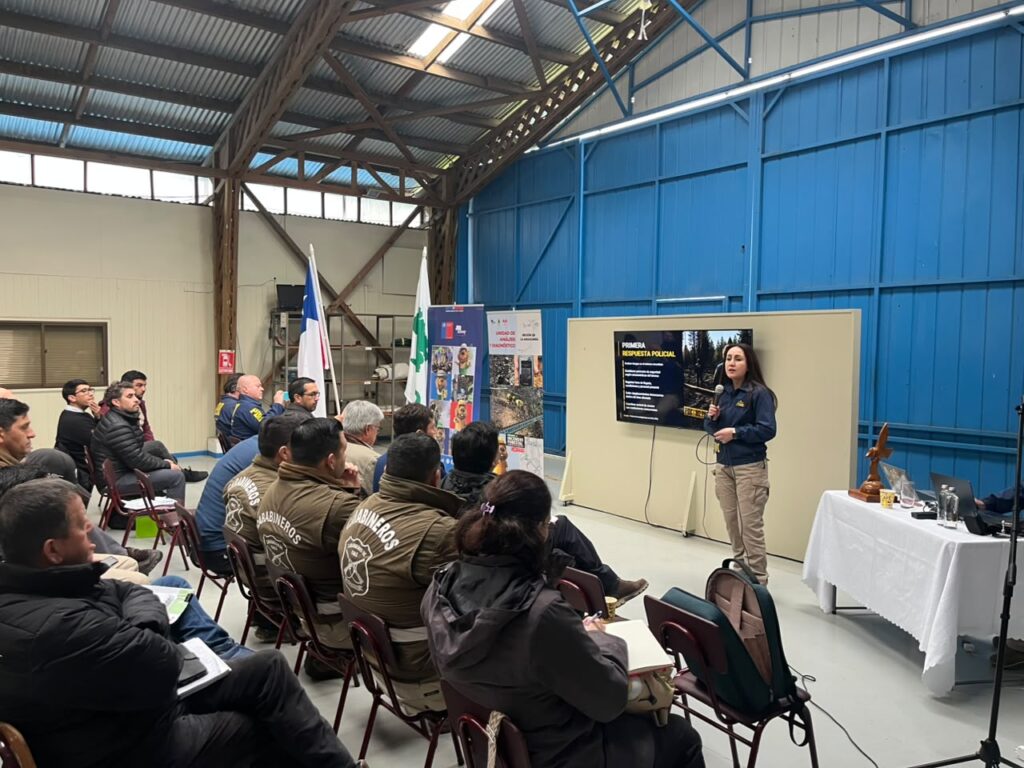
Strengthening coordination among the institutions involved in forest fire investigation and improving capacities to determine their origin and causality was the objective of workshop P-140, Forest Fire Cause Estimation Processes, held in the town of Labranza, at the facilities of Helicópteros del Pacífico.
The session was jointly organized by CORMA and CONAF, with the participation of the Investigative Police, Carabineros, Fire Department, Prosecutor's Office, and representatives of forestry companies. The program included technical presentations by CONAF on cause estimation and by the PDI, through the Investigative Brigade for Crimes against the Environment and Cultural Heritage (BIDEMA), on crime scene protection and interinstitutional coordination.
CONAF regional director Héctor Tillería explained, "our intention, through our diagnosis and causes unit, is to be able to provide the necessary tools to safeguard the evidence of causality at the crime scene and, mainly, the security measures so that the investigations generated through the Prosecutor's Office achieve a good result."
Tillería also highlighted the importance of strengthening coordinated work with the police and Fire Department, particularly to prevent elements that may later be relevant to an investigation from being altered during firefighting efforts. "We must strengthen the bonds of knowledge, properly identify the basic principles of the crime scene and its safeguards, not alter it, not take samples or modify them as a result of forest firefighting tools themselves," he stated.
The head of the Brigade for Crimes against the Environment and Cultural Heritage of the PDI in Temuco, Rodrigo Espinoza, valued the instance as an opportunity for the different institutions to learn about their respective roles in forest fire investigation. "It is an instance to get to know each other, which allows each of the institutions to have some important role within forest fire investigation," he stated.
The officer explained that the PDI's participation was mainly focused on the protection that must exist at crime scenes, in order to subsequently facilitate an adequate investigation of the crime. "The good thing about this type of activity is that we can learn about different perspectives from different people who are also within the ecosystem that allows us to conduct the investigation," he added.
From the forestry sector, the president of CORMA for La Araucanía, Los Ríos, and Los Lagos, Antonio Soto, highlighted that determining causes constitutes a fundamental stage that complements prevention and firefighting actions. "We always concern ourselves with fire prevention, then firefighting, but it is also very important to be able to determine the cause and origin of these forest fires," he stated.
Soto noted that the work carried out in recent years has made it possible to make progress in determining causes, although he raised the need to continue strengthening these capacities, particularly in a region where historically a significant percentage of undetermined causes has been recorded.
"We must intensify this, and that is our main concern, mainly as CORMA, with our forestry companies, and as CONAF as well, to be able to determine and reach a causality to be able to verify and see who is responsible for this fire," he affirmed.
Workshop P-140 is part of the actions aimed at strengthening technical knowledge and coordination among the different actors involved before, during, and after a forest fire. In this case, the focus was placed on a key stage: properly preserving the crime scene so that the evidence can subsequently be used in investigative processes.



Comments (0)
No comments yet. Be the first to comment!
Leave a comment