

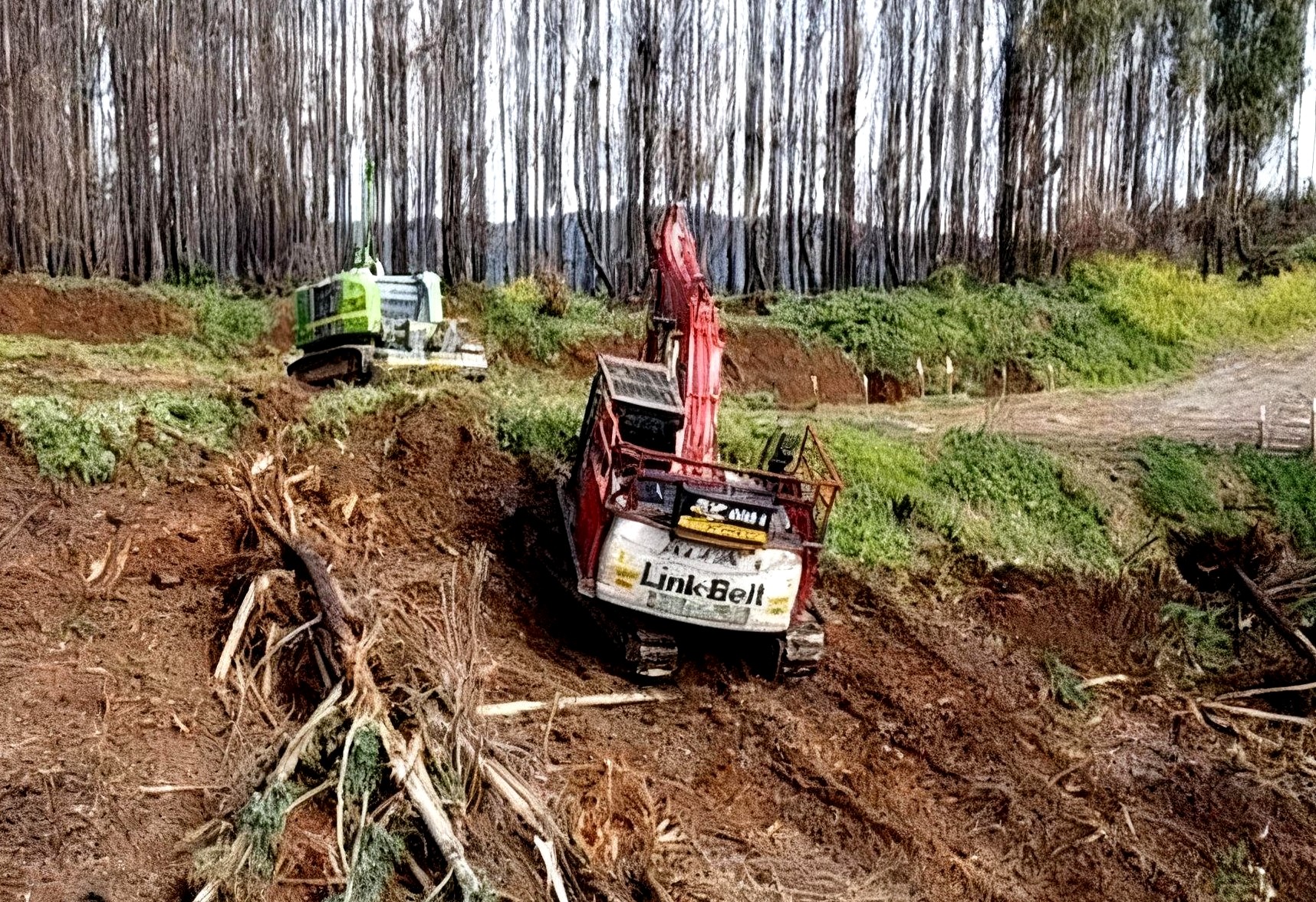
Forestry work has undergone a major transformation. The incorporation of specialized machinery, winch-assisted systems and monitoring tools makes it possible to tackle operations on steep terrain with greater control, efficiency and safety.
For Joaquín Piedra, general manager of Santa Rosario Maquinarias, this change has been especially relevant in areas where terrain characteristics make operations difficult. "Work in our sector has changed enormously. Before, there was a lot of manual work and conventional machinery. Today, with specialized equipment and winch-assisted systems, we can mechanize steep terrain with much more safety and efficiency," he explains.
Stability and traction
After harvesting, the land is left with residues, stumps and irregular surfaces. Under these conditions, a conventional excavator can face limitations in stability and traction. The winch makes it possible to control the machine's movement by means of a cable connected to an anchor point.
"Under this scenario, on steep slopes the machine needs greater stability and traction. There the winch allows us to work in a much more controlled and safe way," notes Piedra.
The system consists of a winch unit connected by a cable to the excavator, providing assistance during movement on the slope. "The system maintains controlled assistance while the machine works on the slope. That improves stability and makes it possible to reach places where a conventional excavator would have many more limitations," he adds.
The operation requires specialized operators, training and planning suited to each terrain. "They have to know the excavator, the winch, the machine's behavior on slopes and all safety procedures very well. Experience is essential," he states.
The goal, moreover, is not simply to clear. Land preparation seeks to prepare the surfaces for a new productive stage. "The idea is not to clear for the sake of clearing. We have to leave the land prepared for the next planting: organize residues, make the brush strips and clear the planting lines, trying to intervene in the soil only where necessary," he explains.
Evolution and productivity
For Piedra, the incorporation of this technology also has a direct impact on safety. "For me, the most important change has been safety. Today we can mechanize work that previously exposed people much more. But always accompanied by training, maintenance, cable inspection and good planning of the operation."
Technological evolution also aims to improve productivity. "These teams require a significant investment, but they make it possible to produce more, reduce times and work land that was previously very difficult. In the end, we look at the complete result: how much it costs to prepare a hectare, how much we produce and with what level of safety and quality we deliver it," he states.
The general manager projects growing mechanization in the sector. "I believe the forestry future is heading toward ever-greater mechanization. We are going to have more technology, better equipment and more information to make decisions. The challenge is to be more productive, but also safer and more sustainable."
Technology applied to supervision is added to this evolution. The company has incorporated high-definition cameras, telemetry, GPS and satellite connectivity for its work units on steep terrain. The cameras make it possible to transmit images in real time to the office, while other systems allow monitoring of operational parameters, location and equipment conditions.
Operators also highlight this change. Patricio Montecinos, with seven years at the company, maintains that winter conditions represent one of the difficulties, due to humidity, mud and obstacles. At the same time, he emphasizes that "safety always comes first," along with checking cable conditions every 10 hours.
Jairo Valenzuela, with 15 years in the forestry sector and nearly three in steep-terrain operations, highlights the technological contribution. The use of Starlink, cameras, GPS and information transmitted in real time makes it possible to maintain communication with the company and better control operations.
José Venegas, an operator with almost five years of experience in assisted work and nearly two decades in the forestry sector, identifies slopes and terrain characteristics as one of the main difficulties and values the tools that have contributed to improving safety.
It cannot be compromised
Solange Medina, SSO Alfa 1 leader at Santa Rosario, summarizes the approach: "We cannot compromise on safety." Prevention is an integral part of the operation and requires planning, procedures and standards. Preventive programs and monthly training are added to this to keep operators up to date.
Thus, machinery, connectivity, training and experience converge in one task: preparing complex land while reducing worker exposure and leaving surfaces in condition to plant again.
From Acoforag, this evolution reflects a task that combines productivity and responsibility: "Assisted land preparation makes it possible to move toward safer, more technified forestry activity prepared for reforestation, always with emphasis on safety."



Comments (0)
No comments yet. Be the first to comment!
Leave a comment