

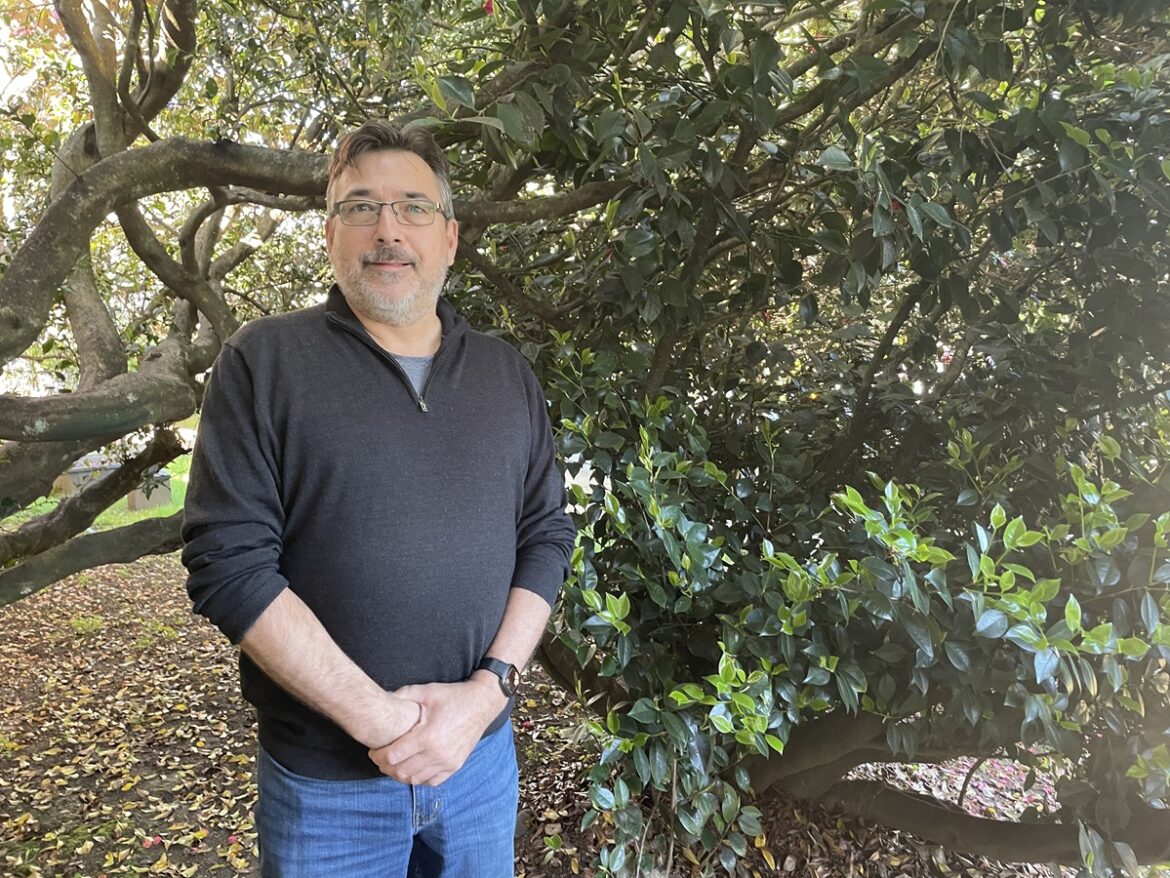
"Planting new ideas in forest landscapes of uncertainty and rapid change" was the talk given by one of the world's leading researchers in forest ecology and silviculture, Dr. Christian Messier, professor at the University of Quebec, in Canada. The activity took place in the Paraninfo hall at the Universidad Austral de Chile and was organized by the academic from the Faculty of Forest Sciences and Natural Resources, Pablo Donoso Hiriart.
"The main message I am trying to send is that today we should replace, almost entirely, the way we manage forests, not only those from which we extract goods, but also those in conservation areas. This is because the forest is being threatened by many factors: climate change, insects, pests, diseases, droughts and fires," the researcher noted.
For the scientist, it is necessary to keep in mind that the species found in a territory are very likely not adapted to the new conditions present on the planet and that are changing very rapidly. Therefore he emphasizes that "we have to diversify with new species and this implies doing so even in areas destined for biodiversity conservation. It is very important to rethink both forest management and conservation areas."
Why diversify?
In Canada the professor and his team are developing a project where they analyze the vulnerability of species in relation to climate and pests. "We use different approaches that are based on what we call the functional traits of species and that refers to how they respond to disturbances and how this affects ecosystems," he indicated. The idea of this initiative is to have species that can respond differently to almost any type of disturbance and this implies mixing trees that possess different functions and responses. In this way a forest resilient to almost any threat is obtained.
"I often make the comparison with a pension fund: you diversify the money you have in different areas so that no matter what happens in the future you will still obtain gains. It is the same with the forest, you will guarantee a forest that will be useful for the provision of water, wood, biodiversity and recreation," Messier commented.
For example, it is likely that some species from the southern zone will not adapt to the new conditions and in that case other species from the central or northern part of the country could be used. One can even think of exotic species, from other countries or regions.
Dr. Messier emphasized that the studies are clear: "the more species there are, the more resilient the forest is."
Background on the speaker
Professor Messier is a forest engineer from the University of Laval and holds a Doctorate in Forest Sciences from the University of British Columbia, both in Canada. Over the last two decades he has worked to promote the diversification of forest plantations. One of his highest-impact books is "A Critique of Silviculture. Managing for Complexity," written together with Klaus Puettmann and David Coates (2009).




Comments (0)
No comments yet. Be the first to comment!
Leave a comment