

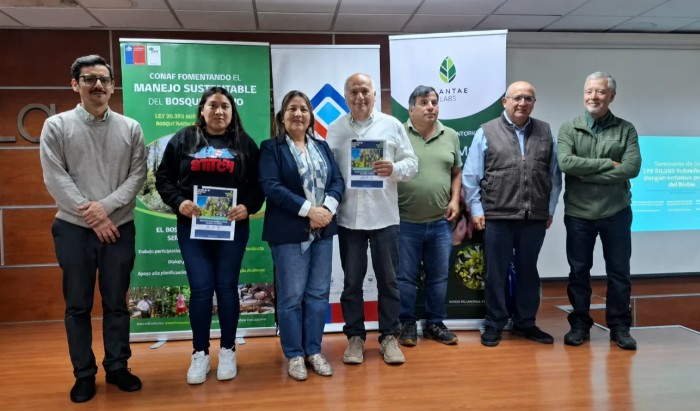
The Biobío Region will have the first Clean Production Agreement (APL) aimed at the sustainable management of native forests, an initiative promoted by Corfo's Sustainability and Climate Change Agency (ASCC), regional authorities, and Plantae Labs, representing a consortium of companies and forest owners.
The agreement seeks to promote a productive model that makes it possible to reconcile the conservation and recovery of native ecosystems with the development of sustainable economic activities. To this end, it contemplates the implementation of Management Plans under Forest Management Criteria (PMCOF), in accordance with Law No. 20,283, as well as training and technical and commercial support for participants.
One of the pillars of the agreement will be to diversify business opportunities associated with native forests. Among the alternatives considered are the production of high-value timber, non-timber forest products such as quillay, hazelnuts, seeds, and honey, as well as ecosystem services and special-interest tourism.
The initiative will also incorporate traceability tools to certify the sustainable origin of products and will facilitate access to promotion instruments. These measures aim to strengthen the economic viability of forestry activities and expand the sources of income for owners and companies.
Conservation challenges
Biobío has more than 615,000 hectares of native forest and another 53,000 hectares of mixed forest. However, over the past decade, 17,178 hectares recorded a critical loss of vegetation vigor, equivalent to 2.56% of the area considered.
In addition to this scenario, 57% of the lands belonging to consortium owners do not have current management plans. Among the main difficulties are preparation costs, the complexity of procedures, and the lack of specialized technical assistance.
Faced with these challenges, the APL will promote the strengthening of owners' capacities to move toward planned and sustainable management of their properties, facilitating the legal and responsible use of forest resources.
Adaptation to climate change
The agreement also considers actions to increase the resilience of forests to climate change, through workshops on climate vulnerability and forest fire prevention.
The initiative has the support of organizations such as CONAF, the Ministry of the Environment, the Biodiversity and Protected Areas Service (SBAP), INDAP, Sercotec, Sernatur, and the Forest Institute (INFOR).
It is also linked to Chile's climate commitments and the National Strategy on Climate Change and Vegetation Resources, which contemplates the sustainable management of 200,000 hectares of native forest within the framework of the Nationally Determined Contribution (NDC).




Comments (0)
No comments yet. Be the first to comment!
Leave a comment