

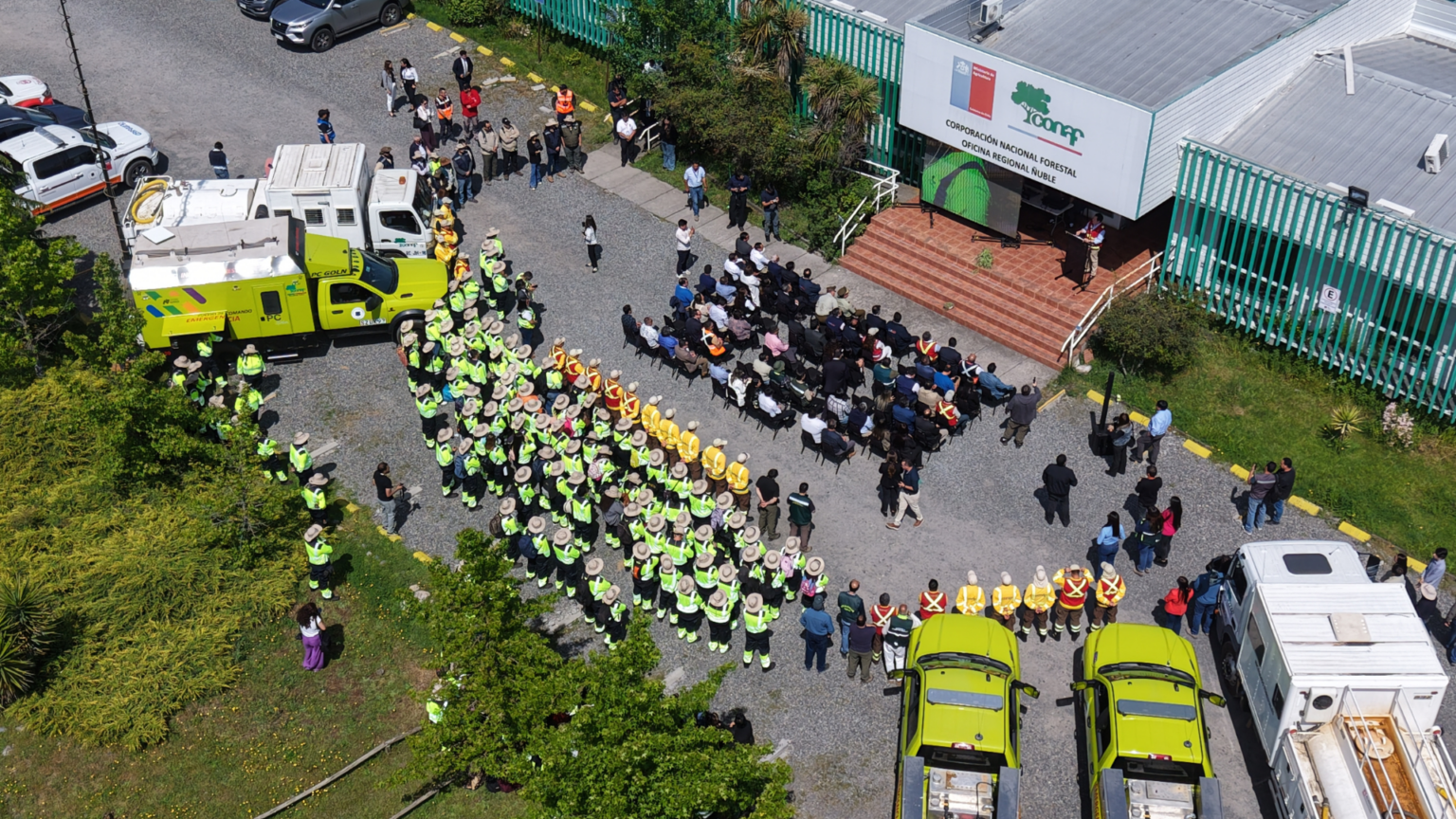
The presidential delegate of Ñuble, Diego Sepúlveda Palma, together with the regional director of the National Forestry Corporation (CONAF), Domingo González Zúñiga, led the presentation of the 2026-2027 Forest Fire Protection Plan, an instance in which the human, aerial and technological resources available to strengthen the prevention and combat of forest fires in the region were announced.
The activity, held at CONAF Ñuble facilities, was attended by mayors, provincial presidential delegates, regional ministerial secretaries (seremis) and representatives of SENAPRED, CORMA, Carabineros and the PDI. The plan, promoted by the Government of President José Antonio Kast, seeks to strengthen prevention, early detection and response capacity to protect families, their homes and the critical infrastructure of Ñuble.
For this season, CONAF Ñuble has deployed 197 brigade members specialized in forest fire combat, distributed across 20 brigades, including mixed, tanker, mechanized, helitransported and nighttime units. Added to this is a fleet of seven aircraft, composed of two light helicopters, two medium helicopters, one Super Puma helicopter and two tanker planes. This deployment will be complemented with specialized machinery and remote surveillance technology to strengthen early detection and response capacity to emergencies.
In terms of prevention, one of the main announcements of this season is the incorporation of 700 extraordinary slots in the employment program, intended exclusively for mitigation and clearing work in risk areas with the presence of vegetative fuel. These tasks include the construction of firebreaks, vegetation clearing and reduction of combustible material in sectors near homes and critical infrastructure. Their function will be strictly preventive, so these teams will not participate in forest fire combat. The incorporation of these workers is managed in coordination with the Municipal Labor Intermediation Offices (OMIL).
In this regard, the presidential delegate of Ñuble, Diego Sepúlveda Palma, highlighted the importance of joint work and the commitment of the different institutions to face this season, stating that "we have just launched our Forest Fire Protection Plan for the 2026-2027 season, together with CONAF and the different services and institutions that play a fundamental role in this task. More than 700 workers are being incorporated to reinforce the protection of the Ñuble region, who join CONAF's regular teams, in addition to all the machinery and resources available. We are working together with Agriculture, SENAPRED and the mayors of the region, because together we all have to protect Ñuble. Prevention is key and we need everyone's commitment to face this season well and avoid forest fires."
For his part, the director of CONAF Ñuble, Domingo González Zúñiga, addressed the preparation of the teams and the shared responsibility in preventing these fires, stating that "today we launched the Forest Fire Protection Plan for the 2026-2027 season, with an important turnout that shows that the authorities are concerned and occupied with advancing prevention and preparing ourselves well for what is to come. Our goal is to face this season with all our team and personnel prepared. Joint work is fundamental in this, because forest fires are everyone's responsibility and each person must take charge of what corresponds to them in order to prevent them and avoid them from occurring."
Meanwhile, the regional minister of Agriculture, Juan Luis Enríquez Fuentes, emphasized the protection of the productive sector, stating that "this protection plan is vital to maintain our productive matrix, since we must not forget that the forestry-agricultural and agro-export engine gives life to our region. With this historic investment we are safeguarding food sovereignty, agricultural infrastructure and the source of employment for thousands of rural families."
Preventive work in the communes of Ñuble
The implementation of this strategy considers close coordination with the municipalities, especially in those communes that present greater exposure to the risk of forest fires. In this context, communal authorities highlighted the importance of having greater resources to strengthen prevention tasks, reduce the presence of vegetative fuel and protect homes and productive activities in rural sectors.
The mayor of Pinto, Jairo del Pino, stated that "in our commune we are working especially in the Pinto Sur sector, adjacent to San Ignacio, which is a critical area due to the presence of wheat, oat and other cereal crops that favor the rapid spread of fire. Taking care of ourselves is everyone's task and we must each contribute to prevention. It is always more important to prevent than to combat."
Meanwhile, the mayor of Bulnes, Gonzalo Bustamante, highlighted that "late rains have generated more combustible material, which is why this initiative is very pertinent. It is a tremendous help and the most important thing is to start working fully on forest fire prevention."
For his part, the mayor of Quirihue, Eduardo Redlich, stated that "we value the contribution in terms of employability, where our commune was favored, which allows us to develop mitigation tasks and strengthen the work we are doing together with the brigade members, CONAF and the municipal teams."
The day ended with a symbolic handover of tools and personal protective equipment to representatives of the new prevention teams of the Chillán Viejo commune, who will carry out mitigation and vegetation clearing tasks in risk sectors, as part of the 700 extraordinary slots contemplated for this season.
In this way, the Government and CONAF reinforce coordinated work to face the period of greatest forest fire risk, by strengthening operational combat capacities and deploying preventive actions aimed at reducing risks and protecting the families of the 21 communes of Ñuble.



Comments (0)
No comments yet. Be the first to comment!
Leave a comment