

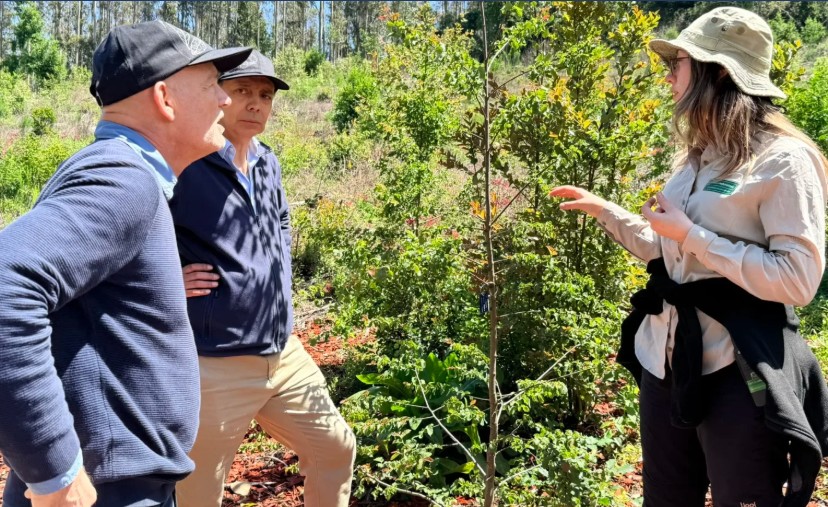
The ruil only grows naturally in the coastal mountain range of Maule. In 2017, the Las Máquinas fire affected 55% of the known area of its remaining forests. Its restricted distribution and exposure to fire explain the need to conserve specimens outside their habitat, a strategy of the first living collection of Campus Naturaleza of the Universidad de Concepción.
Established in 2024, the collection brings together ruil, hualo and roble de Santiago, three threatened and endemic species of Chile. Ex situ conservation makes it possible to maintain plants of different origins to safeguard their genetic diversity, complement the protection of wild populations and become a refuge in the face of climate change.
The initiative is part of the project "Conservation and Restoration of Threatened Nothofagus Species in South America," led by the Landscape Ecology Laboratory of the Universidad de Concepción and funded by Fondation Franklinia, a Swiss entity dedicated to the protection of threatened trees.
On his first trip to Chile, the foundation's general director, Jean-Christophe Vié, highlighted the scientific backing of this collaboration.
"What makes the Universidad de Concepción project attractive is, in fact, that it has a solid and firm scientific basis," he stated.
Diversity within each species
The impact of fire on the ruil continues to be the subject of research. A study published in April 2026 in Frontiers in Plant Science examined three populations affected by the 2017 fire and documented that the high severity of the fire favored the invasion of radiata pine, an additional pressure on its recovery.
Faced with the threats facing natural populations, designing an ex situ collection requires considering what diversity is to be conserved. In the project led by UdeC, seed collection between 2023 and 2025 covered 71% of the populations genetically identified in the initiative.
The seeds came from different populations of ruil (Nothofagus alessandrii), hualo (Nothofagus glauca) and roble de Santiago (Nothofagus macrocarpa). At Campus Naturaleza, each plant has a record of provenance and location that allows monitoring its survival, growth and health status.
Genetic differences within a species can influence its response to environmental changes. For this reason, the selection of plant material and its documentation were part of the scientific work that supports the collection.
Vié underscored this dimension when analyzing conservation efforts: "What really must be guaranteed is that there is genetic and species diversity."
The monitoring of the specimens generates information to guide management decisions and contributes knowledge to the future Botanical Garden of the Casa de Estudios penquista. It also requires teams capable of recognizing the species, propagating them and caring for them. "You need to know your species, know how it works and what needs to be done," he explained.
Collections working as a network
Safeguarding can be expanded through metacollections: collections managed in a coordinated manner by different institutions around the world, which share information and plan the conservation of plant material to represent the genetic diversity of the species.
This coordination makes it possible to distribute risks. If a disease, a fire or a management failure affects one site, having backup material in other locations can reduce the loss of conserved diversity. This requires compatible records, monitoring and agreements that sustain joint work.
The Nothofagus project contemplates the establishment of metacollections in Chilean and international institutions. This networking work is linked to one of the priorities proposed by Vié: sharing knowledge and experiences among those participating in conservation.
For the general director of Fondation Franklinia, information must circulate among universities, public agencies, landowners and communities to guide shared efforts.
"People work in a relatively isolated way, and people really need to share information, techniques, successes and failures," he stated. Knowing the results of other experiences makes it possible to take advantage of what has been learned and adjust interventions.
A commitment that must be maintained
The continuity of these processes requires resources and teams. Vié warned that philanthropic institutions have limited capacities to finance long-term efforts and called for broadening the participation of those who use nature's services.
The collection is part of Campus Naturaleza, an initiative developed under the auspices of the Dirección de Sustentabilidad UdeC and which articulates conservation, restoration, research and human well-being. Through biocultural environmental education, schoolchildren have been able to learn about these species and their value for Chile's natural heritage.
"We have to teach them natural sciences, we have to explain to them the fragility and also the richness of our world," Vié expressed regarding the importance of contact with nature.
The value of the collection depends on sustaining that work over time: caring for the specimens, documenting their development and maintaining the diversity of their origins. Coordination among institutions makes it possible to expand that safeguarding, while the protection of habitats remains indispensable for these species to persist in nature.


Comments (0)
No comments yet. Be the first to comment!
Leave a comment