

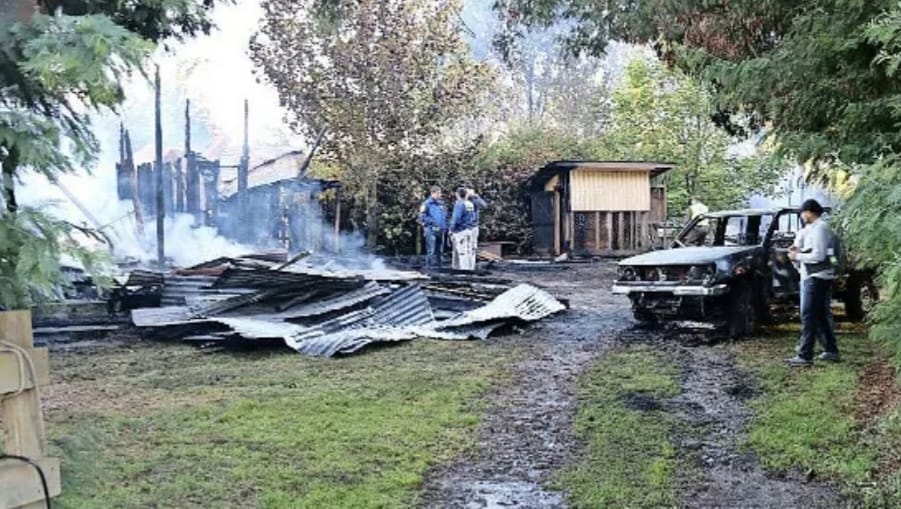
Neither the enactment of the Usurpation Law in November 2023, nor the reduction in property tax payments for seized properties, effective since March 2024, have allowed Cecilia Gajardo's family to recover the lands of the former Santa Clarisa estate, illegally occupied by a Mapuche community in the commune of Cañete, Arauco province, Biobío Region, nor to be exempted from paying the territorial tax.
In a letter published in "El Mercurio" on June 18, Gajardo recounted that in addition to the occupation by the indigenous organization, "my parents' house was set on fire, and the caretaker died in this act of vandalism." In the same publication, she emphasized that over time, "we still cannot enter the property, work the land, safeguard our assets, or exercise the rights inherent to ownership," while "the State continues to demand payment of property taxes as if nothing had happened."
Faced with this situation, agricultural unions in the south warn of the State's "ineffectiveness" and "bureaucracy" in enforcing current regulations.
"Cumbersome procedures"
José Miguel Stegmeier, president of the Southern Agricultural Consortium (CAS) and vice president of the National Agriculture Society (SNA), warns that "it is very cumbersome for farmers to carry out these procedures, because you need to have elements that prove the procedural situation of the seized property, which is often beyond the owner's control."
He suggests that "the core issue is that inspectors from some State entity, through a visit to the seized land, should verify the situation and confirm it with the complaint."
Stegmeier adds that "the process is very slow, and there are many pending cases that have not been resolved." He mentions as another "emblematic" situation the property that remains usurped, despite legal tools, affecting the farmer of Swiss origin, Otto Wild, in Alto Biobío.
State actions "are ineffective"
Sebastián Naveillán, president of the Malleco Farmers Association, adds that, furthermore, in some areas where the usurped properties are in "a neighborhood of violent communities," State actions "become ineffective," since, "after an eviction is carried out, the usurpation is considered over and Carabineros leave the place, these groups re-enter." Alongside this type of situation, Naveillán comments that there are also cases where the usurpers, upon detecting the police arrival, temporarily leave the place, "therefore, the usurpation is not verified and, consequently, the eviction cannot be carried out."
In a conversation with this media outlet, Cecilia Gajardo said that the usurpation actions against the former Santa Clarisa estate began in 2014, with the entry of members of the Francisco Llancao community.
In the final stage when this field was in the hands of her late father, José Manuel Gajardo, the land was dedicated to planting a pine forest and its name was changed to Forestal Santa Clarisa.
As a victim and representing the family, she acknowledges feeling powerless and tired due to the extensive time they have been deprived of continuing the activities her father carried out, and anticipates a willingness to sell the property. "We have already built our lives in Santiago and none of us wants to come and settle here or dedicate ourselves to producing anything," she states. "When this is normalized, we want to sell, either to a State agency, such as Conadi (National Indigenous Development Corporation) or to private individuals. Clearly, that is the action we will take," she emphasizes.
Likewise, she affirms that "it is completely ruled out that the land has any type of indigenous status or title of grace and that, on the contrary, being near the urban boundary, it could perfectly well be urbanized."
Source:El Mercurio





Comments (0)
No comments yet. Be the first to comment!
Leave a comment