

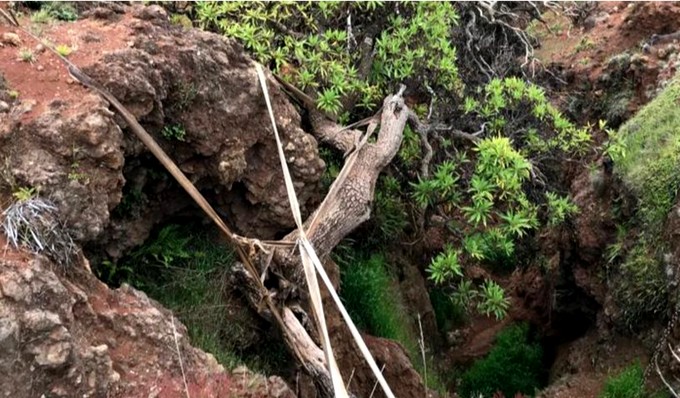
On Robinson Crusoe Island, in the South Pacific of Chile, a tree stands on the slope of a steep cliff. It is the last known wild specimen of Dendroseris neriifolia. To prevent its extinction in the wild, conservationists collected seeds and have begun trials for its cultivation.
The 11 species of the genus Dendroseris are exclusive to the Juan Fernández archipelago, off the coast of Chile. These trees, with striking yellow, orange, or white flowers, have been virtually exterminated by extensive habitat degradation, invasive plants, and damage caused by introduced mammals such as goats and rodents.
According to Paulina Hechenleitner, associate researcher at the Royal Botanic Gardens, Kew, United Kingdom, only one known wild specimen of the critically endangered species D. neriifolia remains on Robinson Crusoe, one of the three main islands of the archipelago.
This nearly 150-year-old tree hangs from a remote, hard-to-reach cliff, requiring specialized fieldwork and meticulous planning to avoid any damage, she explained to Mongabay.
Each year, conservationists attempt to collect seeds from the tree's fruits. However, fruiting is irregular, and some seasons the fruits produce few or no viable seeds, Hechenleitner indicated.
This year, conservationists collected 400 seeds, of which 29 were considered potentially viable and sent to the Millennium Seed Bank (MSB) at Kew, the world's largest wild plant seed conservation program. And 24 seeds showed embryonic development.
These good-quality seeds were divided into three groups, explained Alice Hudson, the collaboration lead. "Initial tests were conducted with eight seeds to check if the conditions were suitable," Hudson told Mongabay. "Now that we know the methodology works, we plan to germinate another eight. The remaining eight will be stored in the Kew Seed Bank for long-term conservation."
The seedlings will be shared with botanical gardens in the United Kingdom to refine and improve cultivation and propagation methods under different conditions, Hechenleitner indicated. "Increasing seed production is key to strengthening the seed bank collections and generating material that can eventually be repatriated to Chile for habitat restoration."
The ultimate goal of the project is to restore the tree's wild populations. However, "this will require a long-term investment in habitat restoration, invasive species control, monitoring, and carefully planned reintroductions," Hechenleitner concluded.
The survival of trees in the genus Dendroseris is crucial for species that depend on them, including the critically endangered Juan Fernández firecrown hummingbird (Sephanoides fernandensis).
Source:Mongabay



Comments (0)
No comments yet. Be the first to comment!
Leave a comment