

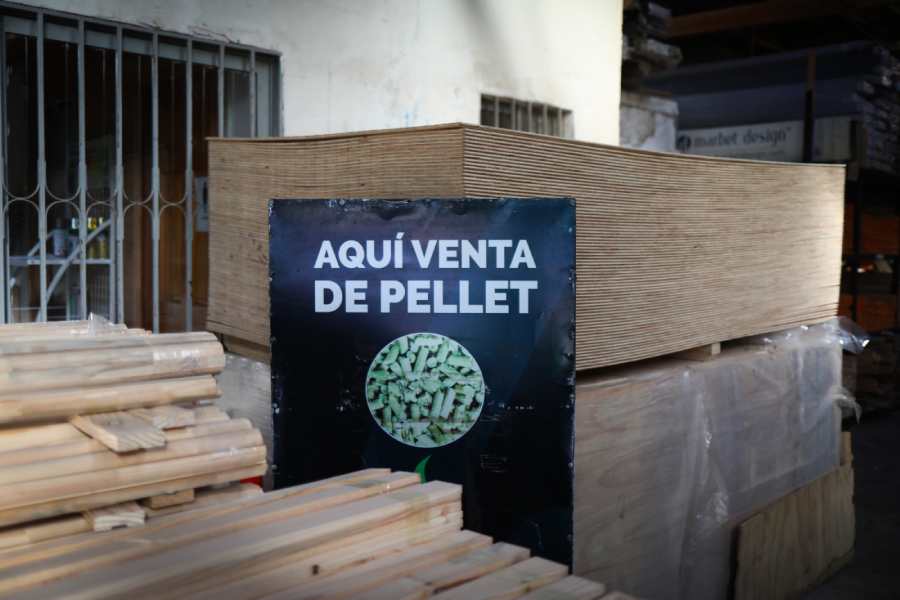
Buying pellet for heating in Chillán has become an almost impossible mission this week, a situation that is repeated in the cities of the central-south and south of the country, where consumers report shortages of the wood-based energy source.
At points of sale in Chillán, warehouses have emptied in recent days, and small restocks sell out within hours, vendors commented.
From the Chilean Biomass Association (Achbiom), the guild that brings together the country's main producers, they attributed the problem to the increase in pellet demand during recent weeks in the south of the country, associated with weather conditions and low temperatures, which, they assured, "has required additional production and logistics efforts to respond promptly to consumers."
Daniela Espinoza, manager of Achbiom, stated that "the pellet industry has a marked seasonality. Production is heavily concentrated during the summer months, while consumption is mainly concentrated between March and September. Therefore, as winter progresses, accumulated stocks decrease, and when periods of low temperatures and consumption peaks occur, pressure on available inventories and the distribution chain increases considerably."
It is worth noting, however, that this phenomenon was not observed last year, nor has it been recorded with other fuels. Some actors point to certain limitations in the distribution chain and the natural evolution of a market that is still not mature and is in constant flux, with the emergence of new producers and the disappearance of others. In fact, the trend shows sustained growth in both demand and production.
From the guild, they ruled out that the shortage is due to the bankruptcy of the company Innapel, from the Biobío Region, in early June. "Innapel's exit had an effect on the market, because it was a relevant player, but not the most important in terms of production levels. The demand that was previously supplied by this company was absorbed by other producers," Espinoza stated.
Last June, when Innapel began its liquidation process, it pointed to rising costs and a 40% drop in raw materials, as a result of the closure of 200 sawmills in the country and the hectares consumed by fires.
"Moment of tightness"
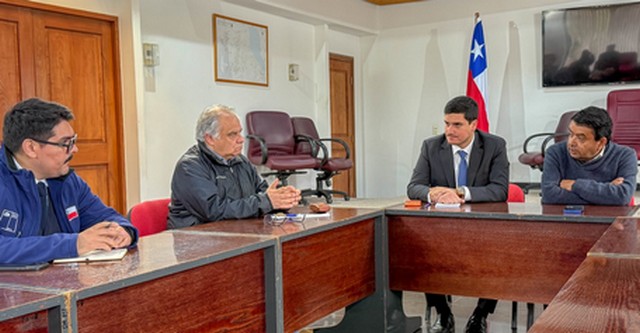
For his part, the Regional Minister of Energy of Ñuble, Cristián Jaque, was categorical in stating that "today there is no breakdown in pellet stock in the country, but we are indeed in a moment of tightness that we are permanently monitoring from the Ministry of Energy."
The authority indicated that, "as a private market, the state does not set prices or production, but we have asked companies to report their stock every 15 days. As of July 31, they report available stock and production capacity to supply the estimated consumption for this winter."
Likewise, Jaque stated that "if supply has been lacking in any commune, it has been due to specific logistical issues, not a lack of product. That is why the call is for calm and to buy responsibly, just what is necessary for each household."
Market evolution
On the other hand, the Achbiom manager highlighted that "the trend we have observed is that of a market that continues to grow, both from a production and demand point of view."
She specified that during 2025, more than 250 thousand tons of pellet were produced, and that the Biobío Region continues to be the country's main production hub, followed by Maule and La Araucanía.
Daniela Espinoza added that, "from a demand point of view, consumption is mainly concentrated in the central and southern zones of the country. The Los Lagos Region is the region with the highest pellet demand nationwide."
Although there are pellet production plants in Ñuble, linked to medium and small sawmills, the aggregate production does not cover total demand. Industry sources agree that the area has sufficient raw material for the installation of new plants.
Source:La Discusión





Comments (0)
No comments yet. Be the first to comment!
Leave a comment