

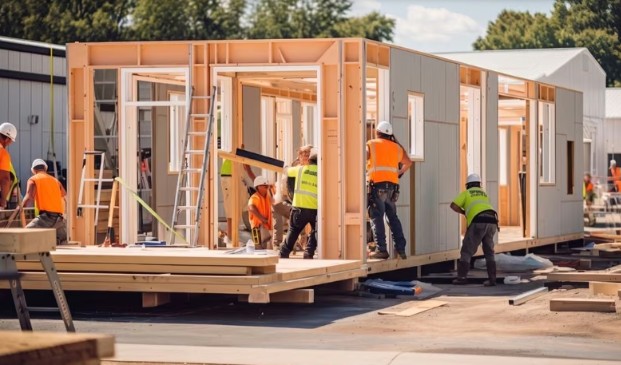
Chile carries a housing deficit of around 700,000 homes, according to figures handled by the construction sector. In that scenario, wood —a material that abounds in a country that defines itself as forestry-based— is once again positioning itself as an alternative capable of accelerating construction without sacrificing quality, while also contributing directly to the goal of carbon neutrality by 2050.
As Felipe Victorero Castaño, associate researcher at the National Center of Excellence for the Wood Industry (CENAMAD) and deputy director of Transfer at the UC Center for Innovation in Wood (CIM UC), explains to El Desconcierto, "in terms of carbon footprint, wood has no rival in construction."
The reason is that the tree stores, during its growth, the carbon that is then fixed in construction products: for every two kilos of wood there is one kilo of retained carbon, equivalent to 3.67 kilos of CO2 captured from the atmosphere.
That property contrasts with more fossil fuel-intensive processes, such as the manufacture of cement for reinforced concrete or steel production. In addition, Victorero recalls that 50% of the emission reduction Chile needs depends on sectors such as electromobility or renewable energies, while the other 50% must be offset by capturing CO2 through the forestry sector.
Today 10% of the country's emissions are already offset with harvested wood products, a percentage that, according to the researcher, could grow by 2050.
Wood's contribution to solving the housing deficit
The country demands the same thermal, acoustic and seismic resistance standards from any material, and wood meets them. "Well-built wood structures perform equal to or better than any other material," says Victorero, who highlights their lower thermal conductivity and flexibility against earthquakes.
To these technical advantages is added a central economic factor: wood is a local product. "We are not importing steel from Asia or fossil fuels to produce cement," notes the researcher, while Chilean forests make it possible to gather all the material needed to build homes in just a few weeks.
That logic of local production is also what explains the model of E2E, a company born in 2018 as a partnership between Arauco and the Belgian Etex —owner in Chile of Pizarreño and Romeral— and which since March 2023 belongs 100% to Arauco.
Its general manager, Felipe Montes, tells this outlet that "we can improve people's habitability through more sustainable construction, of better quality and with better technical performance." The company mainly supplies two segments: social housing certified by ITEC and Minvu, and higher-standard private real estate projects.
Cost and transportation differences compared to concrete and steel
One of the arguments most repeated by the industry is logistical efficiency. According to Montes, "several houses are transported in a single truck," while traditional construction requires separate vehicles for concrete, steel and gypsum board panels.
That reduction in trips lowers emissions, noise and nuisance for neighbors, in addition to shortening assembly times: the panels arrive prefabricated and a home can have its structural framework ready in a day and a half.
How does this transition affect wood SMEs?
Nearly half of the Chilean forestry sector is made up of small and medium-sized companies oriented toward the local market, especially in regions such as Maule and Araucanía. Victorero explains that these SMEs face the challenge of moving toward higher value-added products, beyond sawn wood.
For that, trade associations such as CORMA, regional governments and Corfo funds have promoted reconversion processes, in addition to recent requirements such as wood labeling. The Diseña Madera platform today gathers reports and guides available for the sector.
Along the same lines works the Technological Center for Innovation in Construction (CTEC), through initiatives such as Impulso Pyme 4.0 in Biobío, where wood, metalworking and construction companies strengthen capabilities to produce industrialized housing solutions.
Is the wood industry more sustainable than other materials?
The expansion of wood construction reopens, however, a debate about the environmental impact of the forestry industry. Victorero is emphatic: "every construction material, and every human activity, has an impact," and he recalls that the extraction of aggregates for concrete or iron ore for steel also generates damage in different ecosystems around the world.
In that context, Chile ranks among the countries with the best performance in forest management: 70% of its plantations have sustainable management certification, higher than the 60% shown by Nordic countries such as Finland, Norway or Sweden. More than 99% of the wood the country produces —more than 40 million cubic meters of logs per year— comes from plantations and not from native forest, which with 15 million hectares is not used today for productive purposes.
Nevertheless, Victorero acknowledges that no material automatically guarantees lower emissions. A poorly executed wood construction, with air infiltrations or from sources without sustainable management, can lose much of its benefits.
It is at that point where CTEC's executive director, Carolina Briones, proposes a change of focus: "the right question is which construction system generates the best environmental, productive and economic performance for each project."
As an example she cites ECOIMAD, a three-story social housing building with a 100% wood structure developed together with Canada House within the framework of Construye Zero, whose structural assembly was completed in eight hours.
Pending regulatory gaps
Chile recently updated standard NCh 1198 and incorporated new requirements on wood preservation and quantification of biogenic carbon. However, Victorero identifies in the enforcement of regulatory compliance —rather than in the material itself— the main current obstacle, along with the challenge of scaling toward mid-rise mass timber building, a segment where financial risk continues to hold back the first investors.
Briones agrees that a gap persists between perception and evidence, especially regarding fire behavior. In mass timber elements such as CLT, the surface chars at a predictable rate, which makes it possible to design structures that maintain load-bearing capacity during a given period of fire exposure, a behavior different but not necessarily inferior to that of steel, which rapidly loses strength without protection.
BIM and industrial piloting
Both CTEC and CENAMAD bet on the digitalization of the construction process. Briones details that tools such as BIM make it possible to coordinate design, manufacturing and assembly in advance, while the CTEC Innovation Park, in Laguna Carén, functions as a full-scale laboratory where companies test solutions in wood, concrete and other materials before scaling them, incorporating sensorization, IoT and digital twins.
Looking toward 2050, both Victorero and Briones agree that carbon neutrality will not be achieved just by swapping one material for another, but by comprehensively transforming the way we design, produce and build. On that path, wood appears as one of the resources with the greatest potential for Chile to face at the same time its housing crisis and its climate commitments.
Source:El Dínamo





Comments (0)
No comments yet. Be the first to comment!
Leave a comment