

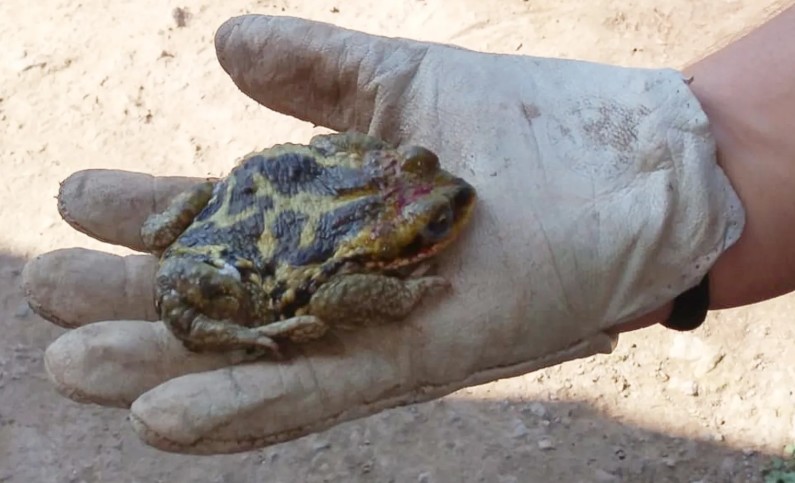
A team of specialists from the University of Concepción recorded, for the first time, an African clawed frog (Xenopus leavis) - one of the most successful invasive amphibians globally - feeding on eggs of the Atacama toad (Rhinella atacamensis), an animal endemic to the north of the country.
This behavior projects a new threat from the invasive species on native frogs and toads, which adds to its role as a transmitter of pathogens, such as the fungus Batrachochrydium dendrobatidis and Ranavirus, linked to the decline of amphibian populations worldwide.
Recently, a predatory attack by Xenopus leavis on a larva of the Chilean frog (Calyptocephalella gayi) was also confirmed, expanding the dangers for its local counterparts at different stages of development.
The African clawed frog is present in Asia, Europe, and America, where it was introduced mainly as a model organism for research and, to a lesser extent, as a pet.
"It arrived in Chile as a laboratory animal and model for scientific research and was found in the wild in the early 1970s. Since then, it has become a threat to the country's amphibians due to competition for habitat and food," explained the academic from the Department of Zoology, Claudio Correa Quezada.
Currently, it is distributed from the Copiapó rivers (in the Atacama Region) and Mataquito (in Maule), and the regions of Valparaíso, Metropolitan, and O'Higgins concentrate the highest density of populations
Stomach analysis
The finding was made by the members of the Laboratory of Systematics and Conservation of Herpetozoans (SyCoH), Iván Mancilla Millán, Constanza Mazzey Andrade, and Dr. Correa (its director) in the locality of Socos, Coquimbo Region, where the presence of the African clawed frog has been known for approximately two decades.
The specialists recorded the event in August of last year, amid a monitoring campaign of Atacama toad populations during their reproductive period, in which they included observations of the interaction with the invasive species.
"During a nocturnal survey, in a sector with high reproductive activity, we observed an African clawed frog feeding directly on newly deposited Atacama toad eggs, in shallow areas," said Iván Mancilla.
To confirm the feeding behavior, they captured three specimens of the African clawed frog - the female observed consuming the eggs and two males that were near egg clutches - to analyze their stomach contents.
First evidence
The analysis, carried out by Constanza Mazzey, revealed the presence of Atacama toad eggs only in the female, with 172 in the stomach, three in the snout, and another 67 regurgitated in the bag where the specimens were captured.
In the males, on the other hand, remains of various invertebrates were found - whose identification was not possible due to their high degree of fragmentation - in addition to unidentified material.
This is the first direct evidence of the predatory attack by the invasive species on Atacama toad eggs and also the first within Chilean amphibian populations.
This facet, undocumented until now, reveals a new risk for the reproduction and conservation of native frogs and toads that, in general, show a high degree of vulnerability.
The Atacama toad is categorized as vulnerable by the International Union for Conservation of Nature and under criterion A2ac of Chile's Species Classification Regulation (RCE), which means that there has been a reduction in populations and that the causes that provoked it still persist.
Among the current pressures that compromise the viability of its populations are the intensive extraction of water for mining and agricultural activities, with effects on the reduction and fragmentation of its aquatic habitat, mentioned Correa.
More studies
Direct predation of eggs by the African clawed frog would be an additional pressure for the Atacama toad and its reproduction.
"This finding highlights the need to deepen studies on predatory behaviors in the population dynamics of native amphibians, particularly of threatened endemic species such as the Atacama toad and the Chilean frog," said Mancilla.
Likewise, it opens new questions about the impact that egg predation by the African clawed frog could have on the reproductive success of native amphibians.
"It will be necessary to determine how frequently this interaction occurs and whether it can represent a relevant effect at the population level," he added.
The researchers suggest that this new ecological facet of the African clawed frog invasion should be considered in future studies and in the design of conservation strategies, especially in areas where both species coincide during reproductive periods.






Comments (0)
No comments yet. Be the first to comment!
Leave a comment