

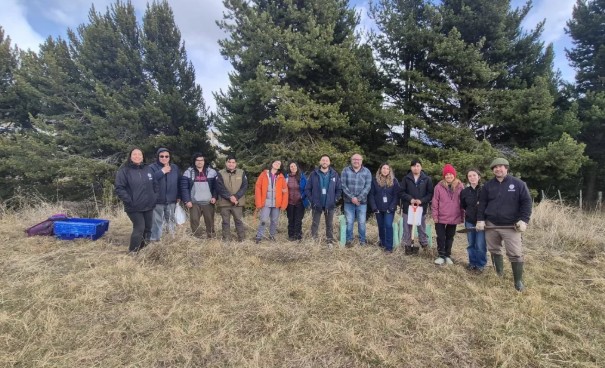
Around 200 specimens of ñirre (Nothofagus antarctica) were planted at the Río Coyhaique Campus of the Universidad de Aysén, marking the beginning of a native vegetation restoration process aimed at contributing to the recovery of the local ecosystem.
The activity was organized by the Directorate of Community Engagement (VcM) and the Department of Natural Sciences and Technology of the university, within the framework of the 11th Winter School. The event brought together students, members of the university community, educational institutions, and representatives from various institutions in the Aysén Region.
In addition to the planting, the activity had an educational component. Specialists and students addressed aspects related to the ecology, distribution, and propagation of the ñirre, along with the main management measures needed to promote the establishment of the trees and reduce the effects of animal browsing.
The initiative also included the participation of professionals from the Biodiversity and Protected Areas Service (SBAP) in Aysén, Hans Bartsch Urra and María Esther González, who valued the collaborative work carried out around the recovery of the region's natural heritage.
"For our Regional Directorate, being part of these inter-institutional collaboration initiatives is essential. The protection and recovery of our natural heritage is a shared effort among the State, academia, and the community," said Hans Bartsch Urra.
The restoration process also helped strengthen collaboration among various institutions linked to conservation and the natural heritage of Aysén. Along with the SBAP, Conaf, the Forest Institute (Infor) Patagonia Branch, Fundación Reforestemos, Parque Refugio Los Ñires, and the Patagonia Study Center participated.
The intervention will continue over the coming weeks with a second phase, which includes the installation of a perimeter fence and other protection measures aimed at safeguarding the planted specimens and promoting their establishment.
In this way, the Río Coyhaique Campus becomes a space for developing ecological restoration actions, environmental education, and engagement between the university community and institutions related to the conservation of the region's native ecosystems.

Comments (0)
No comments yet. Be the first to comment!
Leave a comment