

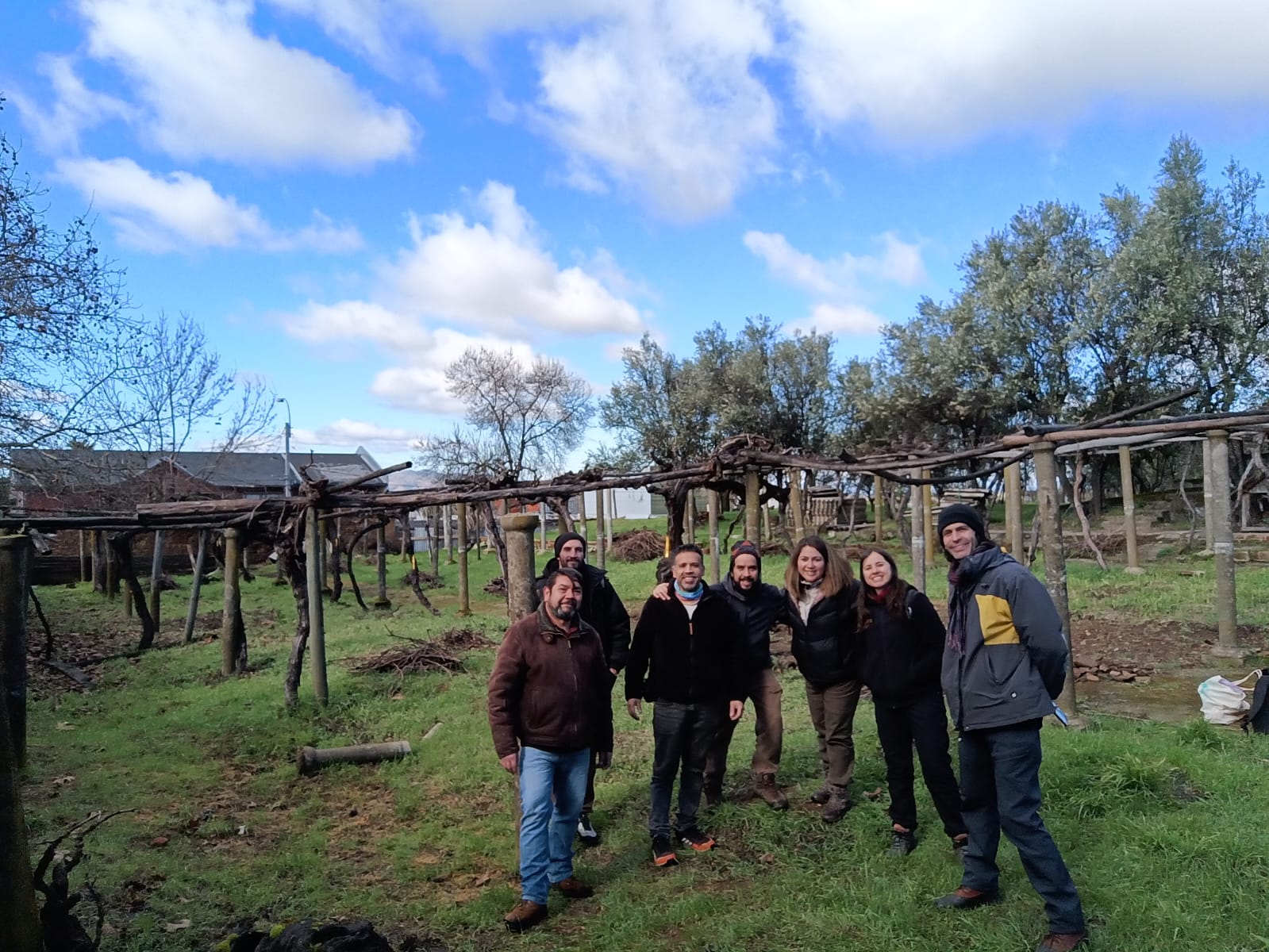
The Jerónimo Lagos Cultural Center in San Javier hosted the seminar "Ancestral Vineyards with Heritage Value: Traces in Wood and Their Legacy for the Future of Chilean Viticulture," an interdisciplinary gathering that brought together knowledge from heritage, history, genetics, dendrochronology, and viticulture, and which had the support of Viña Erasmo.
The activity featured the participation of the Institute of Agri-Food, Animal and Environmental Sciences (ICA3) of the University of O'Higgins (UOH), through academic Alejandro Venegas-González, in charge of the institute's Dendroecology Laboratory (DendroEcoLab). Together with researcher Diego Pillado, he presented the talk "Time Written in Wood: Dendrochronology and Wine Heritage," where he presented the results of a study focused on old País grapevines, one of the first varieties cultivated in Chile, and on the heritage wineries associated with them.
"These vines reach up to 160 years old. In the wineries, which are old heritage structures, both the beams and the pillars are made of common oak, coming from trees that lived between the years 1153 and 1880. Being such long-lived trees, their wood is very resistant, which is why these structures are still preserved and maintain their supporting function," indicated academic Venegas-González.
Dendrochronology allows wood to be dated based on its growth rings. Through cross-dating, which compares common ring patterns among trees and pieces of wood associated with climatic variations, it is possible to precisely determine when a tree grew. Internationally, this technique made it possible to confirm, for example, the Viking presence in America in the year 1021.
The work of DendroEcoLab corresponds to the first dendrochronological study in Chile carried out on grapevines (Vitis vinifera) and was developed in two cases: Viña Erasmo, in Caliboro, and the San Alfonso Parish, in Cauquenes. The research has three lines: dating large-sized vines, studying their climatic sensitivity, and estimating the age of the wooden structures of heritage wineries.
The team estimated ages of between 46 and 162 years for the vines studied. They also dated other species at the site: a bougainvillea of about 101 years, a fig tree of about 87 years, and a peumo of more than 96 years.
In the wineries, the researchers collected a total of 15 samples of beams and pillars, whose analysis turns these structures into true archives of the environmental and productive history of the territory.
As a guest, Nilo Mejía, a researcher at INIA La Platina, also presented, addressing from a genetic perspective the criollo strains of Chile and South America, historical varieties of Chilean viticulture.
The day closed with an interdisciplinary discussion moderated by Mario Astudillo, professional sommelier and defender of Chilean wine heritage. It was attended by Javier Rousseau, general manager of Viña Erasmo; Jorge Medina, academic at ICA3; Diego Pillado, researcher at DendroEcoLab; as well as Nilo Mejía and Alejandro Venegas-González. The discussion opened a space for dialogue between speakers and attendees on heritage conservation and the challenges facing the viticulture of the future.
For ICA3, this type of instance allows science, culture, and territory to be articulated, and contributes to valuing Chile's wine heritage, an area where applied research can provide concrete tools for its safeguarding and projection.




Comments (0)
No comments yet. Be the first to comment!
Leave a comment