

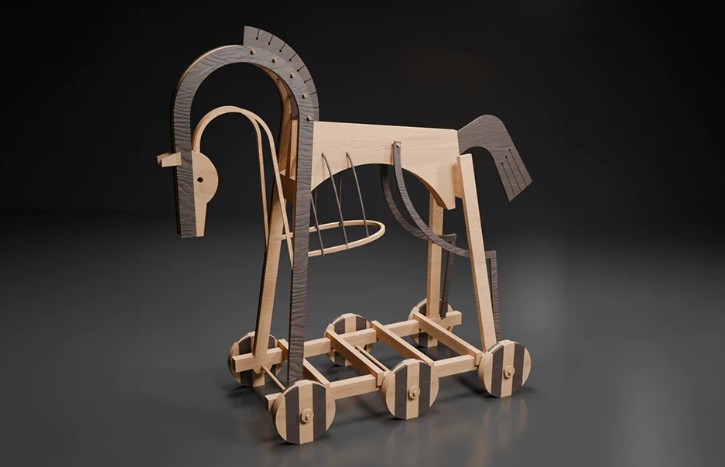
Around 1.5 tons of wood are being transformed into a Trojan Horse that will reach five meters high, five meters long and 2.5 meters wide. The work corresponds to the students participating in the elective course "Wood Construction: Carpentry Craft and Architecture," of the Faculty of Architecture and Urbanism of the University of Chile, whose objective is to bring future architects closer to experimenting with wood at scales previously unimaginable. The result will be exhibited at ExpoCorma 2026, from November 18 to 20.
As "a true Odyssey" the academics of the Faculty of Architecture and Urbanism of the University of Chile, Diego Montoya and Gabriel Felmer, describe the construction of the Trojan Horse. Together with the course assistant, architect Santiago Sierra, they articulated the two semester-long versions of the elective "Wood Construction: Carpentry Craft and Architecture" to address the challenge of working with 47 students per semester and transforming 168 pieces of 2 x 8 inch wood, of structural grade C12, dry and planed, into a structure five meters high, five meters long and 2.5 meters wide. Nothing more and nothing less than 1.5 tons.
The course was born from an academic concern. For the professors, teaching wood construction required more than reviewing its principles and construction systems through presentations. It was necessary to put students in front of the material and make design decisions have concrete consequences. For the academics, direct contact with the material allows recovering a primary dimension of architectural learning. Before designing a solution, students can feel how much a piece weighs, how it responds when worked, stressed or bent, and what happens when a joint does not work as planned. Learning appears while building.
The Trojan Horse is the excuse to develop a full-scale experience that confronts students with a construction challenge and generates learning that they can later transfer to other wood architecture projects. Diego Montoya explains that one of the concepts that inspires the experience is "constructability," a term inspired by the work and teachings of professor Luis Goldsack, which points to "the attributes that architectural design has, in order to be built." For the academic, a design can be correctly drawn and, nevertheless, be difficult to materialize or unviable if it does not consider the space a tool needs, the height available to work or the sequence in which a piece must be installed.
To that constructive view, for Gabriel Felmer, is added the need to broaden the way future architects understand and use wood. "We want to open up the possibilities of doing things with wood, which are unlimited," he states. The academic highlights that this field has expanded with the development of the industry and the incorporation of new technologies, such as high-engineering wood products, including laminated or cross-laminated timber, along with new manufacturing systems and specialized machinery.
The wood used for the Trojan Horse was donated by Forestal Yukon, from the Talca area, and the expanding polyurethane adhesive used in the manufacture of some laminated and cross-laminated elements of the project was provided by Oxiquim. For the finishes, Enko will contribute with its Milesi product line.
The Materials Prototype Laboratory of the Faculty of Architecture and Urbanism of the University of Chile has also accompanied the process, providing tools, guidance, student support and safety training.
Learning with your hands
The reference to The Odyssey is not coincidental. The Trojan Horse works as a way of entering a territory that for students must stop being abstract. The scale of the project changed the rules. Weight began to matter, as did time, tools, manufacturing precision and the way in which a large group could organize itself to build a common structure from multiple components.
During the first semester, 47 students participated. And their enthusiasm accompanied the process from the beginning. Several worked voluntarily during the vacations and many others joined for the pleasure of contributing. The second-semester course was filled again with 47 new students, demonstrating that the experience found a response among those seeking a practical approach to wood construction.
The course began with theoretical classes. "How wood works, the joints, movement, how to bend wood, how to use the tools. And then we held experimentation classes with the material: we burned wood, twisted wood, we did everything," says Diego. The students worked with wood subjected to different conditions, manufactured laminated and microlaminated elements and even "built a handmade steamer to subject it to steam and achieve the curved pieces required for the work," adds Gabriel.
The process forced them to work at a scale that demands patience. An important part of the first semester was dedicated to dimensioning and preparing the wood, gluing and pressing laminated elements and planing them before beginning with the fittings and assembly. For the students, the pace of the work is part of the learning. The project requires stopping, reviewing what has been done and manufacturing again when necessary.
Each section of the horse has required developing different solutions. The neck, for example, allowed exploring two approaches. One of its curves was developed through steam bending and lamination of small-section pieces, while another was built through a faceted solution, based on a structure similar to a spine.
The organization of work is also part of what the professors seek to convey. Building an element of this scale with a large team forces them to coordinate processes, share decisions and understand that each piece must respond to a manufacturing and assembly sequence.
The students were distributed into large groups that advance simultaneously on different parts. One works on the hind legs; another on the front legs, the neck and the head; another tackles the trunk; while the rest advance on the base of the cart, the wheels and the detail elements.
The structure thus becomes a kind of full-scale rehearsal. An opportunity for students to know wood from its possibilities and also from its demands. And in that process a transformation appears that is not in the plans. By facing the material directly, students learn to reduce the distance between what they imagine, what they draw and what they can effectively manufacture and assemble.
The Odyssey continues
At the FAU the final manufacturing stages continue. The wood, already transformed into pieces, awaits the moment of assembly, when the elements that were worked on separately for months must be integrated into a single structure.
The work must be finished at the beginning of October for its presentation at the Faculty of Architecture and Urbanism of the University of Chile.
In November and after months of work, the horse will leave the space where it began to be built and will undertake its journey to Concepción to be exhibited at ExpoCorma 2026. The transfer is also part of the learning. Due to its dimensions and weight, the project must consider a strategy for disassembly, transport and subsequent reassembly, in addition to crane lifting maneuvers, aspects that are already part of the project's construction planning.
Source:Madera 21



Comments (0)
No comments yet. Be the first to comment!
Leave a comment