

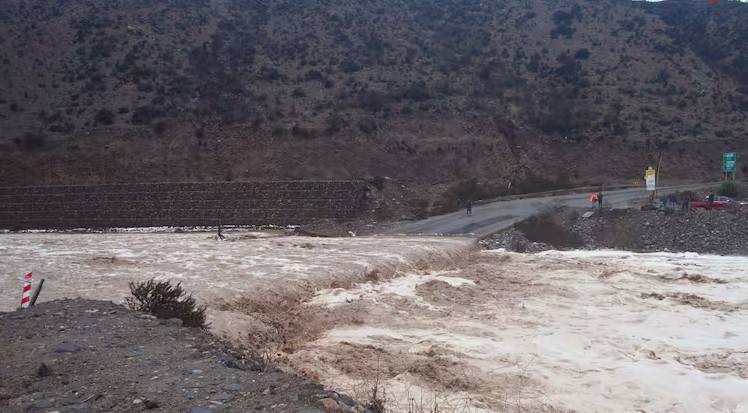
In a conversation with Andrea Obaid on the program Tu Nuevo ADN, the doctor in hydrology and academic at the University of Chile and the University of Talca, Roberto Pizarro, delivered a stark and profound diagnosis of the behavior of the country's rivers and soil during the recent storms. Faced with the dramatic images of mudslides and floods battering the nation, the specialist warned about a dangerous loss of historical memory in society and the State, pointing out that similar catastrophes have occurred before in years such as 1984, 1987, 1997, 2015, and 2023.
In the expert's view, Chile's reactive response to these events stems from a structural deficiency in scientific funding and the alarming lack of local data to anticipate the behavior of watersheds.
Pizarro began by describing the uniqueness of the national geography, characterizing Chile as a “somewhat strange” country due to its narrow strip of land that descends abruptly from the Andes mountain range to the sea. “In an average width of 120 kilometers, it drops 6,000-some meters from the mountain range (...), we are a slide heading toward the sea.” This configuration gives rise to what the specialist defines as five distinct countries from a hydrological perspective: a hyper-arid north, a semi-arid zone in the central region, a humid transition in the south, a rainy extreme, and the cold semi-arid Patagonia. Due to this extreme diversity, he warned that “in Chile, averages do not exist” and using them for public policy planning leads to serious errors.
The major critical issue for the specialist lies in the absence of data and investment in science. While Chile invests only between 0.34% and 0.41% of its GDP in science and technology —far below the 2.5% average of OECD countries— the budget allocated to water research is minimal. The Chilean Committee for the UNESCO Hydrological Program reveals that the country allocates only 0.0025% of public resources to water, despite water-related activities representing 60% of Chile's GDP. Faced with this shortfall, Pizarro proposed a categorical recipe for the political world:
“What would you say are the first three elements that need to be done? Collect data, collect data, collect data. Because from that, we will be able to transfer aspects to the political world so they can generate coherent public policies in turn.”
The collapse of the “runoff threshold” and urban negligence
The hydrologist explained in detail why lands that have already endured continuous rainfall represent a latent risk of new disasters during the rest of the winter. This is due to a key technical concept called the “critical runoff threshold,” defined as “the amount of rain needed for soils to begin to run off” when they can no longer absorb more water.
At the start of the rainy season, dry soil with vegetation cover can retain between 30 and 40 mm of precipitation before becoming saturated. However, after storms, the soil becomes saturated and this threshold drops drastically to 10 mm or even less. This means that any subsequent rainfall, no matter how minimal, immediately turns into runoff flows, causing mass movements and sediments that give the water its characteristic chocolate color.
Nevertheless, the academic emphasized that the origin of the disasters should not be attributed solely to climate change, but primarily to a serious lack of land-use planning and the pressure of the real estate lobby that builds on dunes, hills, or flood zones. In this regard, Pizarro denounced cases of negligence, such as the current construction of a casino in Talca on a wetland and an area that flooded just two years ago. Faced with this, he was blunt in his warning:
“Nature every so often reminds us that it is the owner of the territory, and if we are not aware of that, obviously these phenomena will come.”
The double face of the storm: Relief from the 16-year drought
Despite the social and housing drama of those affected, the expert highlighted the “positive side” of these intense rainfalls in the context of the 16-year drought that has hit the national territory. The storm has allowed important reservoirs to begin recovering —for example, the Paloma reservoir in the north is already close to 20% of its capacity— and has promoted water filtration into groundwater tables and aquifers, securing vital reserves for agriculture and human consumption during the summer.
However, Pizarro called for caution regarding emblematic cases such as the Petorca River, which went from being a symbol of drought to recovering an impressive flow, warning that productive overuse and shortcomings in the water code could leave it dry again by the end of the year.
Source:ADN Radio






Comments (0)
No comments yet. Be the first to comment!
Leave a comment