

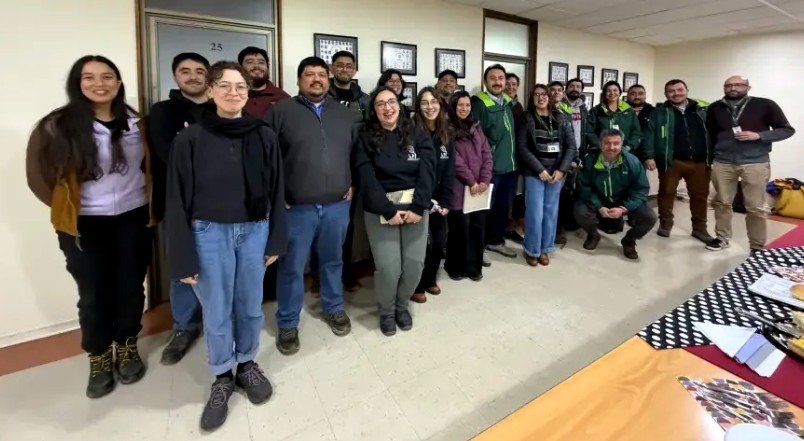
Preventing the entry and spread of invasive alien species requires coordinated responses between scientific research and the agencies responsible for territorial protection. In this direction, the Biological Invasions Laboratory -LIB-, an integrative program of the Institute of Ecology and Biodiversity -IEB- belonging to the Faculty of Forest Sciences of the University of Concepción, brought together officials from the Agricultural and Livestock Service -SAG- Biobío and university researchers in the workshop «Biosecurity in the Biobío Region: joining efforts».
The activity marked a new step in the articulation between institutions, promoting the exchange of knowledge and the generation of a collaborative work agenda to strengthen prevention, detection, and response to biological invasions. During the session, the challenges facing the region as one of the country's main logistics hubs were addressed, due to the presence of ports, an airport, and border crossings, as well as identifying opportunities to strengthen permanent collaboration between agencies.
The session was inaugurated by the director of the Biological Invasions Laboratory, Rafael García, along with the dean of the Faculty of Forest Sciences of the University of Concepción, Eugenio Sanfuentes, the director of the Institute of Ecology and Biodiversity, Aníbal Pauchard, and the regional director of SAG Biobío, Roberto Ferrada.
Subsequently, specialists from SAG, LIB, the Entomology Laboratory, and the Forest Pathology Laboratory, both from the Faculty of Forest Sciences, shared experiences on biosecurity, while working groups allowed defining priorities and actions to consolidate long-term collaboration.
Giving meaning to inspection work
The regional director of SAG Biobío highlighted the importance of this collaborative initiative, «this type of activity allows us to showcase the work that both institutions are developing to prevent the entry and spread of quarantine pests that could affect agriculture and the environment, since there is significant pressure of entry due to international trade, which we verify daily through the phytosanitary inspections we carry out on imports, vessels, passengers, and accompanying baggage arriving at the region's ports,» he stated.
For Hermes Castellano, regional head of Border Control at SAG, this joint work began a few years ago, when during the pandemic the LIB gave a virtual talk for service officials. That experience gave rise to a relationship that today seeks to be consolidated through in-person activities and future joint actions.
«For us this is important, because we want SAG officials to integrate the why of what they do in the field, at the ports.» Castellano explained that understanding the scientific basis of inspections allows giving greater meaning to the daily work of those who inspect vessels, containers, baggage, and goods, as well as strengthening the procedures that the service constantly reviews.
In that context, he announced that one of the next steps will be for researchers from IEB and UdeC to visit SAG facilities in Talcahuano to learn firsthand about port, airport, and import inspections. Likewise, he highlighted that the creation of the SAG Phytosanitary and Zoosanitary Intelligence Unit, implemented last year, opens a new opportunity to institutionalize this collaboration and future agreements.
Coordinating for effective biosecurity
The director of the Biological Invasions Laboratory, Rafael García, highlighted that scientific research provides key information to identify the entry pathways of invasive species, develop early detection systems, and design evidence-based prevention strategies.
Likewise, he warned that the Biobío Region presents high vulnerability, which increases the chances of entry of new organisms, «SAG acts as a first barrier of entry, but there are numerous species that are already present or that can bypass these barriers and threaten urban sectors, productive areas, and natural environments. Therefore, it is essential to strengthen coordination between institutions such as SAG, the National Fisheries and Aquaculture Service -SERNAPESCA-, the National Forestry Corporation -CONAF-, the Biodiversity and Protected Areas Service -SBAP-, and municipalities, because biological invasions are a continuous process that cannot be addressed in a compartmentalized manner.» In this way, he argued that moving toward shared tools and protocols will allow responding more quickly and effectively to new threats to biodiversity and productive systems.
Biobío, a strategic hub for integrated biosecurity
On the other hand, the director of IEB and academic at the Faculty of Forest Sciences of the University of Concepción, Aníbal Pauchard, emphasized that the region is experiencing sustained growth in its logistics and commercial activity, becoming a strategic point for the movement of goods between Chile and Argentina. This scenario undoubtedly increases the chances of entry of invasive alien species and makes it essential to strengthen biosecurity in an integrated manner.
«It is essential that all actors involved handle the same information, that early warning systems exist, and that all of this allows a faster response. Furthermore, better coordination avoids contradictory actions and favors coherent public policies to protect biodiversity.»
Along the same lines, Pauchard stated that one of the main contributions of academia is generating spaces for meeting between the different institutions, «the role of academia is to bring together the different actors so they can sit down and talk, identify their information and methodological needs, and establish priorities.»
Regarding this workshop as a second approach and the projection of working in a more articulated manner, the researcher valued the willingness of the officials and highlighted that there is a positive vision regarding the work that SAG already carries out, as well as the conviction that strengthening the link with IEB will allow better anticipation of the challenges posed by the growing flow of goods and people passing through the Biobío Region.
Finally, to continue advancing in articulation and spaces for meeting, on August 18, the Seminar «Invasive alien species: local experiences and opportunities from a new environmental institutional framework» will be held, organized by the Biodiversity and Protected Areas Service -SBAP- Biobío with the collaboration of the National Center for Research on Rivers, Invasions, and Systems -Centro IRIS-, the IEB -with funding from the National Agency for Research and Development, ANID-, and the Law, Environment, and Climate Change Program -DACC- of the Faculty of Legal and Social Sciences of UdeC.





Comments (0)
No comments yet. Be the first to comment!
Leave a comment