

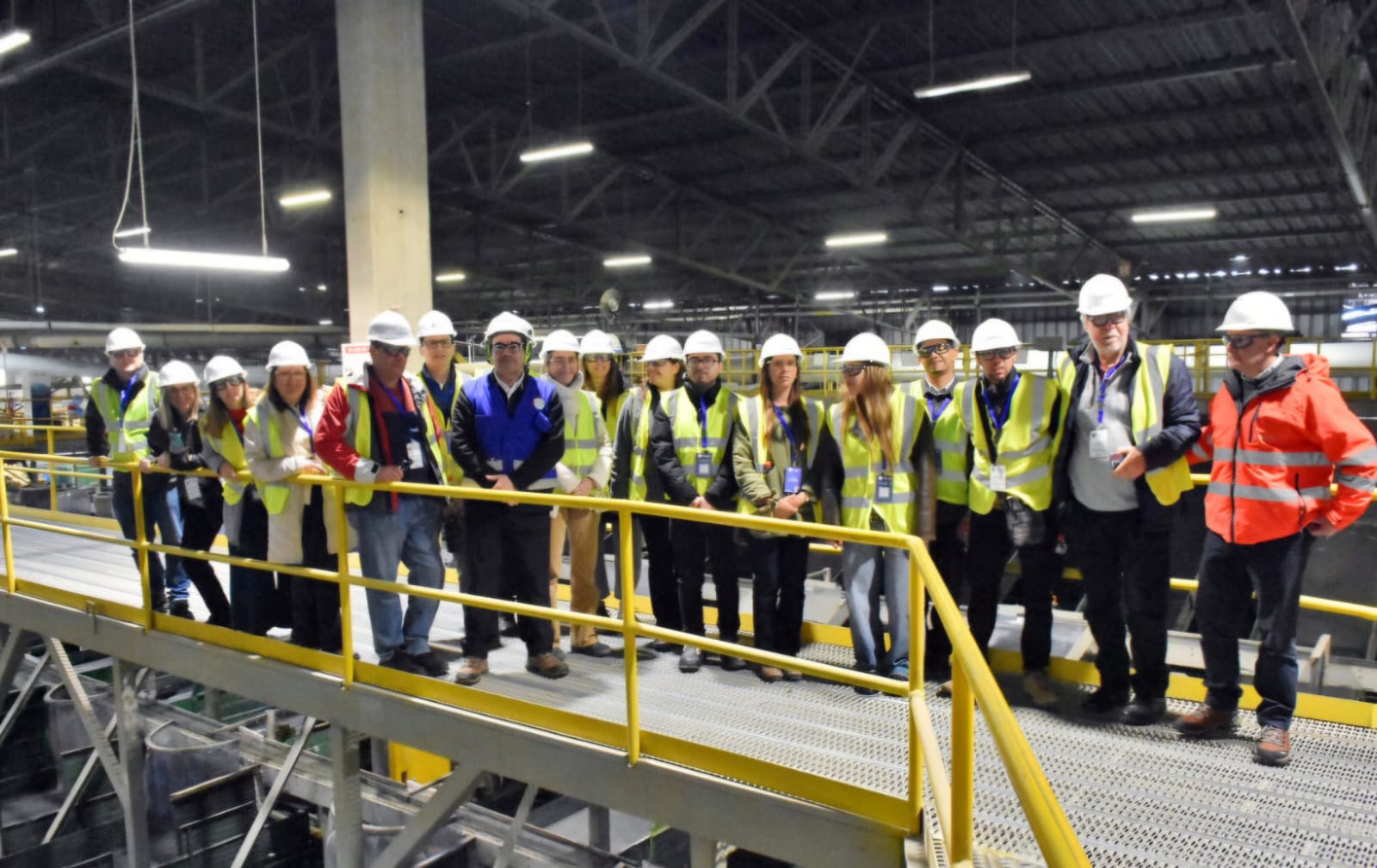
Industrial processes that allow the manufacturing of structural beams, walls, and slabs, machining systems that transfer a digital design directly to the pieces, and buildings erected using elements previously produced in a factory were part of the 2026 Technology Tour, held this Tuesday between Cholguán and Los Ángeles.
The tour, organized by the National Center of Excellence for the Wood Industry (Cenamad), brought together 12 members of a delegation from Uruguay, including representatives of that country's Ministry of Housing, companies linked to construction and architecture, and university-sector entities.
The day began at the Cholguán Industrial Complex of Empresas Arauco, located in the commune of Yungay, Ñuble Region, near the border with Biobío province. Afterwards, the itinerary continued in Los Ángeles with a visit to the CMPC corporate building and concluded at the Niuform plant.
FIRST STOP AT THE CHOLGUÁN INDUSTRIAL COMPLEX
The first part of the day allowed participants to learn about different stages of wood processing at Arauco's facilities located in Cholguán. The tour included the sawmill, the remanufacturing area, and the HILAM plant, dedicated to the production of engineered products for construction.
Rodrigo Morales, head of the Continuous Improvement area at the Cholguán Wood Complex, explained that the visit moved through these facilities until reaching HILAM, where the delegation was able to learn about the manufacturing of structural elements.
"We went on to tour the HILAM processes, starting from its finger joint line, continuous assembly, automatic press, generation of CLT products or MLE beam press, and finally we ended with the automatic machining lines, CNC equipment," he recounted.
According to what Morales explained during the presentation, CLT corresponds to cross-laminated timber panels used as structural elements in construction. The work carried out at HILAM allows the information previously defined in a project's design to be transferred to the manufacturing of the pieces that will later be used on site.
Juan Becerra Briiggink, head of the Technical Department of the Wood Construction area at Aserraderos Arauco, explained that HILAM began operating in the early 2000s and later incorporated new technologies to increase the level of industrialization of its products.
According to the professional, carrying out these tasks beforehand at the plant makes it possible to reduce the work that must later be done on site and to shorten assembly times.
"Today a McDonald's leaves the plant and is assembled on site in nine days. So, those are the times that one saves, let's say, by manufacturing and thinking about the project beforehand, because this is not only manufacturing, but there is also important detail engineering behind it," Becerra explained.
The fast-food establishment mentioned by Becerra was also part of the projects previously exhibited by Morales during the talk, along with examples of educational establishments, sports venues, housing, and infrastructure associated with electromobility, where solutions developed with these construction systems have been used.
A CONSTRUCTION APPLICATION IN LOS ÁNGELES
After the visit to Cholguán, the tour moved on to Los Ángeles to see the CMPC corporate building, the second stop of the day and a full-scale application of wood construction systems.
According to the background information provided by Cenamad for the activity, the building has more than 6,000 square meters and was designed by the Izquierdo Lehmann office. Its structure used, among other components, CLT panels, as well as laminated wood columns and beams.
The building also incorporates systems associated with energy efficiency and climate control.
NIUFORM AND MASS TIMBER MANUFACTURING
The last stage took place at the Niuform plant, a CMPC subsidiary, located at kilometer 485 of Route 5, in the northern sector of the commune of Los Ángeles. There the delegation once again entered a production facility to learn about the manufacturing of elements used in construction projects.
Jorge Becerra, Sales and Service manager at Niuform, explained that the activity allowed participants to observe the different stages that are part of the work carried out at these facilities.
"The purpose of the visit was to learn about Niuform's facilities, to learn about the lamination process. We already showed them the different stages of the process, from cutting to pressing, machining with high-standard numerical control machines, and then finishing and the material storage area for dispatch," Becerra detailed.
During the tour, the delegation also entered the laboratory dedicated to quality control of the products made at the facilities, another of the areas considered during the visit.
According to what Becerra explained, Niuform works mainly with GLT and CLT, products that together are called mass timber. The first corresponds to laminated elements such as columns and beams, while the second is used in structural components such as slabs and walls.
The executive also referred to the use of these elements in works of different characteristics developed by the company.
"We have emblematic projects at the level of public infrastructure, such as sports centers and schools. In Santiago there is a recently completed building also made with CLT, three stories high, which is the Fundación TAD building," he commented.
Niuform currently maintains a workforce of more than TÚ people linked to its production, according to the background information provided by Becerra during the interview. The executive added that the elements manufactured in Los Ángeles are destined both for initiatives developed in Chile and for projects sent to Central America.
Source:La Tribuna



Comments (0)
No comments yet. Be the first to comment!
Leave a comment