

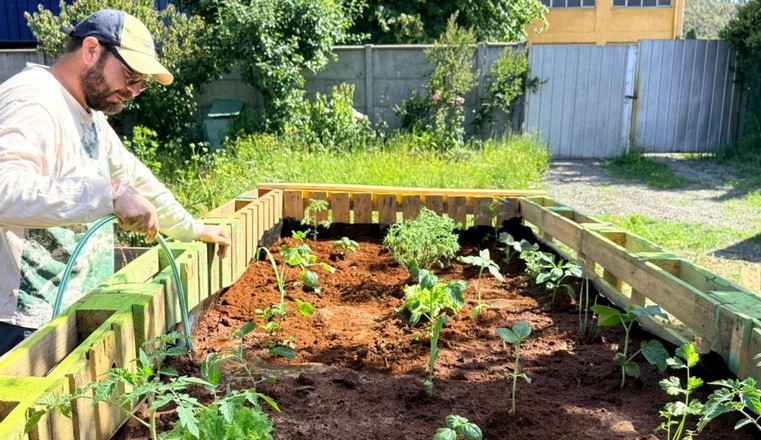
What if unused pallets, leftover branches, and dry leaves could be turned into a garden capable of improving the quality of life for an entire community? That is the premise of Compost Garden, an initiative born in the Biobío Region led by engineer Marcelo Romero, who demonstrates that the circular economy can also sow health, learning, and citizen participation.
Driven by Servipupri and developed alongside the Advisory Council of the Seremi de Salud, the project aims to install organic community gardens with a therapeutic focus, built entirely from reused materials and intended for organizations that lack the resources to access this type of initiative.
"We asked ourselves what we were really contributing to society, and that's where Compost Garden came from. We wanted to reach those organizations that are always left out of competitive funds and offer them a concrete alternative," explains its creator.
A garden that is also a composter
The innovation of the project lies in its simplicity. A Compost Garden combines a composter and a raised garden bed using recycled pallets, cardboard, pruning waste, leaves, and organic matter, on which a layer of soil is later added to begin cultivation.
The system not only allows for the use of waste that would normally end up in a landfill but also significantly reduces implementation costs.
But the goal goes far beyond producing vegetables.
Each garden includes training in composting, plant production, and community management, becoming an educational, therapeutic, and meeting space for those who participate.
Willingness as the main requirement
Unlike other programs, Compost Garden does not select organizations based on economic or administrative criteria.
The decisive factor is the community's commitment.
"We always say that willingness is above all else. If we see that an organization starts gathering pallets, gets the materials, and organizes itself, we know that project will have continuity," he comments.
This commitment has allowed for successful experiences in educational institutions, community centers, senior homes, rehabilitation centers, and even in rural communities.
One of the first projects was implemented at the Buena Esperanza School in Curanilahue, where students, teachers, education assistants, and parents actively participated in building the space.
The garden became part of pedagogical activities, transforming into a tool for interdisciplinary learning and environmental education.
Subsequently, the experience was replicated at the Curanilahue Community Care Center, where caregivers and users found in working with the soil an activity that promotes emotional well-being and social integration.
"The possibility that someone simply goes to the garden to feel better is already a great achievement," he notes.
A network that keeps growing
Currently, the project seeks to expand its reach through alliances with companies and institutions. One of the initiatives under development involves reusing pallets donated by companies to build new gardens in educational institutions, generating both environmental and social impact.
Additionally, an open call remains for community groups to apply for new Compost Gardens, strengthening a network that has already inspired many people to replicate the model in their own homes.
Although the initiative is non-profit, those driving it recognize that the greatest return is not measured in money.
"Of course it generates costs, but it also delivers enormous satisfaction. Seeing how a community organizes, learns, and produces its own food is worth much more than any economic gain," concludes Marcelo Romero.
In times when sustainability has ceased to be an option and has become a necessity, Compost Garden demonstrates that the most effective solutions often arise from simple ideas: reusing what others discard, cultivating in community, and reconnecting with nature.
Source:La Vida Modera



Comments (0)
No comments yet. Be the first to comment!
Leave a comment